
Story
Japanese 10-Year Yield Hits 3% for First Time Since 1996 Amid Global Bond Rout
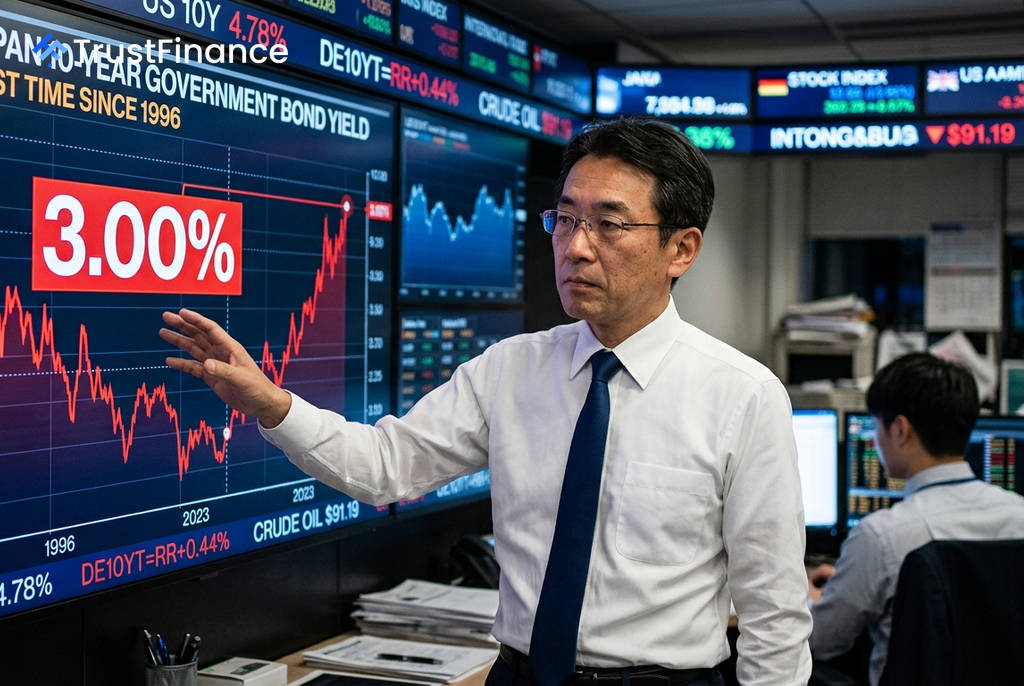
Japan's 10-year government bond yield surged to 3% on Tuesday for the first time since 1996, a milestone in a deepening global bond selloff fueled by persistent inflation fears and renewed geopolitical tensions. The rout was exacerbated by a military escalation in the Middle East that sent Brent crude futures above $91 per barrel, according to Reuters, intensifying concerns about price pressures worldwide.
A Global Regime Change
Analysts described the selloff not as an isolated event but as a fundamental repricing of risk across interconnected global markets. According to Shigeto Nagai, Head of Japan Economics at Oxford Economics, concerns about long-term interest rates in major economies are "fueling each other across borders, leading to a global rise in interest rates."
This marks a significant shift for Japanese Government Bonds (JGBs), which have historically served as an anchor for global fixed income. "It’s a genuine regime change," said Prashant Newnaha, a senior rates strategist at TD Securities. "JGBs were the anchor for global fixed income for a long time. Now it has flipped." This sentiment was echoed by Masahiko Loo of State Street Investment Management, who noted that investors are demanding greater compensation, or term premium, to hold long-term debt, describing the dynamic as more of a "buyers' strike than a sellers' panic."
Repatriation Risks and Fiscal Strain
The move toward higher yields in Japan has significant implications for global capital flows and government finances. Higher JGB yields could encourage Japan's vast pool of investors to sell foreign assets and repatriate their funds, potentially creating downward pressure on U.S. and European markets, according to Vasu Menon, Managing Director of Investment Strategy at OCBC.
 Ad
This shift could also contribute to higher borrowing costs globally, as Japan ceases to be the "marginal buyer of foreign bonds," as noted by Loo. Domestically, higher yields will increase the cost of servicing Japan's substantial national debt. Ryutaro Kimura, a senior fixed income strategist at BNP Asset Management, stated that the bond market is "sounding a warning against fiscal expansion."
Central Banks Under Pressure
The selloff is also prompting a reassessment of central bank policy, particularly at the U.S. Federal Reserve and the Bank of Japan (BOJ). Andrew Lilley, Chief Rates Strategist at Barrenjoey, suggested the market is pricing in further Fed rate hikes. At the same time, there is "growing confidence that the BOJ has further to go" in its own policy normalization, according to Loo.
While the 3% yield is a major psychological threshold that could attract some buyers, analysts believe upward pressure on yields is likely to persist. Eiji Doke, Chief Bond Strategist at SBI Securities, warned that the 3% level is "probably just a waypoint," with pressure coming from both BOJ rate-hike expectations and concerns over fiscal policy.
Read next
More on Forex
Polish Zloty Hits 11-Month Low Against Euro on Energy Price Pressure
The Polish zloty weakened to 4.410 against the euro, its lowest point since November 2023, as rising energy prices and caution ahead of a U.S. Federal Reserve decision weighed on the currency.

Sterling Slips as Dollar Strengthens Ahead of Fed Decision and UK Budget
The British pound lost ground against a resurgent U.S. dollar on Wednesday as market attention shifted from tech sector volatility to upcoming central bank decisions and the UK budget announcement.

Eurozone Bond Yields Climb as French Fiscal Concerns Return Ahead of Fed, ECB Decisions
Yields on French and German government bonds rose as relief from a ratings affirmation for France proved temporary, with investors refocusing on fiscal challenges and awaiting key policy verdicts from the U.S. Federal Reserve and the European Central Bank.

Canadian Dollar Slips as Markets Await Bank of Canada, Fed Decisions
The Canadian dollar edged lower against its U.S. counterpart, snapping a seven-day winning streak as investors adopted a cautious stance ahead of Wednesday's key interest rate announcements from both the Bank of Canada and the U.S. Federal Reserve.