
Story
US Mortgage Rates Rise to Highest Level in a Year on Surging Treasury Yields
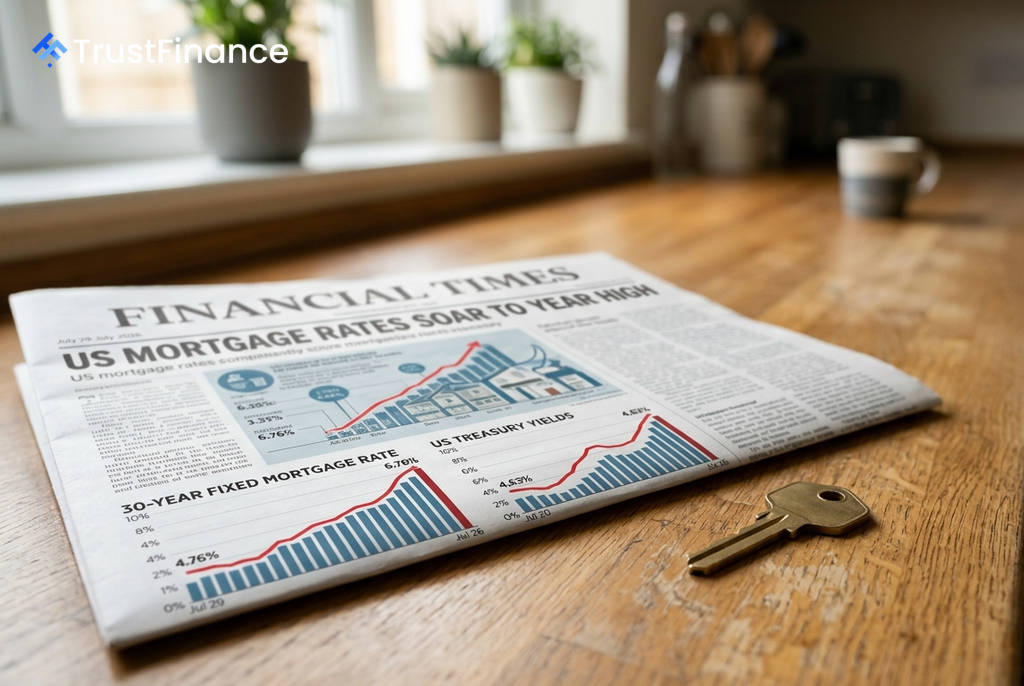
U.S. mortgage rates climbed to their highest point in roughly a year last week, as a spike in Treasury yields pushed borrowing costs higher for homebuyers. The increase impacts a range of home loan products and reflects growing market concerns over inflation and future central bank policy.
Key Rates Reach One-Year Highs
Data released Wednesday by the Mortgage Bankers Association (MBA) for the week ended July 24 showed a broad-based rise in borrowing costs. The MBA reported the following key changes:
- The contract rate on a 30-year fixed-rate mortgage increased by 7 basis points to 6.76%.
- The rate on a 15-year fixed-rate mortgage rose 11 basis points to 6.15%, its highest level in just over a year.
- The rate on a 5-year adjustable-rate mortgage (ARM) also moved higher, reaching 5.98%.
Market Drivers: Treasury Yields and Oil Prices
The primary driver behind the higher mortgage rates is the recent surge in U.S. Treasury yields, which serve as a benchmark for residential lending. The yield on the 10-year Treasury note was trading around 4.63% on Wednesday, near the 18-month high of 4.70% it touched last week.
 Ad
Longer-dated Treasury yields are highly sensitive to the outlook for inflation. According to the source, yields have been pushed higher by a jump in oil prices stemming from renewed conflict between the U.S. and Iran, which has stoked investor concerns about sustained inflationary pressures.
Inflation and Fed Outlook
This rise in borrowing costs comes as the Federal Reserve is set to announce its latest interest rate decision. While the Fed's preferred inflation gauge ran at a 4.1% annual rate in May, expectations are for that figure to have cooled to 3.7% in June.
However, market participants are weighing the possibility that any pullback in inflation could be temporary, particularly given the unpredictable nature of Middle East hostilities and their impact on energy prices. This uncertainty is contributing to expectations that the Fed may implement further rate hikes within the next two months.
Read next
More on Stocks
FTC Orders Walmart, Uber, Delta to Disclose Data on Personalized Pricing
The U.S. Federal Trade Commission is demanding nine major companies, including leading retail, travel, and gig economy firms, to provide information on how they use consumer data for setting individual prices and wages.

Google Launches Gemini 4 Carbon AI Model to Bolster Cybersecurity Capabilities
Alphabet's Google has unveiled Gemini 4 Carbon, its latest AI model specifically designed for advanced cybersecurity tasks like vulnerability detection and secure code generation. The launch escalates competition with rivals OpenAI and Anthropic in the enterprise AI market.

Oracle Shares Surge After Unveiling $225 Billion Revenue Target for 2030
Oracle stock rose sharply after the company presented a long-term financial outlook targeting at least $225 billion in annual revenue by fiscal 2030, driven by its expanding AI infrastructure business.

DOJ Scrutinizes Nvidia's $12.9B Hugging Face Deal Amid Broader Antitrust Probe, Sources Say
The U.S. Department of Justice is reportedly examining Nvidia's planned $12.93 billion acquisition of AI platform Hugging Face as part of a wider, ongoing antitrust investigation into the chipmaker's market conduct.