
Story
S&P 500 Q2 Earnings Growth Hits 26%, Buffering AI Stock Volatility, Goldman Sachs Reports
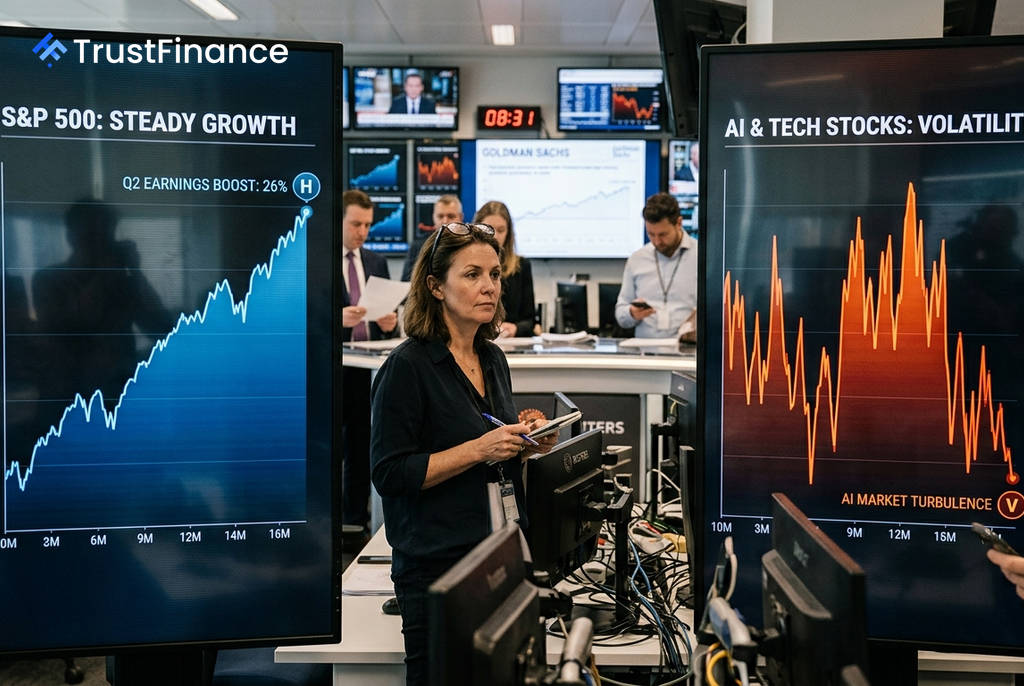
A robust second-quarter earnings season is providing a fundamental support for the U.S. stock market, even as popular artificial intelligence stocks experience significant volatility, according to strategists at Goldman Sachs. The bank noted that the recent turbulence in AI-related shares follows a typical pattern of consolidation after a sharp rally.
A Record-Breaking Earnings Season
With 61% of S&P 500 companies having reported as of July 31, the results have been exceptionally strong. According to the Goldman Sachs report, 64% of these companies have beaten consensus earnings-per-share (EPS) forecasts by at least one standard deviation, one of the highest levels on record.
S&P 500 EPS growth is on track for 26% year-over-year, excluding certain income from mega-cap tech equity investments. When including those gains, the headline growth rate jumps to 45%. The median company in the index is poised to grow its EPS by 12%, well ahead of the 9% that was estimated before the season began.
Tepid Reaction for Tech Winners
Despite the strong results, the market's reaction has been uneven, particularly for technology companies. Goldman's analysis found that the median stock in the Technology, Media, and Telecommunications (TMT) sectors that beat EPS estimates actually lagged the S&P 500 by 192 basis points the following day.
 Ad
In contrast, the median stock outside of the TMT sectors that posted an earnings beat outperformed the S&P 500 by 75 basis points. This suggests investors may be taking profits in high-flying tech names, even after positive reports, while rewarding solid performance in other areas of the market.
AI Capex Surge Signals Long-Term Bet
Reports from major cloud providers, or hyperscalers, pointed to a massive increase in capital expenditures related to AI. The group reported $182 billion in capex during the quarter, financed in part by $101 billion in debt and equity issuance, while generating just $5 billion in free cash flow.
This investment cycle is accelerating, with analyst estimates now pointing to more than $1 trillion in capex for 2027. While this spending is expected to exceed cash flow from operations from 2026 through 2028, Goldman noted it is also showing returns, as cloud revenue growth accelerated to 48% in the quarter. The bank believes that while earnings will ultimately determine the direction of the AI trade, historical patterns and recent investor deleveraging point to an improved outlook.
Read next
More on Stocks
FTC Orders Walmart, Uber, Delta to Disclose Data on Personalized Pricing
The U.S. Federal Trade Commission is demanding nine major companies, including leading retail, travel, and gig economy firms, to provide information on how they use consumer data for setting individual prices and wages.

Google Launches Gemini 4 Carbon AI Model to Bolster Cybersecurity Capabilities
Alphabet's Google has unveiled Gemini 4 Carbon, its latest AI model specifically designed for advanced cybersecurity tasks like vulnerability detection and secure code generation. The launch escalates competition with rivals OpenAI and Anthropic in the enterprise AI market.

Oracle Shares Surge After Unveiling $225 Billion Revenue Target for 2030
Oracle stock rose sharply after the company presented a long-term financial outlook targeting at least $225 billion in annual revenue by fiscal 2030, driven by its expanding AI infrastructure business.

DOJ Scrutinizes Nvidia's $12.9B Hugging Face Deal Amid Broader Antitrust Probe, Sources Say
The U.S. Department of Justice is reportedly examining Nvidia's planned $12.93 billion acquisition of AI platform Hugging Face as part of a wider, ongoing antitrust investigation into the chipmaker's market conduct.