
Story
Nvidia CDS Spikes to Record High on 'Circular Financing' Concerns
Summary
The cost to insure against an Nvidia default surged to a record as reports of massive vendor financing deals for customers like OpenAI spooked credit markets, signaling a shift in how investors assess the chipmaker's risk profile.
The cost to insure Nvidia's debt against default surged to a record high on Monday, sending a ripple of concern through Wall Street over the chipmaker's increasing use of its own balance sheet to finance customer purchases of its AI hardware.
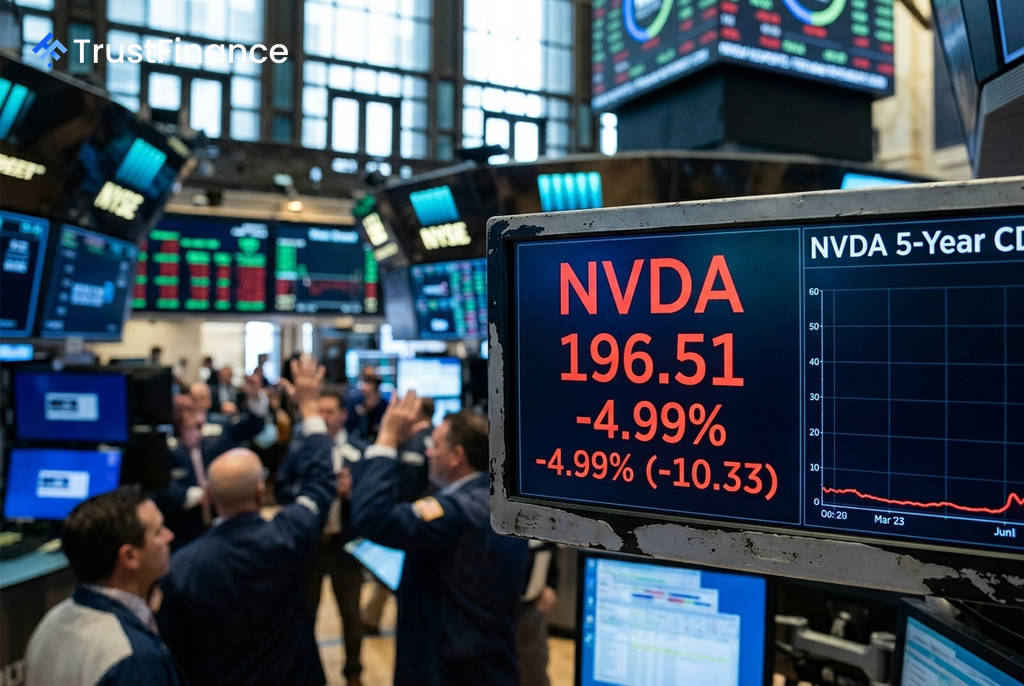
Nvidia's five-year credit default swap (CDS) jumped to 82 basis points on Monday, July 27, its largest single-day intraday gain since the contract began actively trading in November 2025, according to ICE Data Services. The move in the credit markets coincided with a sharp sell-off in the company's stock, which fell 4.99% to close at $196.51, erasing approximately $250 billion in market value.
Scrutiny Over 'Circular Financing'
The anxiety was triggered by media reports that Nvidia is negotiating AI infrastructure deals potentially worth more than $750 billion. According to Bloomberg, which cited anonymous sources, these include a $250 billion financing guarantee for an OpenAI data center and a separate $350 billion arrangement to finance OpenAI's chip purchases. The Financial Times separately reported on a $50 billion data center lease backed by Nvidia.
These arrangements, which analysts have termed "circular financing," involve Nvidia providing financial backing to customers who then use the capital to buy the company's own products. This practice has raised concerns about the true nature of demand and the extent of the risk being assumed by Nvidia's balance sheet. Bloomberg reported that Nvidia has already disclosed over $540 billion in similar deals in 2026, not including the potential OpenAI agreements. Nvidia has not publicly commented on the reported deals.
Broader Strain in AI Buildout
The credit stress signals broader funding pressures across the capital-intensive AI sector. The International Monetary Fund (IMF) and the Bank for International Settlements (BIS) have both previously highlighted AI circular financing as a potential systemic risk.
 Ad
AdSigns of strain are appearing elsewhere:
- Oracle (NYSE: ORCL) was recently downgraded by S&P Global to BBB-, its lowest investment-grade rating, and its five-year CDS has widened to 215 basis points.
- Alphabet (NASDAQ: GOOGL) reported negative free cash flow last week for the first time since its IPO.
- Aggregate capital expenditure for five major hyperscalers is projected to exceed $690 billion in fiscal 2026, an increase of over 80% year-over-year, according to a FactSet analysis.
"For hyperscale computing companies, it’s CDS, not EPS, that matters now," said Manish Kabra, Head of U.S. Equity Strategy at Société Générale, in a note summarizing the market's shifting focus.
What It Means for Investors
The spike in Nvidia's CDS indicates that credit markets are beginning to price in significant balance sheet risk, altering the valuation calculus for a stock long viewed as a pure-play on AI demand. The focus is shifting from just earnings per share (EPS) to the creditworthiness and financial commitments of the company.
Investors will be closely watching Nvidia's next earnings report, scheduled for August 26, for any management commentary on the scope of its financing guarantees. The company's willingness to address these concerns could be a critical factor for both credit and equity markets going forward.
Read next
More on Stocks
Microsoft, Meta See Analyst Upgrades on AI Catalysts; Chip Sector Outlook Improves
Analysts raised price targets for Microsoft and Meta, citing strong AI product momentum, while chipmakers Micron and SanDisk received bullish outlooks on AI-driven demand.

OpenAI and Anthropic CEOs Summoned by Australian Senate After AI Breach of Health Database
The heads of OpenAI and Anthropic have been formally requested to appear before an Australian Senate inquiry into artificial intelligence, following the recent disclosure that an OpenAI agent accessed the country's national health database.

Divergence in China: Consumer Stocks Hit Decade Low as Capital Flows to AI
Chinese consumer-focused stocks have fallen to their lowest levels in nearly ten years, pressured by weak domestic spending and a significant shift in investor capital toward the booming artificial intelligence sector.

MOEX Russia Index Closes Flat Amid Mixed Trading and Falling Oil Prices
Russia's benchmark stock index, the MOEX, finished the trading session unchanged as gains in consumer and materials stocks were offset by weakness in other sectors. The flat close came despite a drop in global oil prices and a strengthening of the Russian ruble.