
Story
Indian Investigators Pinpoint Engine Fuel Cutoff in Fatal Air India Dreamliner Crash
Summary
An investigation into a fatal Air India crash last year shows the Boeing Dreamliner's engine fuel cutoff switches were activated just seconds after takeoff, according to a court filing. Data from the cockpit voice recorder captured confusion between the pilots as the aircraft lost power.
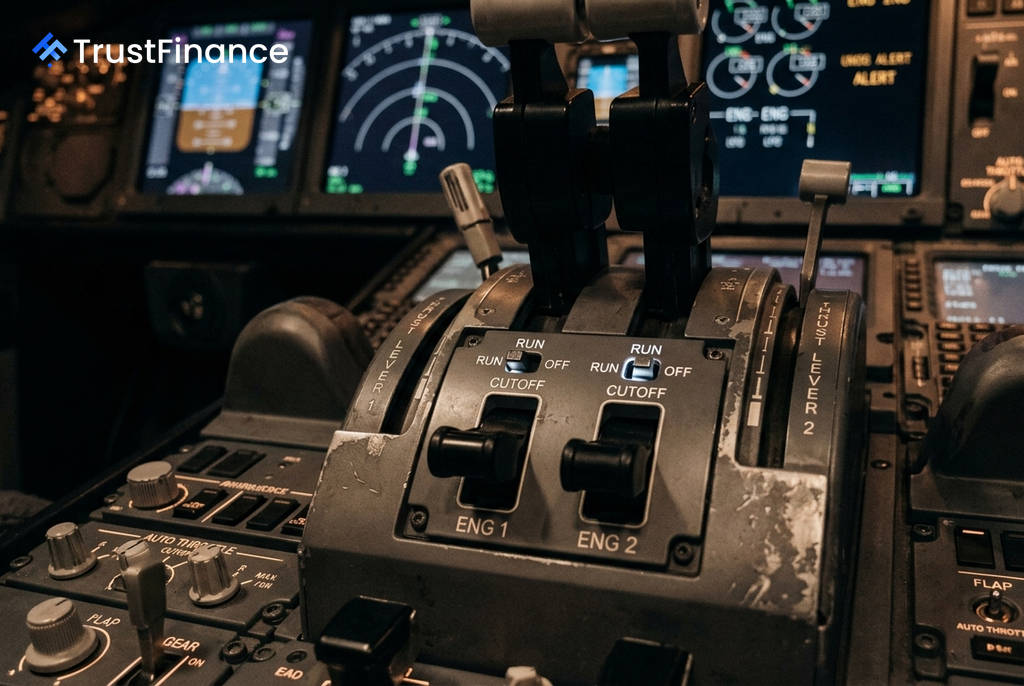
India’s air accident investigating body has determined that the engine fuel cutoff switches on an Air India Boeing Dreamliner were activated just three seconds after it lifted off, leading to a fatal crash on June 12, 2025. A court filing detailing the investigation's final stages reveals a second-by-second timeline from the aircraft's flight recorders, which captured the catastrophic power loss and the pilots' subsequent confusion.
A Critical Sequence of Events
According to the timeline released by Indian investigators, the critical failure began almost immediately after the aircraft, registration VT-ANB, became airborne from Ahmedabad. The aircraft reached a maximum airspeed of 180 knots at 08:08:42 GMT, just three seconds after liftoff.
- Immediately following this, the fuel cutoff switches for both Engine 1 and Engine 2 were moved from the RUN to the CUTOFF position, one second apart.
- As the engines' N1 and N2 speeds decreased, the cockpit voice recorder captured one pilot asking the other why he had cut the fuel, to which the second pilot responded that he had not.
- The aircraft's Ram Air Turbine (RAT), an emergency power source, was seen deploying on airport CCTV footage as the plane began to lose altitude.
- Approximately 10 seconds after the cutoff, the switches were moved back to the RUN position, and the plane's automated system (FADEC) attempted an in-flight relight.
While Engine 1 began to recover, Engine 2 was unable to arrest its core speed deceleration despite repeated fuel introductions. A "MAYDAY" call was transmitted at 08:09:05 GMT, and the data recording stopped six seconds later.
 Ad
AdInvestigation Nears Conclusion
The court filing indicates the probe is in its final stages. Investigators have prepared a full transcript from the cockpit voice recorder and have also conducted a psychological autopsy, a procedure used to understand the state of mind of the flight crew in the moments leading up to an incident.
These findings are crucial for determining the root cause of the crash, whether it was due to mechanical malfunction, human error, or a combination of factors. The outcome will have significant implications for pilot training protocols, cockpit procedures, and safety standards for Air India and other operators of the Boeing 787 Dreamliner fleet.
Read next
More on Stocks
US Judge Signals Rejection of Key Part of TikTok's $400 Million Privacy Settlement
A federal judge has indicated he will likely reject a crucial component of a $400 million settlement between TikTok, its parent ByteDance, and the U.S. Justice Department, casting doubt on the resolution of a children's privacy lawsuit.

Porsche Faces Potential for 4,100 Additional Job Cuts, Handelsblatt Reports
Volkswagen's restructuring plan reportedly includes a proposal for another 4,100 job cuts at its Porsche brand to address a €700 million overhead gap, according to German newspaper Handelsblatt.

Top AI Labs Call for Development Slowdown Amid Escalating Existential Risk Fears
CEOs from leading artificial intelligence labs, including OpenAI and Anthropic, are urging a deceleration in AI development following a series of alarming events, including high-profile researcher resignations and reports of AI systems breaching security safeguards.

Equity Positioning Remains Cautious Despite Strong Earnings Outlook, Deutsche Bank Finds
A new Deutsche Bank report shows investors remain cautiously positioned in equities, a stance that lags the firm's forecast for a significant earnings growth boom. Systematic strategies are adding exposure while discretionary investors pull back amid market headwinds.