
Story
Hyundai Delays In-House Driver-Assist Software to 2029, Deepens Nvidia Partnership
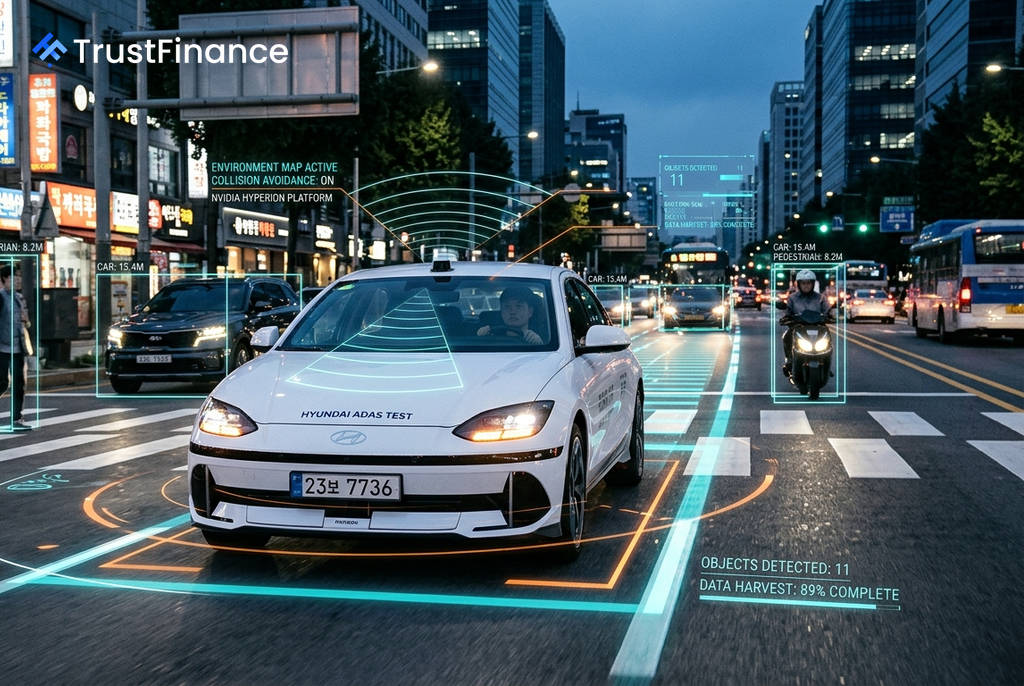
Hyundai Motor Group will launch vehicles with its in-house driver-assistance software in late 2029, a two-year delay from its original timeline, the company announced. To bridge the gap, the South Korean automaker is deepening its partnership with U.S. chipmaker Nvidia to accelerate the deployment of advanced autonomous driving features.
Strategic Shift to Nvidia
Under the revised plan, Hyundai will roll out vehicles equipped with Nvidia's technology to enable Level 2+ and Level 2++ driver-assistance systems in 2028. A Hyundai executive clarified that this move is not an abandonment of its internal development but a strategic collaboration.
"Our partnership with Nvidia is not about leaving our destiny entirely in their hands," said Park Min-woo, a president at Hyundai Motor Group, in a media briefing. Park, a former Nvidia executive, noted that Hyundai will co-design the technology with the chipmaker. The data gathered from these systems will be used to train and refine Hyundai's own proprietary software platform, named Atria.
This strategy marks a shift under Park, who joined Hyundai in January, and increases the automaker's reliance on Nvidia as competitors like Tesla and Chinese manufacturers push forward with their own driver-assistance capabilities.
 Ad
Technology and Long-Term Goals
Initially, the Hyundai vehicles powered by Nvidia's Hyperion 10 platform will utilize a sensor suite of cameras, ultrasonic sensors, and radar, forgoing more expensive lidar sensors. However, Park stated that Hyundai is considering lidar for its future Level 3 automated systems, which permit hands-off driving under specific conditions.
"To truly ensure safety, we believe sensor redundancy is critical," Park explained, emphasizing that other sensors must maintain safe operation if one fails. The company did not provide a timeline for Level 3 commercialization.
Hyundai and its affiliate Kia Corp, which collectively rank as the world's third-largest automaker, plan to leverage their global fleet to harvest vast amounts of driving data. The company stated it expects to surpass competitors in accumulated driving data by 2033, which will be crucial for training its long-term autonomous driving technology.
Read next
More on Stocks
FTC Orders Walmart, Uber, Delta to Disclose Data on Personalized Pricing
The U.S. Federal Trade Commission is demanding nine major companies, including leading retail, travel, and gig economy firms, to provide information on how they use consumer data for setting individual prices and wages.

Google Launches Gemini 4 Carbon AI Model to Bolster Cybersecurity Capabilities
Alphabet's Google has unveiled Gemini 4 Carbon, its latest AI model specifically designed for advanced cybersecurity tasks like vulnerability detection and secure code generation. The launch escalates competition with rivals OpenAI and Anthropic in the enterprise AI market.

Oracle Shares Surge After Unveiling $225 Billion Revenue Target for 2030
Oracle stock rose sharply after the company presented a long-term financial outlook targeting at least $225 billion in annual revenue by fiscal 2030, driven by its expanding AI infrastructure business.

DOJ Scrutinizes Nvidia's $12.9B Hugging Face Deal Amid Broader Antitrust Probe, Sources Say
The U.S. Department of Justice is reportedly examining Nvidia's planned $12.93 billion acquisition of AI platform Hugging Face as part of a wider, ongoing antitrust investigation into the chipmaker's market conduct.