
Story
Goldman Sachs: Rising G-SIB Buffers to Squeeze Capital at Large US Banks
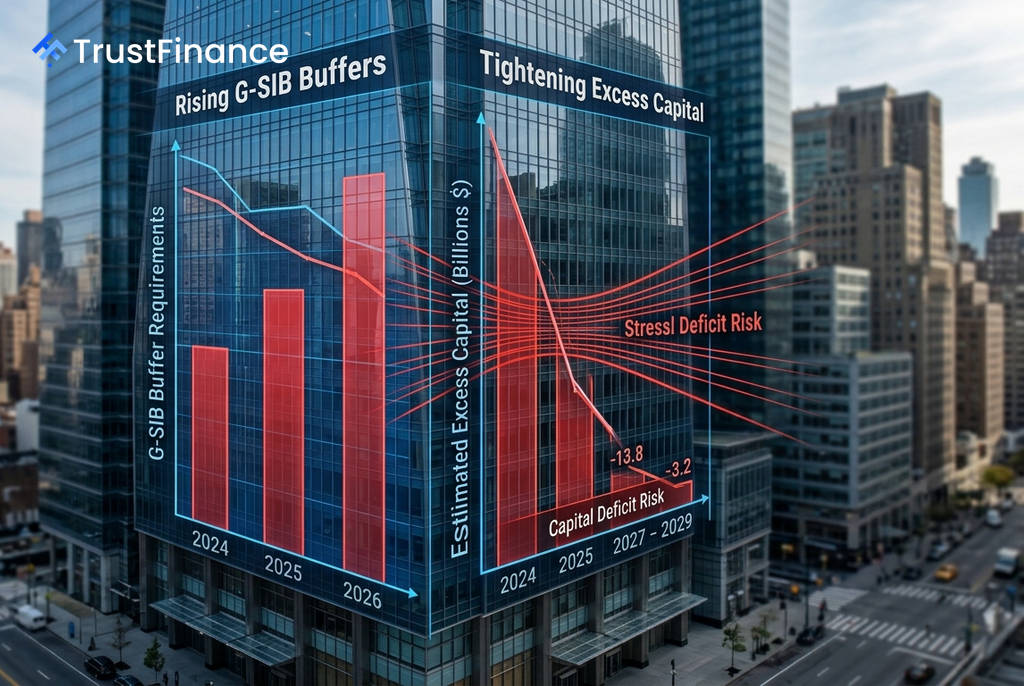
The largest U.S. banks are likely to slow their return of capital to shareholders as they confront rising regulatory requirements and dwindling excess capital for a third straight year, according to a Goldman Sachs research note published Wednesday.
Analyst Richard Ramsden wrote that lenders are expected to pull back on capital deployment "given that excess capital levels have fallen, G-SIB scores have increased YTD, after also increasing in both 2024 and 2025, and the final details on regulatory capital reform are still pending."
G-SIB Pressures Mount
The analysis highlights that five of the seven U.S. Global Systemically Important Banks (G-SIBs) have seen their risk scores increase so far this year, pushing them into higher capital surcharge buckets. The note stated that second-quarter G-SIB scores rose by an average of 23 basis points from the prior quarter, with the most significant increases seen at JPMorgan Chase (JPM), Citigroup (C), and Wells Fargo (WFC).
JPMorgan's score has risen by two buckets year-to-date, placing it in the 7.0% bucket. Goldman Sachs does not expect any of the top five banks to successfully mitigate their scores enough to move down a bucket by the end of the year.
Dwindling Capital Cushions
 Ad
These higher G-SIB surcharges are projected to significantly erode the banks' capital cushions over the next few years. The top seven banks currently hold an estimated $78 billion in excess capital, but Goldman Sachs projects this surplus will shrink dramatically.
Due to a two-year lag in the implementation of G-SIB score increases, the note forecasts that excess capital will fall to $55 billion in 2027 and just $20 billion in 2028. When factoring in the impact of higher buffers, the analysis suggests the group could face a collective capital deficit of $21 billion by 2029.
Implications for Investors
With shrinking capital flexibility, banks may become more cautious with share buybacks and dividends. Goldman Sachs also noted that with bank valuations at approximately 2.1 times price-to-tangible-book value, buybacks are becoming a less attractive use of capital compared to balance sheet expansion.
This outlook suggests a potential shift in strategy for the nation's largest financial institutions as they navigate a more demanding regulatory landscape. The pending finalization of broader capital reforms adds another layer of uncertainty for the sector.
Read next
More on Stocks
FTC Orders Walmart, Uber, Delta to Disclose Data on Personalized Pricing
The U.S. Federal Trade Commission is demanding nine major companies, including leading retail, travel, and gig economy firms, to provide information on how they use consumer data for setting individual prices and wages.

Google Launches Gemini 4 Carbon AI Model to Bolster Cybersecurity Capabilities
Alphabet's Google has unveiled Gemini 4 Carbon, its latest AI model specifically designed for advanced cybersecurity tasks like vulnerability detection and secure code generation. The launch escalates competition with rivals OpenAI and Anthropic in the enterprise AI market.

Oracle Shares Surge After Unveiling $225 Billion Revenue Target for 2030
Oracle stock rose sharply after the company presented a long-term financial outlook targeting at least $225 billion in annual revenue by fiscal 2030, driven by its expanding AI infrastructure business.

DOJ Scrutinizes Nvidia's $12.9B Hugging Face Deal Amid Broader Antitrust Probe, Sources Say
The U.S. Department of Justice is reportedly examining Nvidia's planned $12.93 billion acquisition of AI platform Hugging Face as part of a wider, ongoing antitrust investigation into the chipmaker's market conduct.