
Story
Bernstein: New Entrants Test Profitability of India's Food Delivery Market
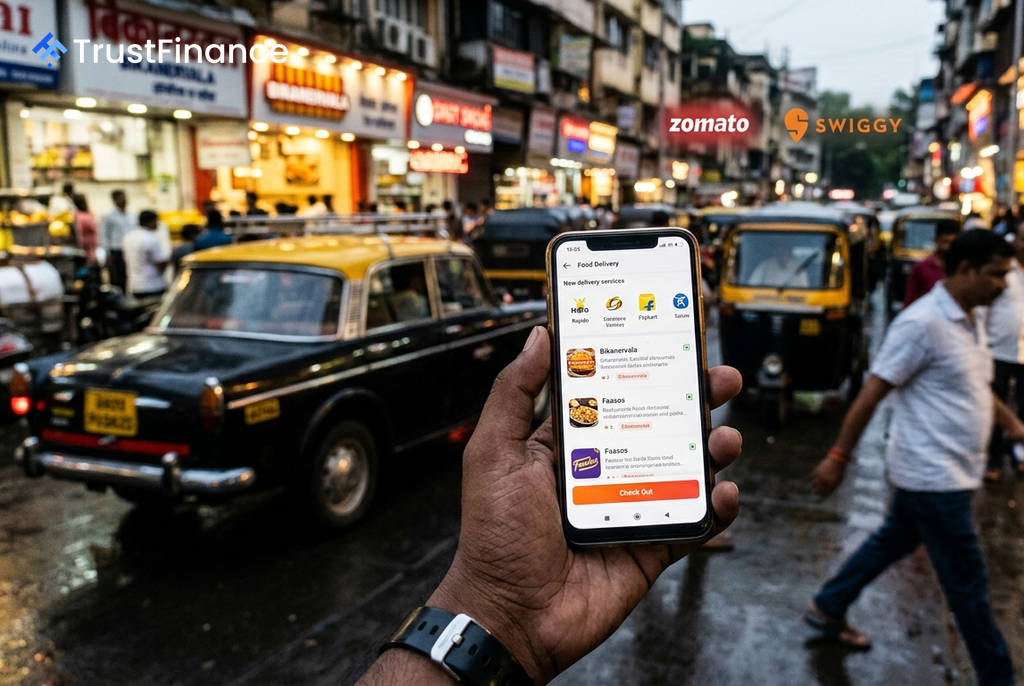
New entrants are poised to disrupt India's highly concentrated food delivery market, prompting analysts at Bernstein to question whether the moves will expand the sector or simply compress the high profit margins currently enjoyed by incumbents Zomato and Swiggy.
An Attractive Duopoly
For years, Zomato and Swiggy have maintained a stable duopoly in a market that has become highly attractive to new competitors, according to Bernstein. The sector boasts strong fundamentals that are drawing new players in:
- Robust Growth: The market is expanding at an 18-20% year-over-year rate.
- High Profitability: Adjusted EBITDA margins are around 5%, which Bernstein notes is the highest globally.
- Rich Valuations: The two companies invested a combined $4-5 billion before their IPOs and their food delivery operations are now valued at approximately $20 billion, suggesting a high Tobin’s Q ratio of 4-5 times.
Despite this growth, the market remains relatively underpenetrated. Food delivery constitutes just 15% of India’s total food services market, with a combined 85-95 million annual transacting customers across both platforms.
New Challengers' Strategies
 Ad
The new entrants are reportedly pursuing aggressive, low-cost models to capture market share. Rapido is said to be testing a no-commission or low-commission model aimed at the lower-priced segment of the market, where the average order value (AOV) is closer to the broader food service market's 150 rupees rather than the current delivery AOV of 400 rupees.
Meanwhile, e-commerce giant Flipkart is reportedly planning to enter with a commission structure of 10-11%. These strategies directly challenge the established pricing power of the current market leaders.
The Unit Economics Hurdle
The central question, according to Bernstein, is whether newcomers can achieve sustainable unit economics by fundamentally altering the cost structure. The most significant barrier is the high cost of fulfillment.
Delivery costs, including last-mile service and rider recruitment, run between 60-65 rupees per order. For a low-commission model to succeed, new players must find a way to significantly reduce this expense, a challenge that has proven difficult for operators globally.
Read next
More on Stocks
FTC Orders Walmart, Uber, Delta to Disclose Data on Personalized Pricing
The U.S. Federal Trade Commission is demanding nine major companies, including leading retail, travel, and gig economy firms, to provide information on how they use consumer data for setting individual prices and wages.

Google Launches Gemini 4 Carbon AI Model to Bolster Cybersecurity Capabilities
Alphabet's Google has unveiled Gemini 4 Carbon, its latest AI model specifically designed for advanced cybersecurity tasks like vulnerability detection and secure code generation. The launch escalates competition with rivals OpenAI and Anthropic in the enterprise AI market.

Oracle Shares Surge After Unveiling $225 Billion Revenue Target for 2030
Oracle stock rose sharply after the company presented a long-term financial outlook targeting at least $225 billion in annual revenue by fiscal 2030, driven by its expanding AI infrastructure business.

DOJ Scrutinizes Nvidia's $12.9B Hugging Face Deal Amid Broader Antitrust Probe, Sources Say
The U.S. Department of Justice is reportedly examining Nvidia's planned $12.93 billion acquisition of AI platform Hugging Face as part of a wider, ongoing antitrust investigation into the chipmaker's market conduct.