
Story
AstraZeneca Rallies, Bristol-Myers Falls as Source Denies Merger Talks
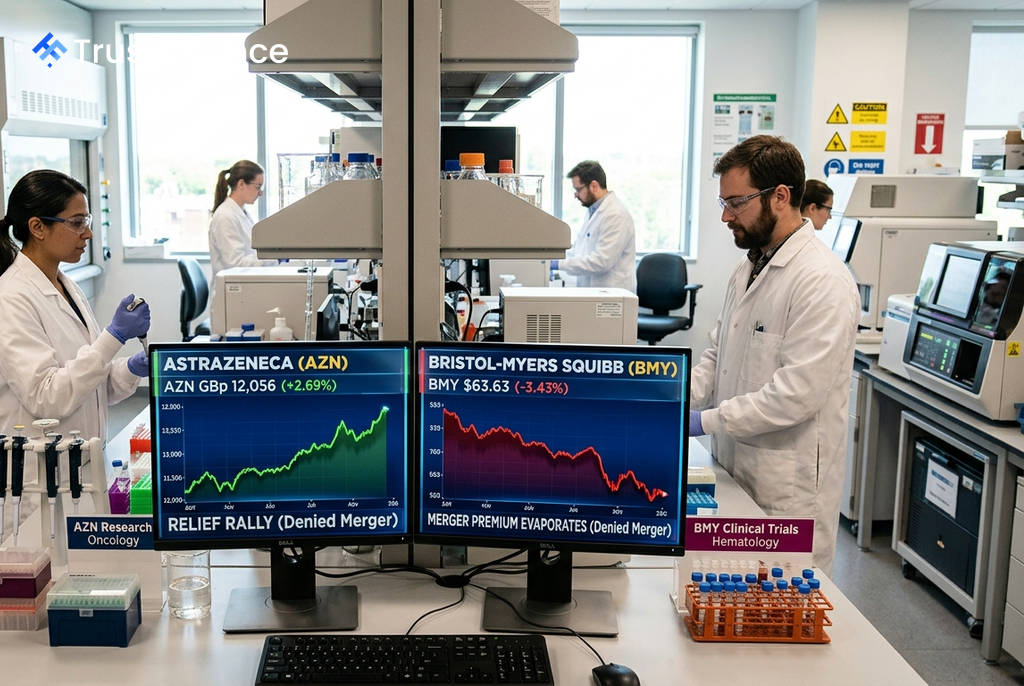
Shares of AstraZeneca and Bristol-Myers Squibb moved in opposite directions after a senior source told Reuters that merger discussions between the two drugmakers never occurred, putting a decisive end to market rumors that began circulating in early August.
The swift denial unwound the sharp stock moves that followed an August 2 Financial Times report of preliminary talks. AstraZeneca stock is rallying on relief, while the acquisition premium that had been priced into Bristol-Myers shares has evaporated.
A Three-Day Speculation Unwinds
The market reaction follows a brief but volatile period for both companies. The timeline of events, according to market reports, was as follows:
- August 2: The Financial Times reported preliminary merger talks, causing AstraZeneca's (AZN) shares to fall approximately 9% while Bristol-Myers Squibb (BMY) shares rose about 6% in pre-market trading.
- August 3: Analysts at RBC Capital Markets characterized the rumor as a "trial balloon," and reports emerged of unanimous opposition from AstraZeneca shareholders.
- August 4: A senior source definitively told Reuters, "there are no discussions" and "never was a deal," triggering a sharp reversal in stock performance. On the day of the denial, AZN shares gained 2.69% while BMY shares shed 3.43%.
Diverging Paths for Shareholders
 Ad
For AstraZeneca, the rebound is seen as a relief rally. Investors had reportedly balked at the prospect of a deal that could have involved a premium of over 40% for Bristol-Myers, financed with significant debt. Despite the day's gains, AZN's stock remains down 16.6% over the past month. The focus now returns to its pipeline, which Bernstein previously called "the deepest and highest quality in the industry," with key data for its tozorakimab and AVANZAR trials expected later this year.
Bristol-Myers Squibb, meanwhile, has surrendered its merger-related gains. The company's fundamentals remain strong, having recently reported Q2 earnings per share of $2.04 on revenue of $12.97 billion, beating consensus estimates by 26.7% and 10.8%, respectively. However, the initial logic behind the merger rumor—BMY's need to address a looming patent cliff—remains a central concern for investors.
Strategic Pressures Remain
While the denial ends the immediate speculation, it does not resolve the underlying strategic questions for either pharmaceutical giant. Bristol-Myers still faces the eventual loss of exclusivity (LOE) for its blockbuster drugs Eliquis and Opdivo, which together constitute roughly half of its total sales. This patent cliff was the primary reason analysts saw BMY as a potential acquisition target.
Analysts and investors will now be looking to both companies' management teams for clarity on their strategic direction and capital allocation plans. These topics are expected to be a major focus during their respective third-quarter earnings calls, scheduled for the final week of October.
Read next
More on Stocks
FTC Orders Walmart, Uber, Delta to Disclose Data on Personalized Pricing
The U.S. Federal Trade Commission is demanding nine major companies, including leading retail, travel, and gig economy firms, to provide information on how they use consumer data for setting individual prices and wages.

Google Launches Gemini 4 Carbon AI Model to Bolster Cybersecurity Capabilities
Alphabet's Google has unveiled Gemini 4 Carbon, its latest AI model specifically designed for advanced cybersecurity tasks like vulnerability detection and secure code generation. The launch escalates competition with rivals OpenAI and Anthropic in the enterprise AI market.

Oracle Shares Surge After Unveiling $225 Billion Revenue Target for 2030
Oracle stock rose sharply after the company presented a long-term financial outlook targeting at least $225 billion in annual revenue by fiscal 2030, driven by its expanding AI infrastructure business.

DOJ Scrutinizes Nvidia's $12.9B Hugging Face Deal Amid Broader Antitrust Probe, Sources Say
The U.S. Department of Justice is reportedly examining Nvidia's planned $12.93 billion acquisition of AI platform Hugging Face as part of a wider, ongoing antitrust investigation into the chipmaker's market conduct.