
Story
Wall Street Strategists See Bull Market Surviving Fed Rate Hikes
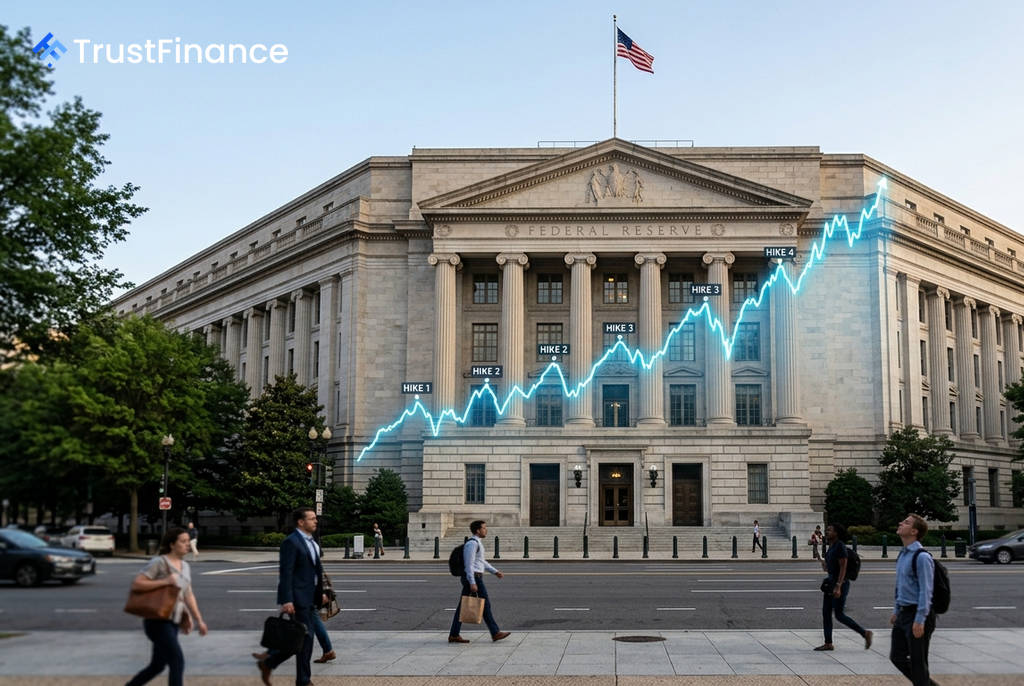
Despite the headwinds that monetary tightening typically presents for equities, strategists across Wall Street contend that the current bull market is positioned to withstand an anticipated cycle of Federal Reserve rate hikes, citing the strength of corporate earnings as the primary driver.
Earnings Seen as Key Buffer
While rising interest rates pressure equity valuations, earnings remain the most important factor for stock performance, according to strategists at Goldman Sachs led by Ben Snider. They noted that the S&P 500's forward price-to-earnings ratio has already compressed from 22 at the start of the year to 19, even as the index remains near record highs, suggesting the market has already digested some of the impact.
This view is shared by other firms. JPMorgan strategists led by Dubravko Lakos-Bujas wrote that a "shallow hiking cycle," which they see as a reversal of last year's "insurance cuts," should be manageable for stocks. Analysts also pointed out that markets are already pricing in more than three rate hikes over the next year, while corporate balance sheets remain robust.
Historical Context and Market Risks
Looking at historical precedent, Goldman Sachs' analysis of seven prior hiking cycles found that the S&P 500 fell an average of 2% in the three months following the first rate increase. However, the index went on to rise an average of 9% over the 12 months after that initial hike.
 Ad
Still, strategists warn that the margin for error is narrowing. A team led by Mislav Matejka said the positive correlation between equities and bond yields could turn negative if the 10-year Treasury yield reaches the 5% to 5.5% range. The primary risks that could disrupt the outlook include:
- A re-acceleration in inflation that forces the Fed into a broader, more aggressive hiking cycle.
- A sudden spike in oil prices, which Morgan Stanley strategists noted could be tied to geopolitical tensions or a sharp rebound in Chinese consumption.
Sector Performance in a Tightening Cycle
As the policy environment shifts, certain market segments may take the lead. According to Morgan Stanley strategists led by Michael Wilson, high-quality U.S. stocks have historically outperformed the broader market during the first hike of a tightening cycle. They also observed that cyclicals and momentum stocks typically perform well after the initial rate increase, particularly when rising rates are a function of strong economic growth rather than inflation concerns.
Read next
More on Stocks
FTC Orders Walmart, Uber, Delta to Disclose Data on Personalized Pricing
The U.S. Federal Trade Commission is demanding nine major companies, including leading retail, travel, and gig economy firms, to provide information on how they use consumer data for setting individual prices and wages.

Google Launches Gemini 4 Carbon AI Model to Bolster Cybersecurity Capabilities
Alphabet's Google has unveiled Gemini 4 Carbon, its latest AI model specifically designed for advanced cybersecurity tasks like vulnerability detection and secure code generation. The launch escalates competition with rivals OpenAI and Anthropic in the enterprise AI market.

Oracle Shares Surge After Unveiling $225 Billion Revenue Target for 2030
Oracle stock rose sharply after the company presented a long-term financial outlook targeting at least $225 billion in annual revenue by fiscal 2030, driven by its expanding AI infrastructure business.

DOJ Scrutinizes Nvidia's $12.9B Hugging Face Deal Amid Broader Antitrust Probe, Sources Say
The U.S. Department of Justice is reportedly examining Nvidia's planned $12.93 billion acquisition of AI platform Hugging Face as part of a wider, ongoing antitrust investigation into the chipmaker's market conduct.