
Story
Wall Street Misinterpreted Solar Tariff Impact, Climate Finance Expert Says
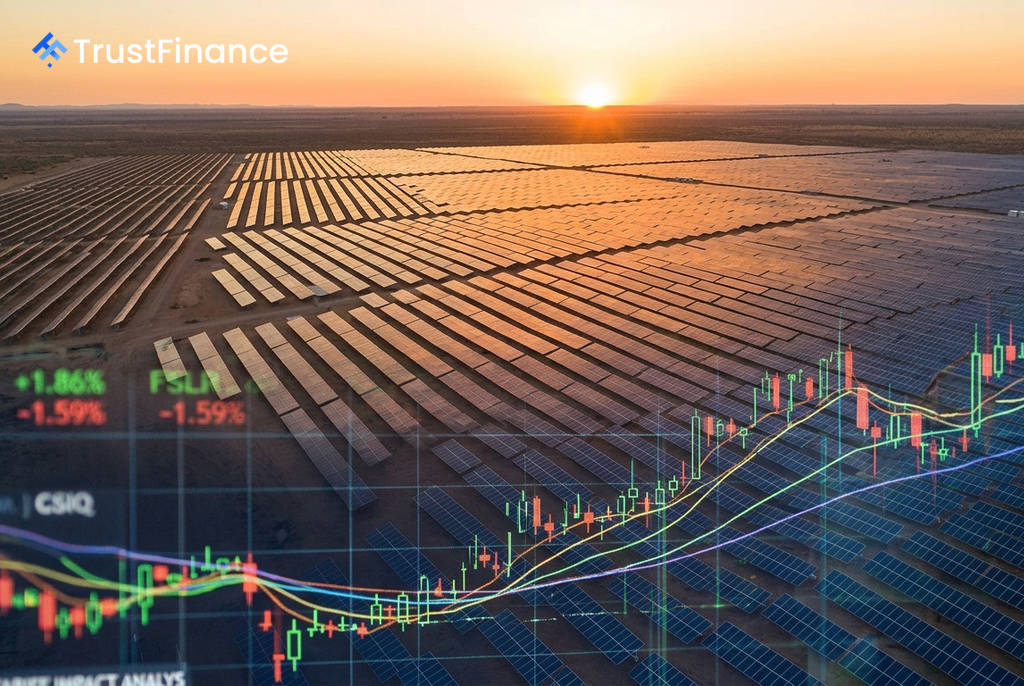
Wall Street’s initial reaction to the latest solar tariff announcement was a misread of the policy's fundamental impact, according to Matt Roling, a climate finance expert and professor at Northwestern's Kellogg School of Management.
In an interview with Investing.com, Roling noted that the market's response was indiscriminate, pointing out that even the stocks of companies negatively exposed to the tariffs saw initial gains. "Everyone's talking about which solar company won from Trump's tariffs. Nobody's talking about the fact that the losers' stocks went up too," he said.
Unpacking the Winners and Losers
According to Roling's analysis, the market failed to appreciate the nuances of the solar supply chain, which is critical to understanding the tariffs' effects. The policy specifically targets the silicon supply chain, creating distinct outcomes for different companies.
Key takeaways from his analysis include:
 Ad
- First Solar (FSLR): A clear "winner by default." Roling explained that First Solar's panels are made from cadmium telluride, not silicon, exempting it from the new regulations. "While every other US panel maker has to prove where its polysilicon came from or risk a penalty, First Solar doesn't have to worry about it at all," he stated.
- Corning (GLW): An overlooked "quiet structural winner." Corning co-owns Hemlock Semiconductor, one of only two polysilicon plants in the U.S. Roling noted the muted share reaction is understandable because the financial benefit is diluted as it flows through a joint venture stake.
- Canadian Solar (CSIQ): The company most exposed to Chinese-linked sourcing. Roling expressed surprise at its positive stock movement, cautioning that its performance is influenced by a Shanghai-listed subsidiary and a one-time tariff refund.
Sector Noise vs. Fundamental Impact
Roling also pointed to several companies whose stock movements were driven by general market sentiment rather than the specifics of the tariff policy.
The initial stock price increase for installer Sunrun (RUN) was particularly surprising to Roling, as the company buys panels and is therefore exposed to higher costs. "The market cheered for a policy that taxes them," he remarked. Similarly, he characterized the initial moves in inverter manufacturers SolarEdge (SEDG) and Enphase (ENPH) as "sector beta," since their products are not part of the polysilicon supply chain targeted by the tariffs.
Read next
More on Stocks
FTC Orders Walmart, Uber, Delta to Disclose Data on Personalized Pricing
The U.S. Federal Trade Commission is demanding nine major companies, including leading retail, travel, and gig economy firms, to provide information on how they use consumer data for setting individual prices and wages.

Google Launches Gemini 4 Carbon AI Model to Bolster Cybersecurity Capabilities
Alphabet's Google has unveiled Gemini 4 Carbon, its latest AI model specifically designed for advanced cybersecurity tasks like vulnerability detection and secure code generation. The launch escalates competition with rivals OpenAI and Anthropic in the enterprise AI market.

Oracle Shares Surge After Unveiling $225 Billion Revenue Target for 2030
Oracle stock rose sharply after the company presented a long-term financial outlook targeting at least $225 billion in annual revenue by fiscal 2030, driven by its expanding AI infrastructure business.

DOJ Scrutinizes Nvidia's $12.9B Hugging Face Deal Amid Broader Antitrust Probe, Sources Say
The U.S. Department of Justice is reportedly examining Nvidia's planned $12.93 billion acquisition of AI platform Hugging Face as part of a wider, ongoing antitrust investigation into the chipmaker's market conduct.