
Story
US Power Grid Expansion Faces Major Hurdles From Permitting Delays, Barclays Warns
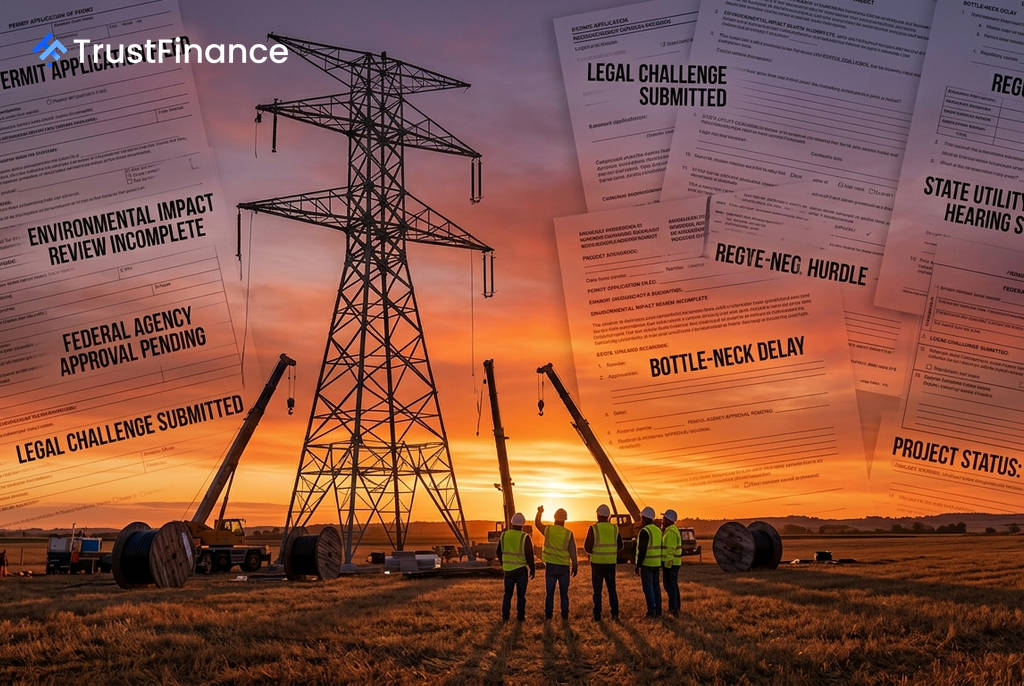
The United States may struggle to expand its power infrastructure at the pace required to meet rising electricity demand, with complex permitting processes and slow transmission development creating significant bottlenecks, according to a new report from Barclays.
The investment bank concluded that policy constraints could prevent the U.S. from adding generation and transmission capacity at the necessary scale, potentially impacting economic growth and the energy transition.
A Widening Supply-Demand Gap
The report highlights a stark contrast between historical and recent infrastructure development. While U.S. electricity generation more than doubled during the 1950s and the country built roughly 8,000 miles of transmission lines annually in the late 1960s and early 1970s, the pace has slowed dramatically.
Barclays cited data showing a steady decline in the rate of transmission expansion:
- 1980s-1990s: Annual capacity growth averaged about 2%.
- 2004-2016: The rate fell to 1.2%.
- 2017-2024: Growth slowed further to just 0.6%.
This slowdown comes as the Congressional Budget Office estimates that transmission capacity may need to grow by at least 3% annually to meet future electricity demand, driven by factors like data centers, electrification, and onshoring of manufacturing.
 Ad
Permitting Bottlenecks Create Delays
Barclays identifies the increasingly complex U.S. permitting system as a primary obstacle. For large projects costing over $200 million, the bank's analysis found a labyrinth of regulatory hurdles involving at least 64 permits and reviews across 15 federal agencies and their subdivisions.
The process involves approximately 425 actions and milestones, with 230 considered non-optional. These delays are compounded at the state and local levels, where 37 states grant local governments authority over project siting. According to the report, this complexity has contributed to nearly 30% of large energy-related projects being either cancelled or paused.
Reform Efforts Fall Short
Previous attempts to accelerate the approval process have produced limited results, Barclays noted. The 2023 Fiscal Responsibility Act, which established a two-year deadline for environmental impact studies, has seen only 39% of studies meet that target.
While more recent executive orders aim to speed up approvals for energy and data-center infrastructure, Barclays stated it is too early to judge their effectiveness. The bank concluded that without durable, cross-government legislative reform, permitting is likely to remain a major impediment to expanding U.S. energy infrastructure at the required speed.
Read next
More on Stocks
FTC Orders Walmart, Uber, Delta to Disclose Data on Personalized Pricing
The U.S. Federal Trade Commission is demanding nine major companies, including leading retail, travel, and gig economy firms, to provide information on how they use consumer data for setting individual prices and wages.

Google Launches Gemini 4 Carbon AI Model to Bolster Cybersecurity Capabilities
Alphabet's Google has unveiled Gemini 4 Carbon, its latest AI model specifically designed for advanced cybersecurity tasks like vulnerability detection and secure code generation. The launch escalates competition with rivals OpenAI and Anthropic in the enterprise AI market.

Oracle Shares Surge After Unveiling $225 Billion Revenue Target for 2030
Oracle stock rose sharply after the company presented a long-term financial outlook targeting at least $225 billion in annual revenue by fiscal 2030, driven by its expanding AI infrastructure business.

DOJ Scrutinizes Nvidia's $12.9B Hugging Face Deal Amid Broader Antitrust Probe, Sources Say
The U.S. Department of Justice is reportedly examining Nvidia's planned $12.93 billion acquisition of AI platform Hugging Face as part of a wider, ongoing antitrust investigation into the chipmaker's market conduct.