
Story
Turkey Imposes Stricter Hedge Fund Rules Amid Market Manipulation Concerns
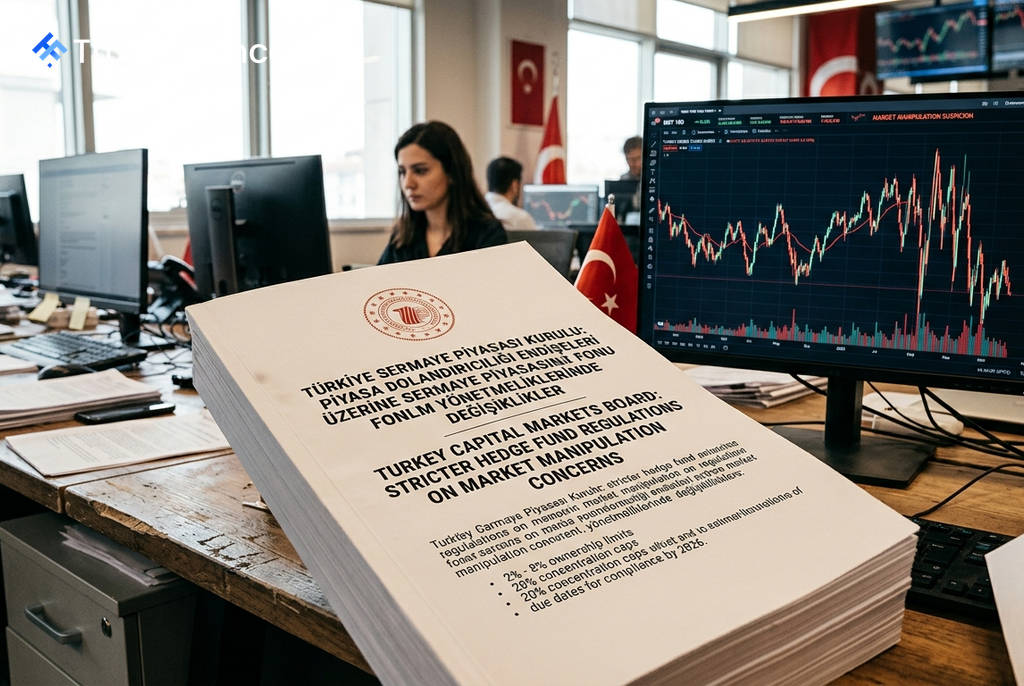
Turkey's capital markets regulator has rolled out stricter regulations for hedge funds, aiming to curb potential market manipulation and address concerns over unusually high returns linked to concentrated stock positions. The new rules, announced Saturday, impose firm limits on portfolio concentration and exposure to related-party entities, according to a report by Bloomberg.
New Rules Target Concentration Risk
The guidelines from the Capital Markets Board of Turkey introduce several key restrictions designed to enhance market integrity. The new framework includes:
- Single-Stock Limits: A hedge fund's holding in a single issuer's free-floating shares will be capped at between 2% and 8%, with the specific limit depending on the company's free-float ratio.
- Related-Party Exposure: Funds will be prohibited from investing more than 20% of their portfolio in capital market instruments issued by entities controlled by the fund's own management.
- Portfolio Concentration Cap: The total value of individual positions that each account for more than 5% of a fund's portfolio cannot collectively exceed 20% of the portfolio's total value.
Compliance and Market Context
Funds are required to reduce their excess holdings in phases, cutting them by at least one-third by October 31, two-thirds by November 30, and reaching full compliance with the immediate thresholds by December 31. A final deadline for all funds to fully conform to the new regime is set for the end of 2026.
 Ad
The regulatory action follows growing concerns that some Turkish investment funds have exerted significant control over illiquid stocks. This has been linked to abnormally high fund returns and sharp increases in certain stock prices, raising questions about potential price manipulation, coordinated trading, and distorted valuations in the Turkish equity market.
Scrutiny from Global Index Providers
The new rules arrive as Turkey faces increased scrutiny from major global index providers, including MSCI, S&P Dow Jones, and FTSE Russell, over issues of shareholder transparency, free-float ratios, and market accessibility.
Index giant MSCI has explicitly warned that it could launch a review of Turkey's emerging-market classification status if authorities do not improve shareholder transparency before its next assessment in November. In May, MSCI removed several Turkish stocks from its small-cap index due to insufficient free-float, and in June it raised separate concerns about short-selling restrictions and what it termed "coordinated trading." While Turkey amended its free-float calculation methods in June, MSCI has stated it is still evaluating the effectiveness of the changes.
Read next
More on Stocks
FTC Orders Walmart, Uber, Delta to Disclose Data on Personalized Pricing
The U.S. Federal Trade Commission is demanding nine major companies, including leading retail, travel, and gig economy firms, to provide information on how they use consumer data for setting individual prices and wages.

Google Launches Gemini 4 Carbon AI Model to Bolster Cybersecurity Capabilities
Alphabet's Google has unveiled Gemini 4 Carbon, its latest AI model specifically designed for advanced cybersecurity tasks like vulnerability detection and secure code generation. The launch escalates competition with rivals OpenAI and Anthropic in the enterprise AI market.

Oracle Shares Surge After Unveiling $225 Billion Revenue Target for 2030
Oracle stock rose sharply after the company presented a long-term financial outlook targeting at least $225 billion in annual revenue by fiscal 2030, driven by its expanding AI infrastructure business.

DOJ Scrutinizes Nvidia's $12.9B Hugging Face Deal Amid Broader Antitrust Probe, Sources Say
The U.S. Department of Justice is reportedly examining Nvidia's planned $12.93 billion acquisition of AI platform Hugging Face as part of a wider, ongoing antitrust investigation into the chipmaker's market conduct.