
Story
T-Mobile Leads Telecom Sector in Free Cash Flow Growth and Valuation Upside, Analysis Shows
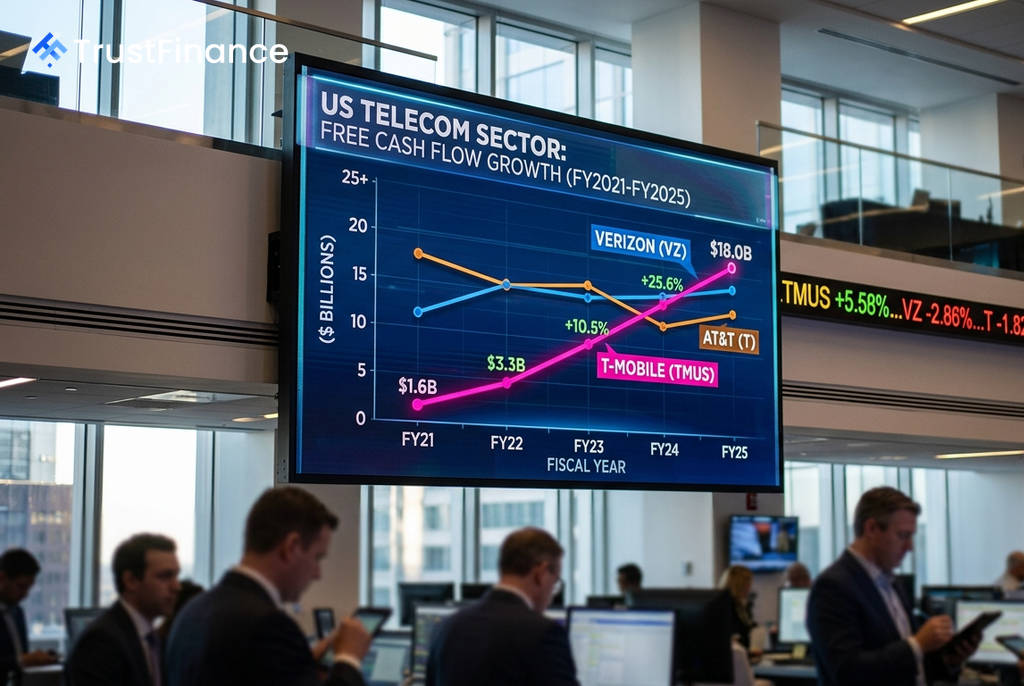
The U.S. telecommunications sector is showing signs of renewed financial health, with major carriers reporting year-over-year EPS growth in the second quarter of 2026. This improvement comes as the industry moves away from the aggressive promotional subsidies that characterized 2023–24, according to an analysis by Investing.com.
Despite the positive sector-wide fundamentals, market performance has been divergent. Verizon (VZ) has seen its stock rise 28.3% year-to-date, while T-Mobile US (TMUS) has declined 11.8% over the same period, largely due to investor concerns over soft subscriber guidance for the third quarter.
T-Mobile's Cash Flow Story
A key differentiator for T-Mobile is its explosive growth in free cash flow (FCF), a direct result of its successful integration of the Sprint merger. The company's levered FCF surged from $1.6 billion in fiscal year 2021 to $18.0 billion in FY2025, an 11-fold increase in four years, based on Investing.com data as of September 17, 2026.
This rapid expansion contrasts with the more stable financial profiles of its peers. Verizon's FCF recovered to $20.1 billion in FY2025, while both it and AT&T (T) are seeing largely flat-to-modest revenue growth. T-Mobile's revenue, meanwhile, grew from $78.6 billion in FY2023 to a projected $88.3 billion in FY2025.
Valuation and Investor Outlook
 Ad
According to the analysis, T-Mobile's current stock price presents a significant dislocation from its fundamental value, suggesting a potential 36.1% upside. The company is strategically focusing on increasing average revenue per account (ARPA) rather than maximizing short-term subscriber numbers.
Key factors for investors to consider include:
- Bull Case: T-Mobile has confirmed FCF guidance of $18.4–$18.8 billion for FY2026. The stock's 24.8% one-year decline is seen by some as an overreaction to guidance rather than a fundamental problem.
- Bear Case: The company carries significant debt, with a debt-to-equity ratio of 208.9% in FY2025. Its stock trades at a premium P/E ratio of 17.0x, compared to Verizon's 12.5x and AT&T's 8.1x, leaving less room for error if it misses its modest Q3 guidance of 250,000 postpaid net account additions.
Broader Sector Context
Beyond the three major carriers, the analysis notes that cable companies like Comcast (CMCSA) and Charter (CHTR) present deep value opportunities but face secular pressures on their broadband businesses. The overall telecom infrastructure market is projected to expand from $1.5 billion to $4 billion by 2029, driven by 5G and fiber network buildouts, which could provide a tailwind for the sector.
Read next
More on Stocks
FTC Orders Walmart, Uber, Delta to Disclose Data on Personalized Pricing
The U.S. Federal Trade Commission is demanding nine major companies, including leading retail, travel, and gig economy firms, to provide information on how they use consumer data for setting individual prices and wages.

Google Launches Gemini 4 Carbon AI Model to Bolster Cybersecurity Capabilities
Alphabet's Google has unveiled Gemini 4 Carbon, its latest AI model specifically designed for advanced cybersecurity tasks like vulnerability detection and secure code generation. The launch escalates competition with rivals OpenAI and Anthropic in the enterprise AI market.

Oracle Shares Surge After Unveiling $225 Billion Revenue Target for 2030
Oracle stock rose sharply after the company presented a long-term financial outlook targeting at least $225 billion in annual revenue by fiscal 2030, driven by its expanding AI infrastructure business.

DOJ Scrutinizes Nvidia's $12.9B Hugging Face Deal Amid Broader Antitrust Probe, Sources Say
The U.S. Department of Justice is reportedly examining Nvidia's planned $12.93 billion acquisition of AI platform Hugging Face as part of a wider, ongoing antitrust investigation into the chipmaker's market conduct.