
Story
South Korean Stocks Hit Record-Low Valuations Despite AI-Driven Earnings Surge
Summary
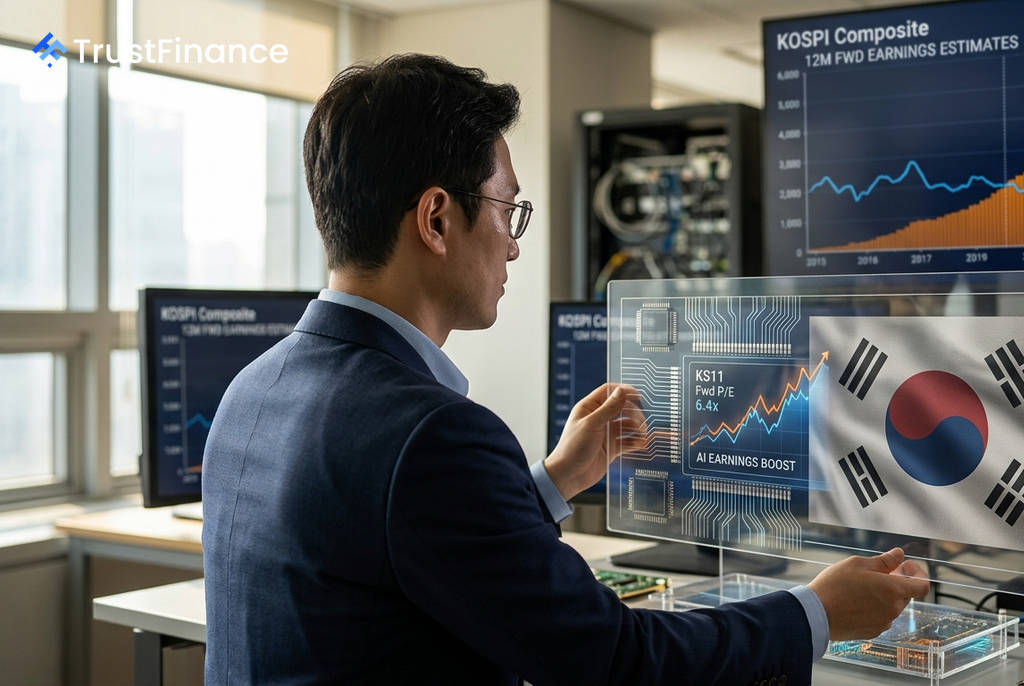
South Korea's Kospi index is trading at a record-low forward price-to-earnings ratio of 6.4, as a 170% projected surge in corporate earnings, fueled by AI chip demand, has dramatically outpaced the market's 80% rally.
South Korean equities are trading at their cheapest valuation on record, even after an 80% rally this year. The market's advance has been outstripped by a massive surge in corporate profit forecasts, driven primarily by demand for memory chips used in artificial intelligence applications, according to a report from Bloomberg.
Earnings Growth Outpaces Market Rally
The benchmark Kospi index is valued at just 6.4 times forward earnings, a multiple lower than levels seen during the 2008 global financial crisis. This valuation compression comes as consensus earnings estimates for the index's components have risen for 17 consecutive months.
Analysts now expect the Kospi's forward earnings per share (EPS) to increase by approximately 170% this year, which would mark the largest annual jump since Bloomberg began tracking the data in 2006. The robust profit outlook is largely attributed to the performance of semiconductor giants Samsung Electronics and SK Hynix, which are benefiting from the global AI boom.
A Steep Discount to Peers
 Ad
AdDespite outperforming many global markets, South Korean stocks maintain a significant valuation discount. The Kospi's forward P/E ratio is roughly one-third of the multiple for Taiwan's Taiex index, a key regional peer. Some investors view this gap as a potentially attractive entry point into the market.
However, skepticism remains regarding the sustainability of this trend. Some market participants question whether the AI-fueled demand for memory chips can break the industry's historical boom-and-bust cycles. Other potential headwinds include:
- Rising Prices: Higher memory chip prices could eventually dampen demand from major technology companies looking to manage costs.
- Supply Risk: Planned production capacity expansions by Samsung and SK Hynix could lead to oversupply and pressure profit margins.
- Competition: Intensifying competition from Chinese chip manufacturers poses a long-term risk.
Some analysts also note that other valuation metrics, such as price-to-book and PEG ratios, suggest that leading Korean chip stocks are not as inexpensive as the headline P/E ratio implies. Nonetheless, potential catalysts like a U.S. listing for SK Hynix could help narrow the valuation gap if strong earnings momentum continues.