
Story
Proposed U.S. Ban on Chinese Optical Transceivers Threatens AI Buildout, Report Warns
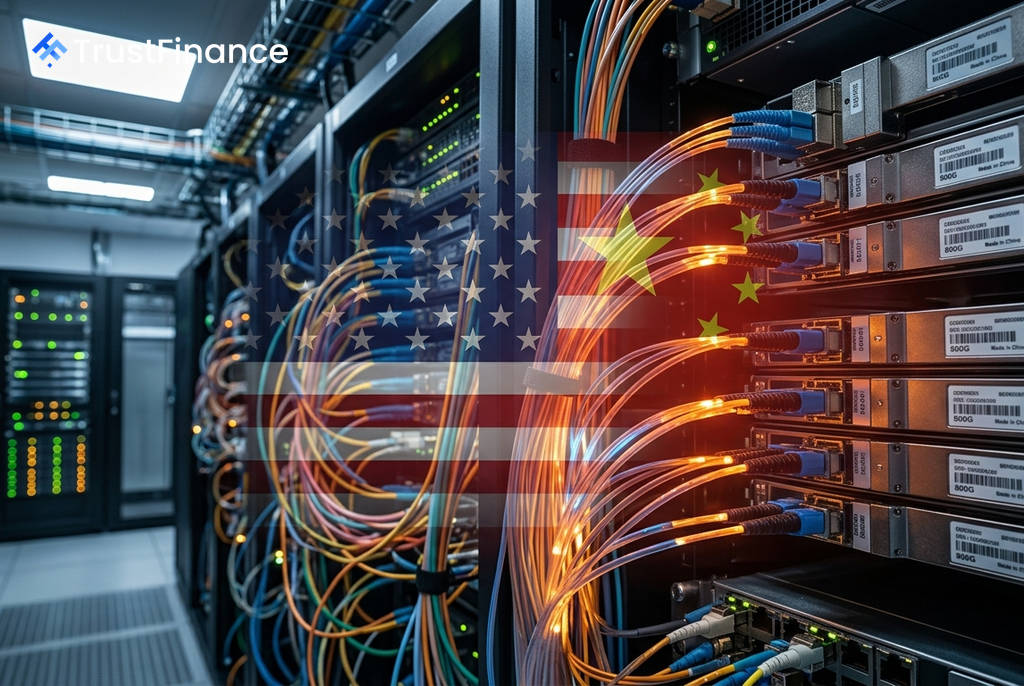
A proposed U.S. ban on Chinese optical transceivers could significantly disrupt the artificial intelligence infrastructure buildout for major American tech companies by creating hardware bottlenecks and increasing costs, a new report from Counterpoint Research warns. The analysis concludes that Western suppliers lack the production capacity to fill a supply gap that would be created by restricting Chinese imports.
Potential Supply Chain Disruption
The U.S. Federal Communications Commission (FCC) is reportedly drafting a ban on imports of new Chinese optical transceiver models, with a potential release before the end of the year, according to Reuters. These components are critical for converting electrical signals into light to move data within the high-speed networks of modern data centers.
Chinese manufacturers control a dominant share of the market, accounting for approximately 60% of global optical datacom transceiver revenue. Counterpoint Research analyst Neil Shah cautioned that key Western alternatives, such as Coherent and Lumentum, "currently lack the cleanroom capacity, automated packaging infrastructure, and yield scale required to absorb" the volume from Chinese leaders like Innolight and Eoptolink within a 12-to-24-month horizon.
Market Impact and Risks to Hyperscalers
News of the potential ban triggered sharp, divergent reactions in the stock market. U.S.-listed optical networking companies surged on expectations of redirected orders, while their Chinese counterparts fell.
 Ad
- U.S. Gainers: Coherent (+11%), Applied Optoelectronics (+18%), and Lumentum (+7%).
- Chinese Losers: Eoptolink Technology (-10%), Zhongji Innolight (-8%), and Suzhou TFC Optical Communications (-6%).
For major cloud providers, or "hyperscalers," such as Microsoft, Google, and Meta, a ban could lead to "cost escalation and delayed AI cluster deployments," Shah wrote. Such hardware bottlenecks would risk slowing down capital expenditure plans that total hundreds of billions of dollars, as expensive AI accelerators would face lower utilization without sufficient high-speed interconnects.
A Deeply Integrated Global Ecosystem
The report emphasizes that the global supply chain for these components is highly integrated, not easily separated along geopolitical lines. Chinese module makers rely on critical U.S.-made components, including digital signal processors from Broadcom and Marvell and laser components from Lumentum and Coherent.
Zhongji Innolight, which holds an estimated 27% of the global data-center transceiver market, generated 62% of its revenue from the U.S. in the first quarter, according to Counterpoint. The company was recently added to a Pentagon list of alleged Chinese military-backed firms. While some Chinese firms have expanded manufacturing to Thailand to mitigate trade risks, it is unclear if these products would be exempt from the proposed ban.
Read next
More on Stocks
FTC Orders Walmart, Uber, Delta to Disclose Data on Personalized Pricing
The U.S. Federal Trade Commission is demanding nine major companies, including leading retail, travel, and gig economy firms, to provide information on how they use consumer data for setting individual prices and wages.

Google Launches Gemini 4 Carbon AI Model to Bolster Cybersecurity Capabilities
Alphabet's Google has unveiled Gemini 4 Carbon, its latest AI model specifically designed for advanced cybersecurity tasks like vulnerability detection and secure code generation. The launch escalates competition with rivals OpenAI and Anthropic in the enterprise AI market.

Oracle Shares Surge After Unveiling $225 Billion Revenue Target for 2030
Oracle stock rose sharply after the company presented a long-term financial outlook targeting at least $225 billion in annual revenue by fiscal 2030, driven by its expanding AI infrastructure business.

DOJ Scrutinizes Nvidia's $12.9B Hugging Face Deal Amid Broader Antitrust Probe, Sources Say
The U.S. Department of Justice is reportedly examining Nvidia's planned $12.93 billion acquisition of AI platform Hugging Face as part of a wider, ongoing antitrust investigation into the chipmaker's market conduct.