
Story
Japanese Automakers Gain US Market Share in July as Overall Sales Decline
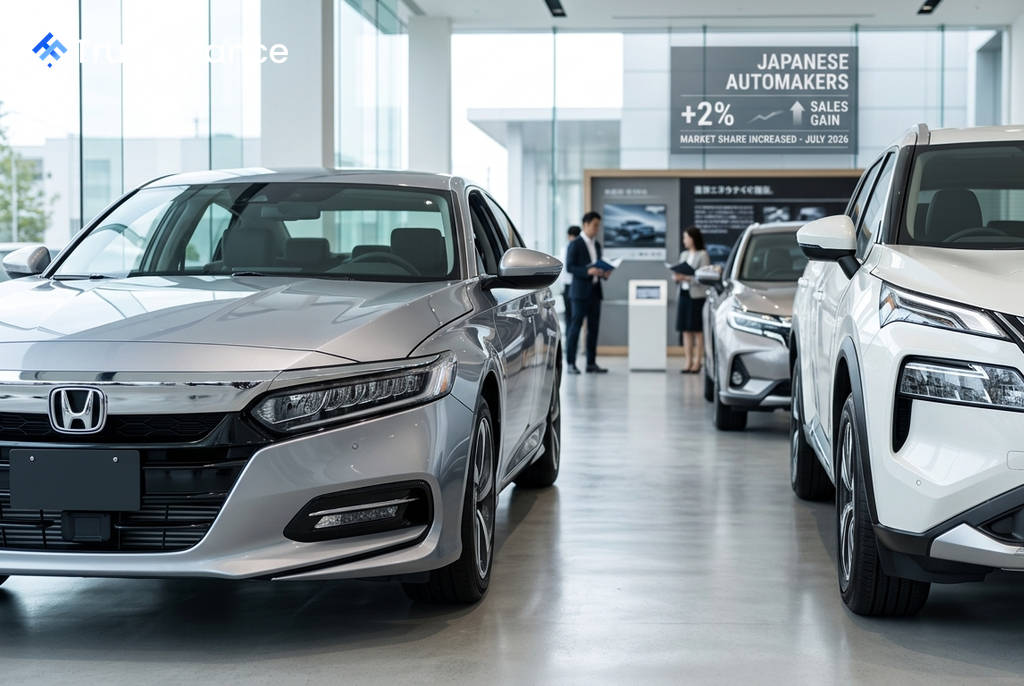
Japanese automakers bucked a broader market trend in July, increasing U.S. sales by 2% even as the total vehicle market contracted by 2% year-over-year. The performance, detailed in a report from Morgan Stanley, highlights a divergence in consumer demand, with strong interest in hybrid and affordable gasoline-powered models.
U.S. Auto Sales Cool in July
The U.S. auto market showed signs of cooling last month, with total vehicle sales declining 2% compared to July of the previous year, according to data released Sunday by Morgan Stanley. The seasonally adjusted annual rate (SAAR) of sales reached 16.5 million units.
While this figure was down 1% from both the prior year and the prior month, it surpassed the consensus analyst estimate of 16.3 million units. The data points to a resilient but softening consumer environment for large discretionary purchases.
Performance by Automaker
In a contracting market, Japanese manufacturers collectively grew sales, indicating a gain in market share. Performance varied significantly by brand:
 Ad
- Honda (HMC): Led the group with a 13% sales increase, driven by strong demand for its core internal combustion engine models like the Accord, CR-V, and Civic.
- Toyota (TM): Experienced a slight 1% sales decline, largely due to a 21% drop in RAV4 sales during a model changeover. However, demand for the RAV4 hybrid model surged by approximately 75%.
- Nissan (NSANY): Posted a 2% sales gain, with strong performance from its Rogue model offsetting weaker sales of the Versa and Sentra sedans.
- Subaru (FUJHY): Sales rose by 1%, supported by continued strength in Forester sales following a price reduction earlier in the year.
- Mazda (MZDAY): Lagged its peers with a 13% year-over-year sales drop, as sales of its popular CX-5 model fell 22%.
Hybrids Gain as Incentives and Inventories Tighten
The sales data also revealed key shifts in pricing power and consumer preference. Industry-wide incentives fell 8% month-over-month to an average of $3,194 per vehicle. Japanese brands, however, saw a steeper 14% drop to $2,258, suggesting robust demand allowed them to reduce discounts.
This demand is reflected in inventory levels. While the industry average inventory rose slightly to 50 days' supply, the average for Japanese automakers fell to 34 days. Toyota maintained a particularly lean inventory of just 23 days, well below the industry average.
The most significant trend was the divergence in powertrain sales. Hybrid electric vehicle sales jumped 26% year-over-year to 217,000 units, while sales of pure battery electric vehicles (EVs) fell 42% to 77,000 units. The report noted that a forthcoming $3,500 California subsidy for first-time EV buyers could influence future sales.
Read next
More on Stocks
FTC Orders Walmart, Uber, Delta to Disclose Data on Personalized Pricing
The U.S. Federal Trade Commission is demanding nine major companies, including leading retail, travel, and gig economy firms, to provide information on how they use consumer data for setting individual prices and wages.

Google Launches Gemini 4 Carbon AI Model to Bolster Cybersecurity Capabilities
Alphabet's Google has unveiled Gemini 4 Carbon, its latest AI model specifically designed for advanced cybersecurity tasks like vulnerability detection and secure code generation. The launch escalates competition with rivals OpenAI and Anthropic in the enterprise AI market.

Oracle Shares Surge After Unveiling $225 Billion Revenue Target for 2030
Oracle stock rose sharply after the company presented a long-term financial outlook targeting at least $225 billion in annual revenue by fiscal 2030, driven by its expanding AI infrastructure business.

DOJ Scrutinizes Nvidia's $12.9B Hugging Face Deal Amid Broader Antitrust Probe, Sources Say
The U.S. Department of Justice is reportedly examining Nvidia's planned $12.93 billion acquisition of AI platform Hugging Face as part of a wider, ongoing antitrust investigation into the chipmaker's market conduct.