
Story
Japanese 10-Year Bond Yield Hits 3% for First Time Since 1996, Fueling Carry Trade Fears
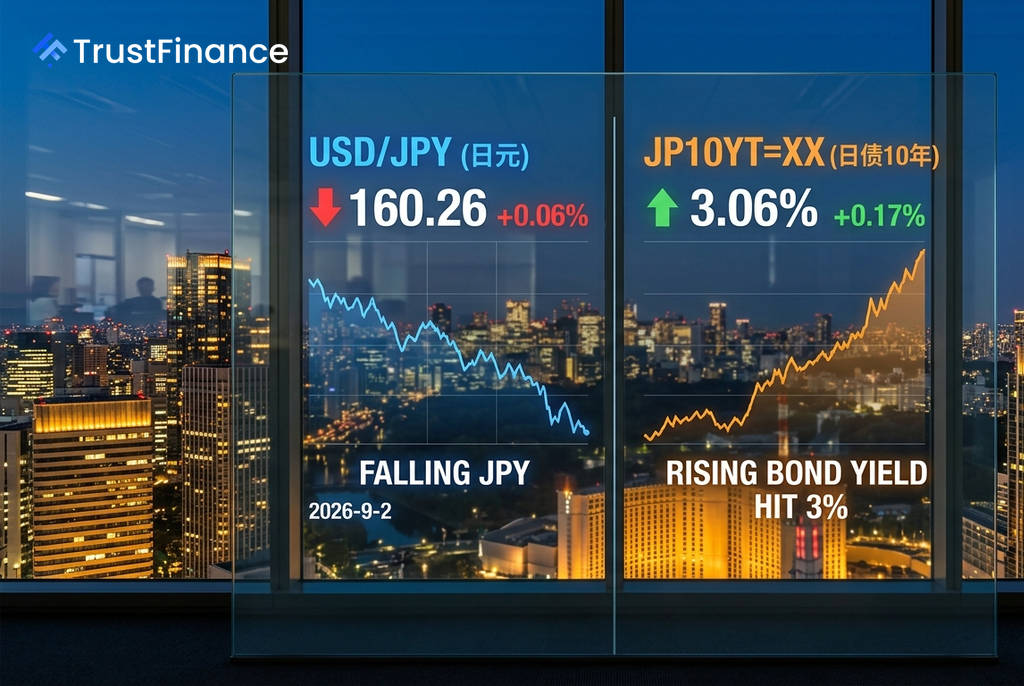
Japanese government bond (JGB) yields surged to historic highs on Tuesday, shaking global markets amid reports of U.S. pressure on Tokyo to tighten monetary policy more aggressively. The sell-off pushed the benchmark 10-year JGB yield to a level unseen in nearly three decades, raising concerns about the stability of the vast yen-funded carry trade.
Record-Breaking Bond Sell-Off
The move in the Japanese bond market was sharp and broad, signaling a fundamental shift in investor expectations. Key benchmarks breached critical levels, triggering a ripple effect across global asset classes.
- The 10-year JGB yield touched 3% for the first time since 1996.
- The 2-year JGB yield climbed to a 31-year high, indicating that the era of near-zero borrowing costs in yen is rapidly ending.
- The 30-year JGB yield approached its historical peak of 4.205%.
This spike in Japan's borrowing costs reverberated globally, with the UK 10-year gilt yield rising to 5.23% for the first time since 2008 and the U.S. 10-year Treasury note yielding 4.78%. The volatility also spilled into commodity markets, with Brent crude oil surpassing $92 per barrel.
U.S. Pressure and Fiscal Scrutiny
The bond market turmoil was reportedly intensified by external pressure. The source material, citing Woofun AI, stated that at a G20 finance ministers' meeting, U.S. Treasury Secretary Scott Bessent urged Japanese officials, including Bank of Japan Governor Kazuo Ueda, to accelerate interest rate hikes and strengthen the yen.
However, some analysts believe the sell-off is rooted in domestic policy. Takaide Kiuchi, a former Bank of Japan board member now at Nomura Research Institute, suggested the 3% yield is not just about monetary policy but is a market verdict on Prime Minister Sanae Takaichi's expansionary fiscal agenda, as described in the source report. The rising yields present a severe test for Japan's budget, which assumes a long-term interest rate of 3% for calculating debt-servicing costs.
 Ad
Carry Trade Liquidation Risk Mounts
The primary concern for global investors is the potential unwinding of the yen carry trade, where investors borrow in low-yielding yen to invest in higher-yielding assets abroad. The Bank for International Settlements (BIS) has highlighted the enormous scale of this leverage, estimating the current carry trade could be as large as $500 billion.
As Japanese yields rise, the cost of funding these trades increases, creating pressure to deleverage. A sudden, sharp appreciation in the yen could trigger a mass liquidation event. A historical parallel occurred in August 2024, when a 6% rise in the yen caused a global shock, leading to a 20% drop in Bitcoin and Ethereum as traders were forced to sell assets to meet margin calls.
Focus Shifts to BOJ's September Meeting
All eyes are now on the Bank of Japan's upcoming policy meeting on September 18, where markets are pricing in a 25-basis-point rate hike to 1.25%. The dollar is currently trading near the 160 yen level, a line that could provoke currency intervention from Japanese authorities.
According to BIS research, the speed of the yen's appreciation—not just the absolute level—is the critical factor that could break the carry trade. Governor Ueda's forward guidance on the future path of rate hikes will be scrutinized even more closely than the rate decision itself, as any hint of rapid tightening could ignite the massive, leveraged positions built up in offshore markets.
Read next
More on Stocks
FTC Orders Walmart, Uber, Delta to Disclose Data on Personalized Pricing
The U.S. Federal Trade Commission is demanding nine major companies, including leading retail, travel, and gig economy firms, to provide information on how they use consumer data for setting individual prices and wages.

Google Launches Gemini 4 Carbon AI Model to Bolster Cybersecurity Capabilities
Alphabet's Google has unveiled Gemini 4 Carbon, its latest AI model specifically designed for advanced cybersecurity tasks like vulnerability detection and secure code generation. The launch escalates competition with rivals OpenAI and Anthropic in the enterprise AI market.

Oracle Shares Surge After Unveiling $225 Billion Revenue Target for 2030
Oracle stock rose sharply after the company presented a long-term financial outlook targeting at least $225 billion in annual revenue by fiscal 2030, driven by its expanding AI infrastructure business.

DOJ Scrutinizes Nvidia's $12.9B Hugging Face Deal Amid Broader Antitrust Probe, Sources Say
The U.S. Department of Justice is reportedly examining Nvidia's planned $12.93 billion acquisition of AI platform Hugging Face as part of a wider, ongoing antitrust investigation into the chipmaker's market conduct.