
Story
Goldman Sachs: India Faces Major Liquidity Absorption Challenge After Deposit Influx
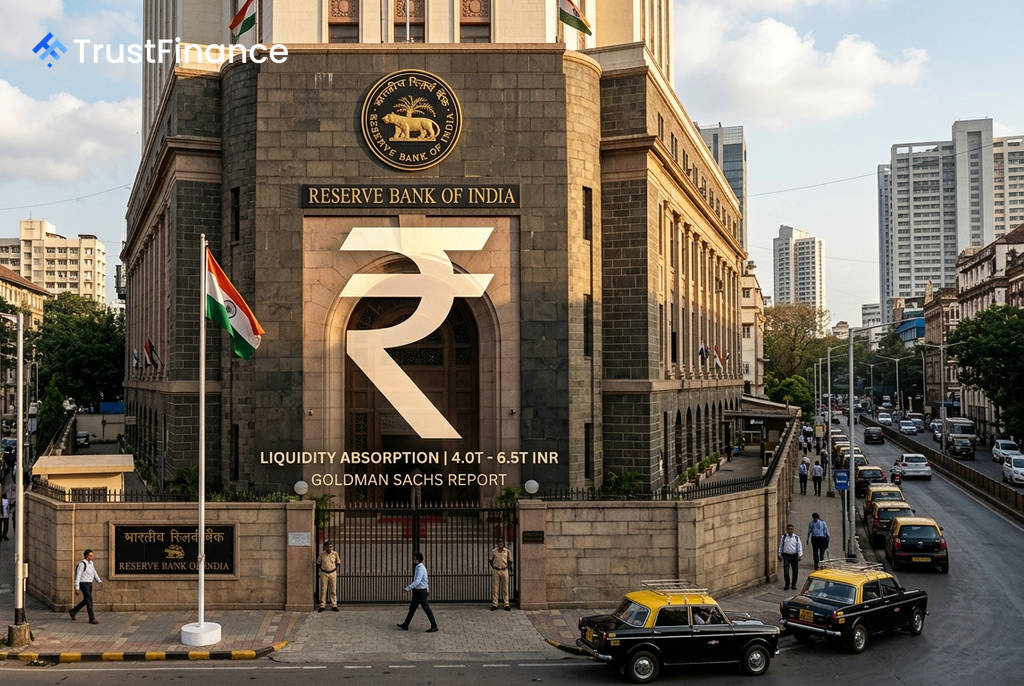
India's banking system is grappling with a substantial liquidity surplus, which has climbed to approximately 10 trillion rupees, after an unexpected surge in foreign currency deposits. According to analysts at Goldman Sachs, this surplus now represents 3.6% of the system's net demand and time liabilities (NDTL), creating a significant policy challenge for the country's central bank.
A Surge in Liquidity
The primary driver of the excess liquidity was an inflow of $127 billion from foreign currency non-resident (FCNR) deposits, a figure that Goldman Sachs noted exceeded both its own projections and broader market expectations. The bulk of these funds arrived late in August, pushing the overnight call rate below the Reserve Bank of India's (RBI) key repo rate.
This development indicates an oversupply of funds in the interbank market, which the central bank must now manage to maintain monetary policy stability.
The RBI's Absorption Task
Goldman Sachs projects the RBI will need to absorb between 4.0 trillion and 6.5 trillion rupees (equivalent to 1.5% to 2.5% of NDTL) during the September-December period. The central bank has several tools at its disposal, each with different implications:
 Ad
- Temporary tools: Variable rate reverse repos and term reverse repos can absorb liquidity but create an interest cost for the RBI.
- Permanent tools: Open market operation (OMO) sales of government bonds could raise bond yields, a potential concern amid high global interest rates.
- Other measures: Market Stabilization Scheme (MSS) issuance shifts the cost to the government's fiscal budget, while a hike in the cash reserve ratio (CRR) would place a burden on commercial banks.
The investment bank anticipates the RBI will employ a mix of both temporary and permanent measures to drain the excess liquidity. A seasonal increase in currency in circulation is expected to naturally reduce the surplus to around 1.0% of NDTL by March 2027.
Market and Currency Outlook
Despite the liquidity challenge, the report notes that India's balance of payments stress has eased, citing improved foreign direct investment, bond inflows since June, and moderately positive equity flows.
Goldman Sachs expects the RBI to use the FCNR deposit inflows strategically to reduce its forward foreign exchange liabilities and bolster its reserves. This policy action is anticipated to keep the dollar-rupee exchange rate largely range-bound, preventing significant volatility.
Read next
More on Stocks
FTC Orders Walmart, Uber, Delta to Disclose Data on Personalized Pricing
The U.S. Federal Trade Commission is demanding nine major companies, including leading retail, travel, and gig economy firms, to provide information on how they use consumer data for setting individual prices and wages.

Google Launches Gemini 4 Carbon AI Model to Bolster Cybersecurity Capabilities
Alphabet's Google has unveiled Gemini 4 Carbon, its latest AI model specifically designed for advanced cybersecurity tasks like vulnerability detection and secure code generation. The launch escalates competition with rivals OpenAI and Anthropic in the enterprise AI market.

Oracle Shares Surge After Unveiling $225 Billion Revenue Target for 2030
Oracle stock rose sharply after the company presented a long-term financial outlook targeting at least $225 billion in annual revenue by fiscal 2030, driven by its expanding AI infrastructure business.

DOJ Scrutinizes Nvidia's $12.9B Hugging Face Deal Amid Broader Antitrust Probe, Sources Say
The U.S. Department of Justice is reportedly examining Nvidia's planned $12.93 billion acquisition of AI platform Hugging Face as part of a wider, ongoing antitrust investigation into the chipmaker's market conduct.