
Story
Goldman Sachs Holds Neutral 3-Month Stance Amid Market Rotation and Fed Rate Bets
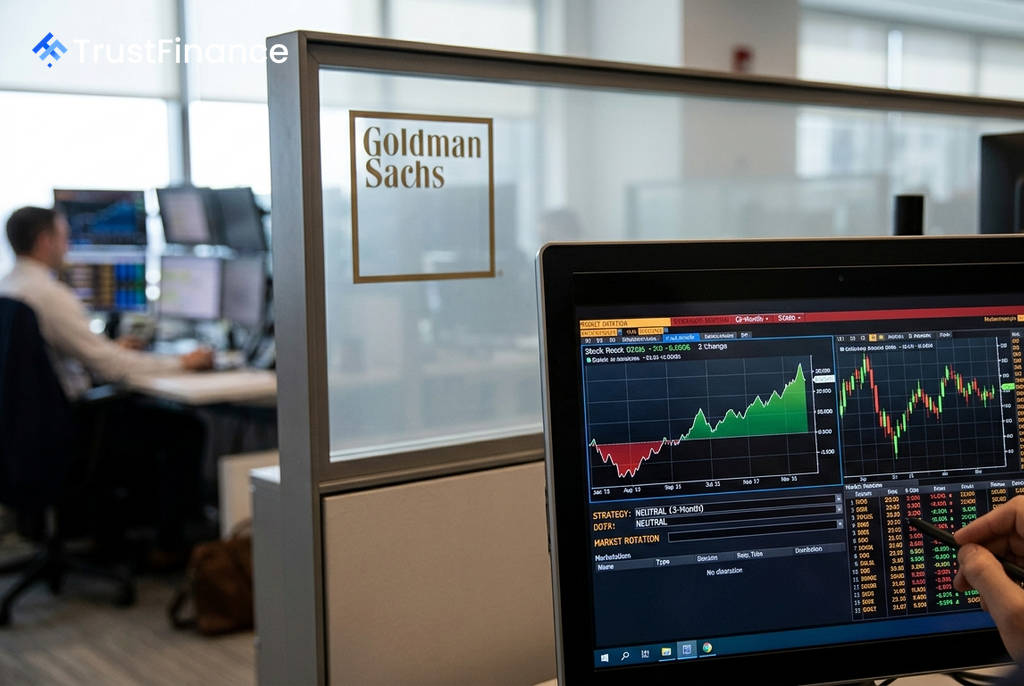
Goldman Sachs is maintaining a tactically neutral stance on markets for the next three months while remaining modestly pro-risk over a 12-month horizon, according to a Tuesday report. The investment bank cited a recent slowdown in the procyclical rotation across assets and shifting expectations for central bank policy following strong U.S. labor market data.
Rate Hike Expectations Intensify
The bank's assessment follows a U.S. labor market report that surpassed expectations, with nonfarm payrolls rising by 162,000 in August and the unemployment rate holding steady at 4.1%. According to Goldman Sachs, this data has increased market expectations for a September interest rate hike.
Investors are now closely watching this week's U.S. Producer Price Index (PPI) and Consumer Price Index (CPI) data for further inflation signals. Upcoming central bank decisions, including the European Central Bank (ECB) meeting, are also key events on the market's radar.
Shifting Leadership Across Asset Classes
While the procyclical rotation that favored growth-sensitive assets continued over the summer, its momentum has slowed. The report highlighted several key performance shifts:
 Ad
- Commodities: Led returns, particularly European gas and refined products. Grains also posted one of the largest cross-asset moves.
- Equities: Broad benchmarks remained relatively range-bound, but leadership shifted materially. Energy led returns, while Financials and Health Care were among the strongest non-energy sectors.
- Bonds: Global sovereign bonds sold off, with longer-dated yields approaching post-GFC highs, driven by strong nominal growth and fiscal concerns.
- Safe Havens: Gold, the Swiss franc (CHF), and Bitcoin rallied despite higher U.S. 10-year real yields.
Strategic Outlook and Volatility
Goldman Sachs noted that while the VIX remains relatively anchored, single-stock implied volatility has normalized after reaching a record peak relative to the market in mid-July. In this environment, the bank's report suggested combining global AI exposure with high-dividend and low-volatility styles.
Following the recent reset in volatility, the firm identified several hedging strategies as attractive. These include momentum collars, VIX call spreads, and put options on the EUR/CHF currency pair, as well as on the Financials, Energy, and Japanese TOPIX sectors, complemented by call options on South Korea's KOSPI index.
Read next
More on Stocks
FTC Orders Walmart, Uber, Delta to Disclose Data on Personalized Pricing
The U.S. Federal Trade Commission is demanding nine major companies, including leading retail, travel, and gig economy firms, to provide information on how they use consumer data for setting individual prices and wages.

Google Launches Gemini 4 Carbon AI Model to Bolster Cybersecurity Capabilities
Alphabet's Google has unveiled Gemini 4 Carbon, its latest AI model specifically designed for advanced cybersecurity tasks like vulnerability detection and secure code generation. The launch escalates competition with rivals OpenAI and Anthropic in the enterprise AI market.

Oracle Shares Surge After Unveiling $225 Billion Revenue Target for 2030
Oracle stock rose sharply after the company presented a long-term financial outlook targeting at least $225 billion in annual revenue by fiscal 2030, driven by its expanding AI infrastructure business.

DOJ Scrutinizes Nvidia's $12.9B Hugging Face Deal Amid Broader Antitrust Probe, Sources Say
The U.S. Department of Justice is reportedly examining Nvidia's planned $12.93 billion acquisition of AI platform Hugging Face as part of a wider, ongoing antitrust investigation into the chipmaker's market conduct.