
Story
Global Investors' Low Currency Hedging Exposes US Dollar to $230 Billion Sell-Off Risk
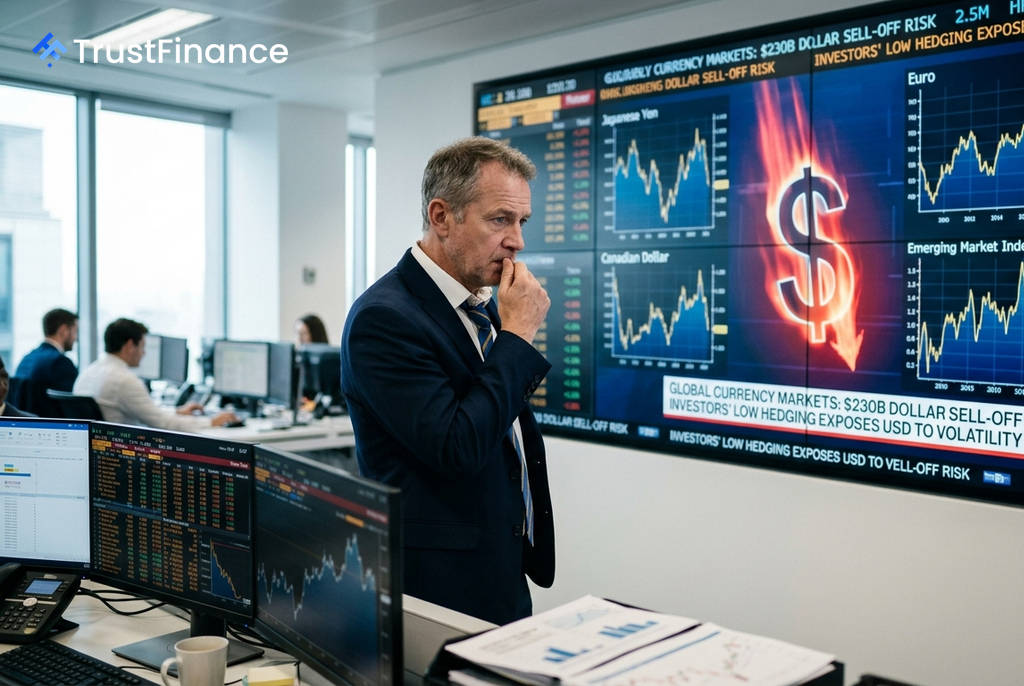
A sharp drop in currency hedging by global institutional investors has left the U.S. dollar vulnerable to a sudden and significant downturn. The dollar's traditional pillars of support—wide interest rate differentials and its safe-haven status—are weakening, shifting the market's focus toward U.S. policy and fiscal credibility.
A Historically Low Hedging Ratio
Analysis of institutional investors across six key markets, including Japan, Canada, and Taiwan, reveals a significant shift in currency risk management. As of June 30, these investors had hedged only 41% of their foreign currency exposure, the lowest level recorded since at least 2015.
This low level of hedging creates a substantial, latent selling pressure on the dollar. Based on the $4.6 trillion in foreign assets held by investors in these markets, a mere 5 percentage point increase in the hedging ratio would translate into approximately $230 billion in U.S. dollar sales through derivatives like forwards and swaps.
This doesn't imply an imminent sale of U.S. stocks or bonds. Rather, it signifies potential selling pressure on the dollar's exchange rate as institutions could move to protect the value of their U.S. assets in their home currencies without divesting from the assets themselves.
The Asymmetric Risk and Market Impact
The current low-hedging environment presents an asymmetric risk. While it is not actively depressing the dollar now, it has created conditions for a negative feedback loop. Should the dollar fail to appreciate during a period of market stress—a break from its typical safe-haven behavior—pension funds and insurance companies could rush to add hedges.
Such a move could trigger a cycle where an initial dollar decline prompts more hedging, which in turn pushes the dollar lower still. "Given the scale of foreign holdings of US assets, it doesn't take a dramatic change in positioning to have an impact on the market," said Laura Cooper, a macro credit director at Nuveen, which manages $1.4 trillion in assets.
 Ad
This dynamic could lead to a divergence between the performance of U.S. assets and the U.S. dollar, where demand for American stocks and bonds could remain strong even as the currency weakens under hedging pressure.
Weakening Pillars of Support
Two key factors that previously supported a low-hedging strategy are now reversing:
- Shrinking Interest Rate Differentials: The high cost of hedging, driven by the Federal Reserve's higher interest rates, is diminishing. For a yen-based investor, the three-month cost to hedge U.S. dollars has fallen from a high of 6% in October 2023 to 2.75%, a four-year low. For euro-based investors, the cost is down to 1.32%.
- Eroding Safe-Haven Status: Growing concerns over the U.S. fiscal deficit, Treasury Department actions to manage long-term bond yields, and questions about monetary policy independence are chipping away at the dollar's credibility as a reliable haven.
"If investors become less confident that the dollar will reliably rally in times of stress, they may become less willing to tolerate large, unhedged currency exposures," noted Nourdine Al-Hammoury, chief market strategist at Equiti Group.
Analysts at Wells Fargo expect the euro to be a primary beneficiary of any significant re-hedging activity, given the large unhedged U.S. equity holdings by European funds. Japan, as the largest foreign holder of U.S. Treasuries, is seen as a potential major catalyst for a widespread increase in hedging.
Read next
More on Forex
Polish Zloty Hits 11-Month Low Against Euro on Energy Price Pressure
The Polish zloty weakened to 4.410 against the euro, its lowest point since November 2023, as rising energy prices and caution ahead of a U.S. Federal Reserve decision weighed on the currency.

Sterling Slips as Dollar Strengthens Ahead of Fed Decision and UK Budget
The British pound lost ground against a resurgent U.S. dollar on Wednesday as market attention shifted from tech sector volatility to upcoming central bank decisions and the UK budget announcement.
Eurozone Bond Yields Climb as French Fiscal Concerns Return Ahead of Fed, ECB Decisions
Yields on French and German government bonds rose as relief from a ratings affirmation for France proved temporary, with investors refocusing on fiscal challenges and awaiting key policy verdicts from the U.S. Federal Reserve and the European Central Bank.

Canadian Dollar Slips as Markets Await Bank of Canada, Fed Decisions
The Canadian dollar edged lower against its U.S. counterpart, snapping a seven-day winning streak as investors adopted a cautious stance ahead of Wednesday's key interest rate announcements from both the Bank of Canada and the U.S. Federal Reserve.