
Story
Chinese Sportswear Brands See Growth While Manufacturers Face Pressure, GF Securities Reports
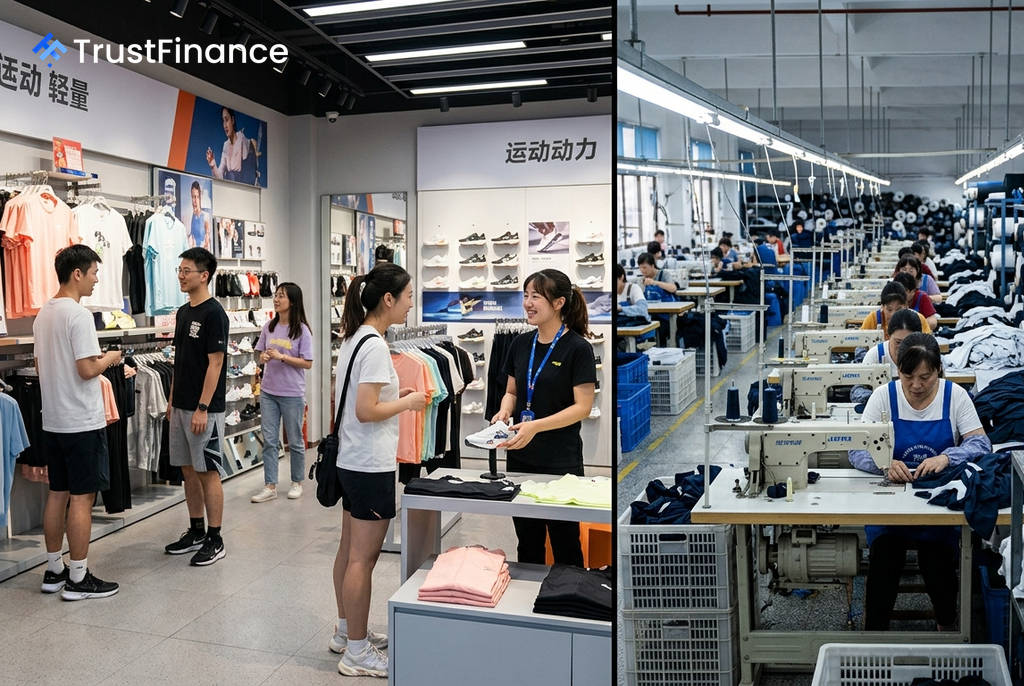
China's sportswear industry experienced a significant performance split in the first half of 2026, as downstream brand retailers achieved solid growth while upstream manufacturers faced considerable headwinds, according to a new research report from GF Securities.
A Tale of Two Sectors
Analysis of company financial statements for the first half of the year shows a clear divergence between the two segments of the sportswear supply chain. Brand retailers benefited from stable consumer demand, while contract manufacturers were hit by weaker overseas orders, raw material price volatility, and currency fluctuations.
GF Securities provided the following key metrics for H1 2026:
- Brand Retailers:
- Revenue: ¥80.66 billion, up 7.5% year-over-year.
- Net Profit: ¥13.29 billion, a 23.9% year-over-year increase.
- Gross Margin: 54.9%, an improvement of 1.2 percentage points.
- Upstream Manufacturers (OEMs):
- Revenue: ¥62.67 billion, down 9.5% year-over-year.
- Net Profit: ¥4.0 billion, a sharp 44.6% year-over-year decline.
- Gross Margin: 17.4%, a contraction of 3.9 percentage points.
Operational metrics also reflected these trends. Manufacturers saw inventory and accounts receivable turnover days increase to 72 and 66 days, respectively, indicating slower operations.
Outlook for the Second Half
 Ad
Looking ahead, GF Securities anticipates a potential recovery for both sectors in the latter half of 2026. For brand retailers, a low base of comparison from the prior year and major sporting events like the Aichi-Nagoya Asian Games in September are expected to provide a sales boost for leading domestic brands.
The firm projects that the manufacturing segment could see a rebound from its second-quarter performance. This is based on expectations of recovering external demand, stabilizing domestic orders, and a clearer U.S. tariff policy, which may encourage clients to resume normal order placements. Easing currency headwinds and a low comparative base from the previous year are also cited as potential positive factors.
Analyst Commentary
In the long term, GF Securities remains positive on the sportswear industry's large market potential. The report noted that leading companies in both retail and manufacturing possess strong competitive advantages in marketing, R&D, and production capacity that should support stable long-term growth.
However, the firm also highlighted several risks that could impact the industry, including a broader macroeconomic downturn, significant currency exchange rate volatility, and rising labor costs.
Read next
More on Stocks
FTC Orders Walmart, Uber, Delta to Disclose Data on Personalized Pricing
The U.S. Federal Trade Commission is demanding nine major companies, including leading retail, travel, and gig economy firms, to provide information on how they use consumer data for setting individual prices and wages.

Google Launches Gemini 4 Carbon AI Model to Bolster Cybersecurity Capabilities
Alphabet's Google has unveiled Gemini 4 Carbon, its latest AI model specifically designed for advanced cybersecurity tasks like vulnerability detection and secure code generation. The launch escalates competition with rivals OpenAI and Anthropic in the enterprise AI market.

Oracle Shares Surge After Unveiling $225 Billion Revenue Target for 2030
Oracle stock rose sharply after the company presented a long-term financial outlook targeting at least $225 billion in annual revenue by fiscal 2030, driven by its expanding AI infrastructure business.

DOJ Scrutinizes Nvidia's $12.9B Hugging Face Deal Amid Broader Antitrust Probe, Sources Say
The U.S. Department of Justice is reportedly examining Nvidia's planned $12.93 billion acquisition of AI platform Hugging Face as part of a wider, ongoing antitrust investigation into the chipmaker's market conduct.