
Story
Boeing Shares Tumble as 737 Production Delays Overshadow Long-Term Goals
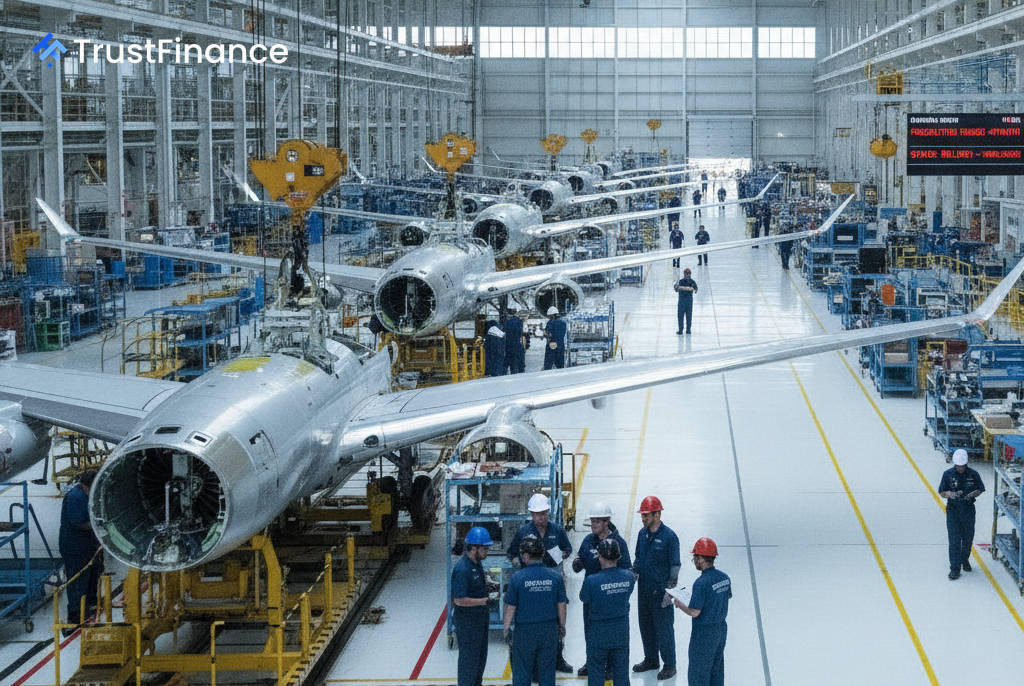
Boeing Co. (BA) shares fell sharply on October 27 after the aerospace giant reported third-quarter results that missed analyst expectations and announced a delay in its crucial 737 production ramp-up. The company's stock dropped over 9% to near its 52-week low following the news, as operational setbacks overshadowed the company's otherwise intact long-term financial outlook.
Production Setbacks and Earnings Miss
Boeing reported a third-quarter adjusted earnings per share of -$0.34 on revenue of $24.19 billion, falling short of consensus estimates that called for a loss of $0.24 per share on $24.39 billion in revenue. The negative market reaction was driven primarily by a revised production timeline for its best-selling 737 jet.
Management disclosed that output remains stalled at 47 aircraft per month due to instability in the wing production system. In an earnings call, Boeing's CEO stated that fixing the issue "is taking us longer than we had expected." Consequently, the planned production increase to 52 jets per month is now delayed until the second half of 2027, and the company confirmed it will miss its 2026 delivery target of 500 aircraft.
Long-Term Targets and Demand Remain Firm
Despite the near-term production hurdles, Boeing reaffirmed its long-term financial guidance. The company generated $464 million in positive free cash flow during the quarter and maintained its long-range plan to reach approximately $10 billion in annual free cash flow by 2029.
 Ad
Demand for Boeing's aircraft remains robust, a key positive for investors. The company's backlog grew to a record $745 billion, and it delivered 161 aircraft in the quarter, its highest since 2018. The defense division also provided a bright spot, with revenue increasing 15% to $7.9 billion.
Market Impact and Key Catalysts
Investors appeared to penalize the delay in execution rather than a change in the company's ultimate direction. The timeline slip extends the path to Boeing's financial recovery and prompted analysts to sharply cut earnings estimates, citing pressure on profit margins from supply chain costs and supplier disruptions.
Moving forward, market participants will be closely watching several key catalysts for signs of operational stability:
- 737 Production: Evidence that the wing-system issues are resolved and that a stable rate of 47 jets per month is achieved.
- Rate Ramps: Progress on increasing 787 production to 10 per month before the end of 2026.
- 777X Certification: The program's progress toward its first delivery, targeted for 2027.
- 2026 Guidance: Confirmation of the full-year free cash flow target of about $2 billion in the next earnings report.
Read next
More on Stocks
Helsinki Benchmark Slips as Wartsila, Neste Drag on Industrials and Energy
Finland's main stock index ended Tuesday's session with a minor loss, as significant declines in industrial firm Wartsila and refiner Neste offset gains in other major stocks.

Swedish Stocks Advance as OMX 30 Index Gains Nearly 1%
Sweden's benchmark OMX Stockholm 30 index closed higher on Tuesday, lifted by broad gains across the financial, industrial, and telecommunications sectors. The advance occurred even as global energy prices declined.

BEL 20 Hits 1-Month High, Lifted by Tech and Materials Stocks
Belgium's benchmark BEL 20 index gained 0.31% on Tuesday to reach a new one-month high, driven by strong performance in the technology and basic materials sectors, with Umicore leading the gains.
Honda Executive Calls Potential US Tariffs on Canadian Imports 'Catastrophic' for Auto Industry
A senior Honda executive warned that a pending January 1 increase in U.S. tariffs on Canadian steel and autos would be 'catastrophic,' urging negotiators to extend a key trade agreement.