
Story
Asset Managers, Exchanges Oppose SEC's Proposed 'Novel ETF' Label
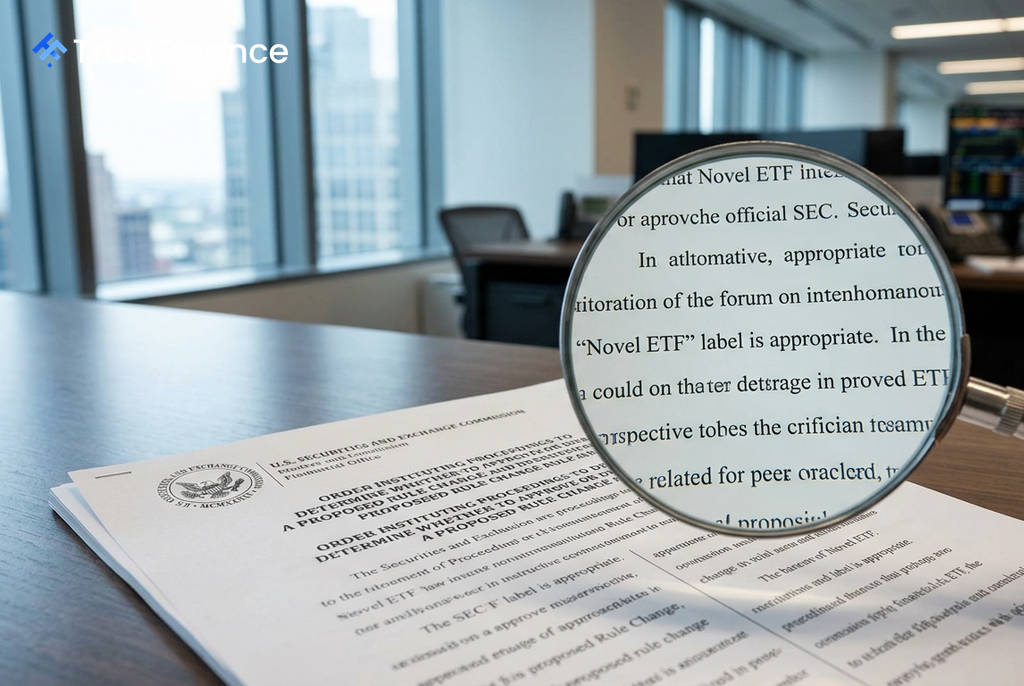
Asset managers, exchanges, and other market participants are raising significant concerns over a U.S. Securities and Exchange Commission (SEC) proposal to classify certain exchange-traded funds as "novel ETFs." In a series of comment letters filed with the regulator, firms argued the label is poorly defined and could disrupt the fund launch process, according to a Reuters review.
An 'Obsolete on Arrival' Definition
The central argument from the industry is that the term "novel" is too ambiguous and subjective to be a useful regulatory category. Opponents fear that a broad, ill-defined label would create uncertainty and could penalize financial innovation.
"We believe that ’Novel ETFs’ cannot be effectively defined," wrote Angela Brickl, chief operating officer and general counsel of Rafferty Asset Management, which operates the Direxion ETF brand. In the firm's submission, she argued that a definition based on today's new asset classes would be "obsolete on arrival" as future innovations would fall outside of it.
This sentiment was echoed by others, including Mike Khouw, a strategist at YieldMax, which uses complex options strategies in its funds. While YieldMax did not file a letter, Khouw stated that "lumping together all of these products is painting with too broad a brush."
Risk to Market Growth
 Ad
A key concern for the industry is the potential disruption to the current fund approval framework. Most new ETFs can currently launch automatically 75 days after filing, a process that has facilitated the expansion of the $12 trillion U.S. ETF market.
Issuers and exchanges warned the SEC that creating a separate, potentially more arduous approval track for "novel" funds could jeopardize this growth. In his letter, Jeffrey Davis, senior vice president of Nasdaq, acknowledged that some recent ETF filings have "tested the boundaries" of current rules. However, he urged the SEC to focus on "structural characteristics that meaningfully affect investor protection and market integrity" rather than creating broad asset-class labels.
Prediction Market Funds Spark Debate
The SEC's review was prompted by several asset managers attempting to launch ETFs tied to prediction markets. These products have drawn divergent opinions on how they should be regulated.
Douglas Crescenzi of Adjacent Markets, which builds indexes tied to such event contracts, argued they should be treated like any other ETF. In contrast, Ben Schiffrin of the advocacy group Better Markets contended there was "no reason for the SEC to treat these funds as equivalent to ETFs that invest in securities."
Read next
More on Stocks
FTC Orders Walmart, Uber, Delta to Disclose Data on Personalized Pricing
The U.S. Federal Trade Commission is demanding nine major companies, including leading retail, travel, and gig economy firms, to provide information on how they use consumer data for setting individual prices and wages.

Google Launches Gemini 4 Carbon AI Model to Bolster Cybersecurity Capabilities
Alphabet's Google has unveiled Gemini 4 Carbon, its latest AI model specifically designed for advanced cybersecurity tasks like vulnerability detection and secure code generation. The launch escalates competition with rivals OpenAI and Anthropic in the enterprise AI market.

Oracle Shares Surge After Unveiling $225 Billion Revenue Target for 2030
Oracle stock rose sharply after the company presented a long-term financial outlook targeting at least $225 billion in annual revenue by fiscal 2030, driven by its expanding AI infrastructure business.

DOJ Scrutinizes Nvidia's $12.9B Hugging Face Deal Amid Broader Antitrust Probe, Sources Say
The U.S. Department of Justice is reportedly examining Nvidia's planned $12.93 billion acquisition of AI platform Hugging Face as part of a wider, ongoing antitrust investigation into the chipmaker's market conduct.