
Story
US 30-Year Treasury Yield Holds Near 19-Year High as Investors Weigh Competing Forces
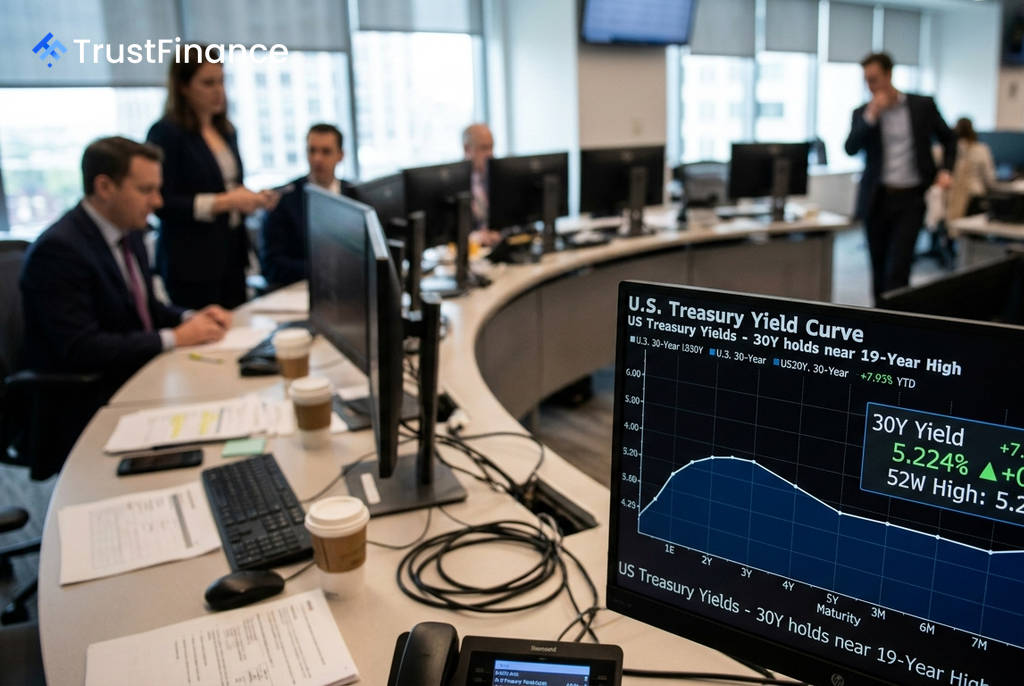
The U.S. 30-year Treasury yield is holding near a two-decade peak, settling at 5.224% after touching a 52-week high of 5.281% last week. This level, not seen since before the 2008 financial crisis, has created a sharp divide between bullish and bearish outlooks for the long end of the bond market.
The Bull Case: Attractive Long-Term Yields
For investors with a long-term horizon, the current nominal yield presents a compelling proposition. At over 5.2%, the 30-year bond offers a return that compares favorably to the typical S&P 500 earnings yield and significantly outpaces average dividend yields.
Furthermore, the yield provides a term premium of approximately 150 basis points over the upper end of the Federal Reserve's current benchmark rate of 3.50%–3.75%. For institutions like pension funds and insurance companies, this offers a chance to lock in substantial income streams for decades, with the potential for significant price appreciation if interest rates eventually decline.
The Bear Case: Inflation and Fiscal Headwinds
However, significant risks temper the bullish outlook. With the Fed's preferred inflation gauge, the Personal Consumption Expenditures (PCE) index, running at 3.7% year-over-year as of June, the real yield is a more modest 1.5%. This return may be insufficient for a 30-year commitment if inflation proves persistent.
 Ad
Analysts at Wolfe Research have pointed to a challenging fiscal backdrop, with federal debt near 100% of GDP and deficits exceeding 6% even during an economic expansion. This structural pressure may require increased bond issuance, potentially pushing yields higher. The Treasury's upcoming Quarterly Refunding Announcement (QRA) on August 5 will be a key event for gauging future supply. Adding to concerns, the cost to insure against a U.S. default, measured by the 30-year credit default swap, has risen 21.3% year-to-date.
The Japan Factor
A crucial and often underappreciated dynamic is Japan's influence on the U.S. Treasury market. As the largest foreign holder of U.S. debt with approximately $1.1 trillion in Treasuries, Japan's policy decisions have a direct impact.
A weakening yen can pressure Japanese authorities to sell U.S. Treasuries to fund currency interventions, placing upward pressure on U.S. yields. While a recent joint intervention by the U.S. and Japan stabilized the yen, the risk remains. Simultaneously, as the Bank of Japan raises its own interest rates, currently at 1%, Japanese investors may be incentivized to repatriate capital, a process that could involve further selling of U.S. bonds.
Read next
More on Stocks
FTC Orders Walmart, Uber, Delta to Disclose Data on Personalized Pricing
The U.S. Federal Trade Commission is demanding nine major companies, including leading retail, travel, and gig economy firms, to provide information on how they use consumer data for setting individual prices and wages.

Google Launches Gemini 4 Carbon AI Model to Bolster Cybersecurity Capabilities
Alphabet's Google has unveiled Gemini 4 Carbon, its latest AI model specifically designed for advanced cybersecurity tasks like vulnerability detection and secure code generation. The launch escalates competition with rivals OpenAI and Anthropic in the enterprise AI market.

Oracle Shares Surge After Unveiling $225 Billion Revenue Target for 2030
Oracle stock rose sharply after the company presented a long-term financial outlook targeting at least $225 billion in annual revenue by fiscal 2030, driven by its expanding AI infrastructure business.

DOJ Scrutinizes Nvidia's $12.9B Hugging Face Deal Amid Broader Antitrust Probe, Sources Say
The U.S. Department of Justice is reportedly examining Nvidia's planned $12.93 billion acquisition of AI platform Hugging Face as part of a wider, ongoing antitrust investigation into the chipmaker's market conduct.