
Story
Tesla-SpaceX Merger Talk Heats Up After Musk Cites 'Growing Overlap'
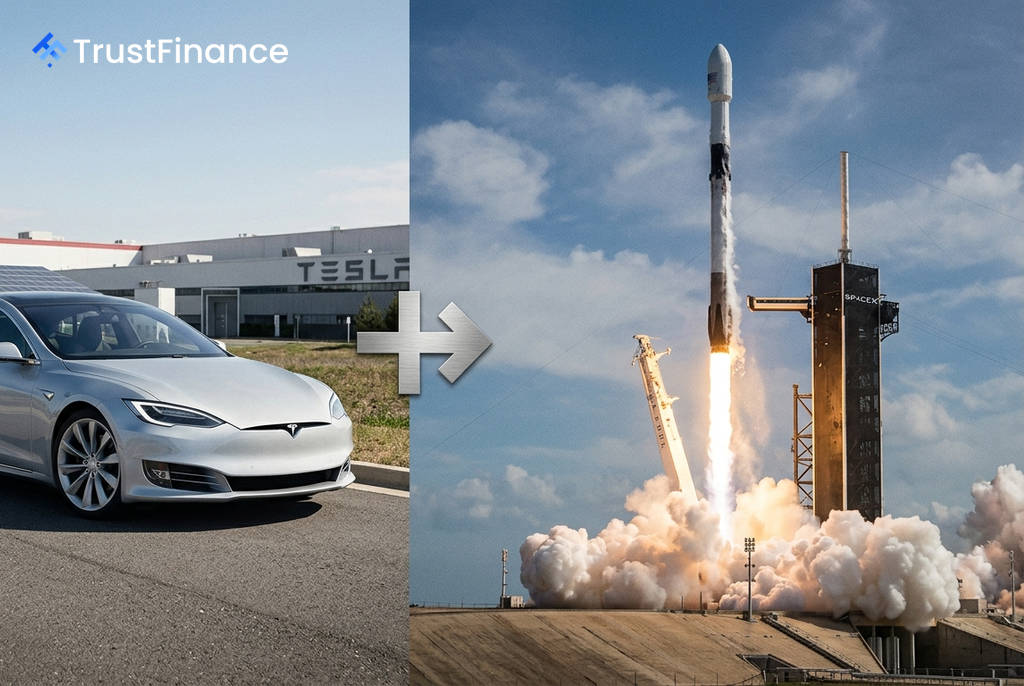
Speculation over a potential merger between Tesla and SpaceX is intensifying after CEO Elon Musk acknowledged a "growing overlap" between the two companies, with some analysts now viewing a combination as inevitable.
On Tesla's July 22, 2026, earnings call, Musk declined to dismiss the possibility of a merger, citing increased collaboration and stating that any such deal would need to go through the "appropriate process." Following his remarks, analysts have raised the odds of a deal, with Gene Munster reportedly putting the probability at 90%. According to Investing.com, analysts at Stifel believe investors see the combination as a matter of when, not if.
The Valuation Calculus
The renewed discussion has also focused on the financial mechanics of a potential all-stock transaction, particularly in light of Tesla's recent performance. The company's stock fell 14.52% after reporting second-quarter results that missed expectations, including a 34% miss on earnings per share and negative free cash flow of -$1.09 billion.
Some market observers theorize that a lower Tesla share price could be advantageous for a merger. The logic centers on the exchange ratio in an all-stock deal:
- A lower Tesla (TSLA) valuation would mean SpaceX shareholders receive a greater number of Tesla shares.
- Musk holds an estimated 82% of the voting power in SpaceX, a significantly larger stake than he holds in Tesla, meaning a merger could consolidate his control under a single public entity.
 Ad
Operational and Structural Hurdles
Despite the strategic rationale, any potential merger faces significant challenges. The companies are already collaborating on projects like "Terafab," a joint semiconductor facility for AI chips, and Tesla supplies battery technology to SpaceX, suggesting some synergies are being realized without a formal merger.
Key obstacles to a deal include:
- Regulatory Scrutiny: SpaceX’s deep ties to the U.S. government could create national security concerns for regulators in China, a critical market for Tesla.
- Governance: Combining the two entities would require reconciling different governance structures and would significantly alter Musk's voting power.
- Shareholder Approval: The deal would require approval from Tesla's minority shareholders and would likely face legal challenges over fiduciary duty.
- Market Pressure: An upcoming lockup expiry on August 6 could allow for the sale of approximately 911.5 million SpaceX shares, potentially impacting its valuation.
Both companies' stocks are currently under pressure. According to the report, Tesla recently traded at $309.24, while SpaceX's stock sat 16% below its IPO price. While the path to a merger is complex, Musk's recent comments have firmly established the possibility as a key narrative for investors in both companies.
Read next
More on Stocks
FTC Orders Walmart, Uber, Delta to Disclose Data on Personalized Pricing
The U.S. Federal Trade Commission is demanding nine major companies, including leading retail, travel, and gig economy firms, to provide information on how they use consumer data for setting individual prices and wages.

Google Launches Gemini 4 Carbon AI Model to Bolster Cybersecurity Capabilities
Alphabet's Google has unveiled Gemini 4 Carbon, its latest AI model specifically designed for advanced cybersecurity tasks like vulnerability detection and secure code generation. The launch escalates competition with rivals OpenAI and Anthropic in the enterprise AI market.

Oracle Shares Surge After Unveiling $225 Billion Revenue Target for 2030
Oracle stock rose sharply after the company presented a long-term financial outlook targeting at least $225 billion in annual revenue by fiscal 2030, driven by its expanding AI infrastructure business.

DOJ Scrutinizes Nvidia's $12.9B Hugging Face Deal Amid Broader Antitrust Probe, Sources Say
The U.S. Department of Justice is reportedly examining Nvidia's planned $12.93 billion acquisition of AI platform Hugging Face as part of a wider, ongoing antitrust investigation into the chipmaker's market conduct.