
Story
SpaceX Valuation Hinges on Four Key Hurdles, Bernstein Says
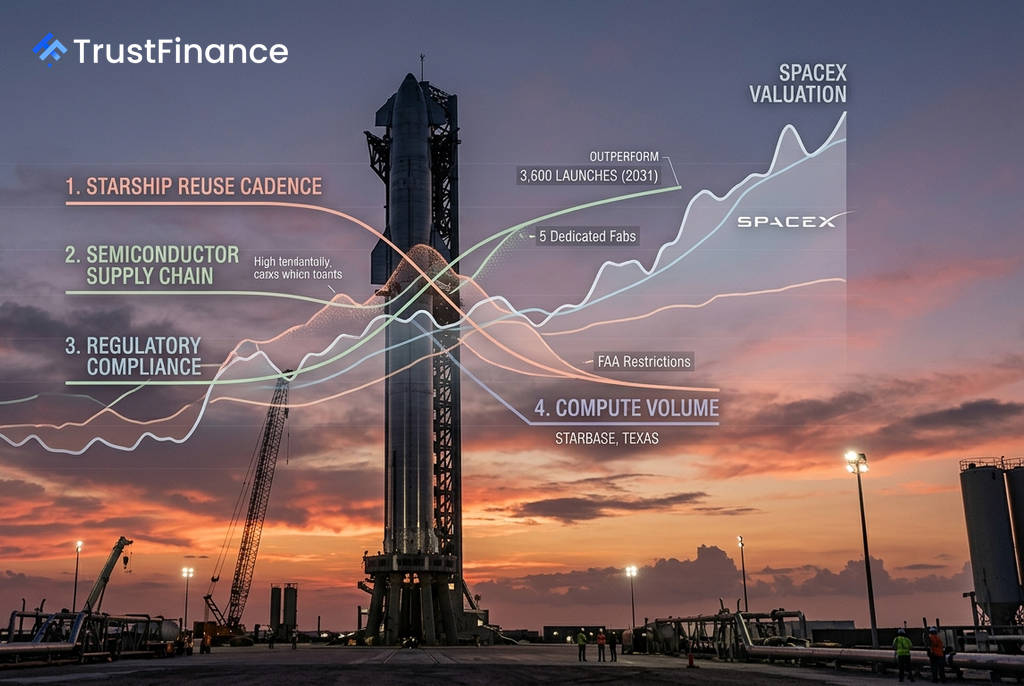
Analysts at Bernstein have identified four pivotal factors that will be central to the valuation of SpaceX, highlighting them in a recent research note. The firm, which recently initiated coverage on the company with an Outperform rating and a $239 price target, emphasized that achieving rapid and full reusability of its Starship rocket is the single most important driver for its investment thesis.
The Reusability Challenge
The core of Bernstein's valuation model rests on SpaceX's ability to make both stages of its Starship rocket fully and rapidly reusable. The firm's projections call for an ambitious 3,600 launches in the year 2031, a cadence that analysts say is impossible without mastering this technology.
While Bernstein acknowledges progress, such as successful landings of Starship V2 boosters, it notes that key milestones remain. The success of this high-frequency launch model also depends on expanding infrastructure beyond the current two launchpads, with negotiations reportedly underway for several more locations.
Supply Chain and Compute Constraints
Beyond launch technology, securing a massive supply chain for critical components presents a significant hurdle. To meet its 2031 satellite deployment goals, Bernstein estimates SpaceX will need approximately five dedicated semiconductor fabrication plants, an endeavor that could cost over ~$160 billion and take years to build.
 Ad
Similarly, the firm's vision for an orbital data center program depends on acquiring an immense volume of computing power. Analysts noted that while long-term ambitions are high, current plans are more modest, and securing the necessary compute capacity amid surging demand from the AI industry will be a major challenge.
Navigating the Regulatory Landscape
Finally, the path to thousands of annual launches is fraught with regulatory complexities. SpaceX has not yet received clearance for an orbital Starship flight, and while the FAA has signaled a willingness to facilitate a higher launch cadence, Bernstein warns that this could change, especially under a less supportive political administration.
Analysts also pointed out that regulatory considerations will extend globally, particularly as the company expands its telecommunications services, requiring approvals from numerous international bodies.
Read next
More on Stocks
FTC Orders Walmart, Uber, Delta to Disclose Data on Personalized Pricing
The U.S. Federal Trade Commission is demanding nine major companies, including leading retail, travel, and gig economy firms, to provide information on how they use consumer data for setting individual prices and wages.

Google Launches Gemini 4 Carbon AI Model to Bolster Cybersecurity Capabilities
Alphabet's Google has unveiled Gemini 4 Carbon, its latest AI model specifically designed for advanced cybersecurity tasks like vulnerability detection and secure code generation. The launch escalates competition with rivals OpenAI and Anthropic in the enterprise AI market.

Oracle Shares Surge After Unveiling $225 Billion Revenue Target for 2030
Oracle stock rose sharply after the company presented a long-term financial outlook targeting at least $225 billion in annual revenue by fiscal 2030, driven by its expanding AI infrastructure business.

DOJ Scrutinizes Nvidia's $12.9B Hugging Face Deal Amid Broader Antitrust Probe, Sources Say
The U.S. Department of Justice is reportedly examining Nvidia's planned $12.93 billion acquisition of AI platform Hugging Face as part of a wider, ongoing antitrust investigation into the chipmaker's market conduct.