
Story
SpaceX Post-IPO Tumble Serves as Cautionary Tale for OpenAI, Anthropic Debuts
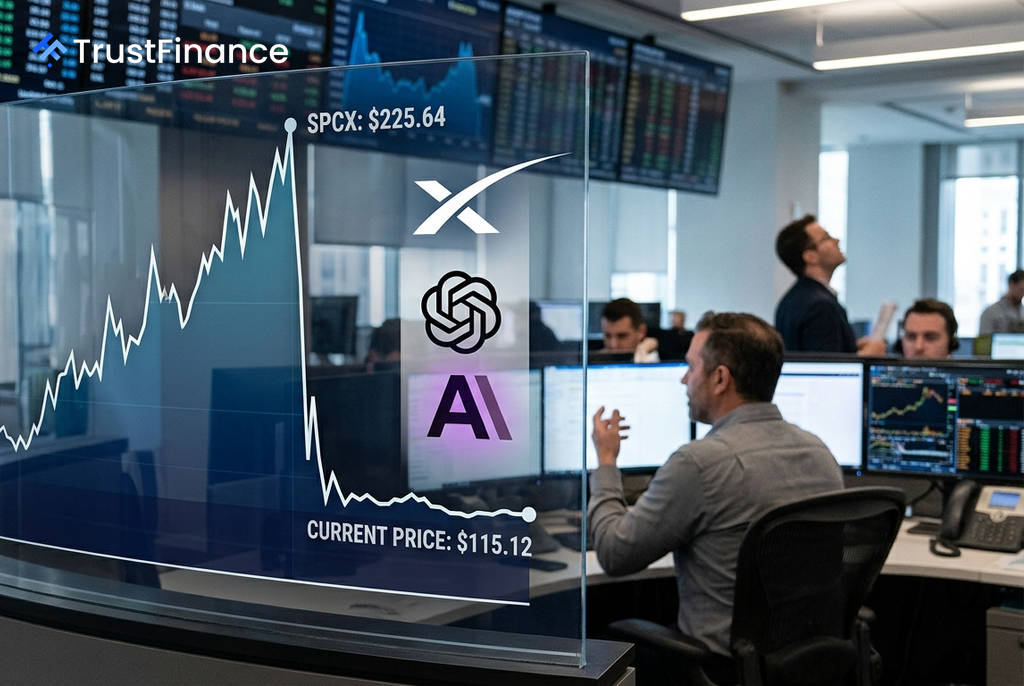
SpaceX's (SPCX) historic initial public offering has provided a stark stress test for equity markets, with its share price collapsing nearly 50% from its peak just weeks after raising a record $85.7 billion. The dramatic reversal offers a crucial lesson for investors as they anticipate even larger public debuts from artificial intelligence giants OpenAI and Anthropic, which could trigger an unprecedented capital rotation.
The SpaceX Case Study
SpaceX's IPO on June 11, 2026, was the largest in Nasdaq history, accounting for 59% of all U.S. IPO capital raised in the first half of the year. After debuting at $135 per share, the stock surged to an intraday peak of $225.64 before falling to $115.12, or 14.7% below its offering price, according to an Investing.com analysis.
The swift downturn has been accompanied by significant bearish sentiment. Short interest has climbed to 31% of the public float, indicating that sophisticated investors are betting against the stock. A major test looms with the first major lock-up expiration on August 6, 2026, which could release up to 911.5 million additional shares into the market.
A Larger Rotation Looms
The sheer scale of the SpaceX offering drew enormous capital out of other assets, and the potential IPOs of OpenAI and Anthropic could dwarf its impact. With private valuations reportedly exceeding $852 billion for OpenAI and $965 billion for Anthropic, their public offerings could require tens or even hundreds of billions in new investment.
 Ad
Evidence of this capital shift is already visible in private markets. Strategic investors like Amazon have poured billions into these AI leaders, with one report citing a $28.7 billion investment in OpenAI's Series C and $11.3 billion into Anthropic in the first half of 2026 alone. This suggests institutional players are already positioning themselves for the public debuts.
Potential Winners and Losers
An influx of pure-play AI stocks could force a re-evaluation of the market, creating clear winners and losers. The most exposed sectors include:
- High-multiple AI-adjacent stocks: Software and SaaS companies with AI features may see their valuation premiums compress as investors rotate into the core AI model developers.
- Potential beneficiaries: Companies providing essential AI infrastructure are likely to benefit regardless of which AI model wins. This includes firms in power generation (Constellation Energy, Oklo), data center infrastructure (Vertiv, Eaton), and semiconductors (TSMC, Arm).
However, the SpaceX fallout highlights several headwinds for upcoming AI IPOs. Investors will be wary of post-IPO lock-up cliffs, uncertain revenue models amid high capital expenditures, and the significant regulatory and security risks unique to the AI industry—factors that were less pronounced for SpaceX.
Read next
More on Stocks
FTC Orders Walmart, Uber, Delta to Disclose Data on Personalized Pricing
The U.S. Federal Trade Commission is demanding nine major companies, including leading retail, travel, and gig economy firms, to provide information on how they use consumer data for setting individual prices and wages.

Google Launches Gemini 4 Carbon AI Model to Bolster Cybersecurity Capabilities
Alphabet's Google has unveiled Gemini 4 Carbon, its latest AI model specifically designed for advanced cybersecurity tasks like vulnerability detection and secure code generation. The launch escalates competition with rivals OpenAI and Anthropic in the enterprise AI market.

Oracle Shares Surge After Unveiling $225 Billion Revenue Target for 2030
Oracle stock rose sharply after the company presented a long-term financial outlook targeting at least $225 billion in annual revenue by fiscal 2030, driven by its expanding AI infrastructure business.

DOJ Scrutinizes Nvidia's $12.9B Hugging Face Deal Amid Broader Antitrust Probe, Sources Say
The U.S. Department of Justice is reportedly examining Nvidia's planned $12.93 billion acquisition of AI platform Hugging Face as part of a wider, ongoing antitrust investigation into the chipmaker's market conduct.