
Story
Global Investors Reassess South Korean Stocks After Leverage-Driven Sell-Off
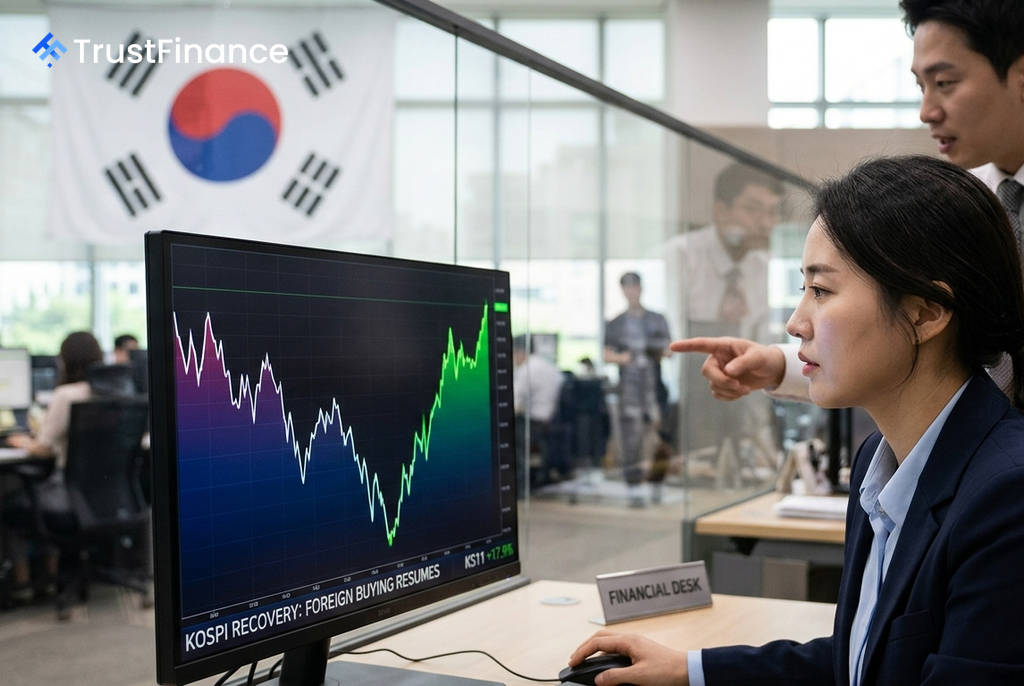
A dramatic deleveraging event in South Korea that rocked local markets in July is now being viewed by some global investors as a potential buying opportunity, driven by the belief that the forced selling is largely complete and the fundamentals of key technology firms remain strong.
A Market Unwound by Leverage
The recent turmoil was amplified by leveraged investment products, which contributed to a roughly 40% drawdown from a peak in June. According to research from J.P. Morgan, assets in leveraged exchange-traded funds (ETFs) tied to Korean giants Samsung Electronics and SK Hynix collapsed from $50 billion in late June to $17 billion last week.
This deleveraging created extreme volatility but also set the stage for a sharp reversal. In a sign of shifting sentiment, foreign investors turned net buyers on a recent Friday, purchasing a record 7.2 trillion won ($5 billion) worth of stock, more than double the previous one-day high, according to the source report.
Fundamentals vs. Technicals
Several market participants contend the sell-off was a technical event disconnected from corporate performance. Steve Lawrence, chief investment officer of Balfour Capital Group, described it as a "leverage event, not an earnings event," noting that the memory cycle and AI capital expenditure story remain intact.
This view is supported by the performance of market heavyweights. Samsung Electronics shares nearly halved from their June peak to their July trough, despite the company reporting a massive increase in chip profits and a solid outlook. J.P. Morgan analysts led by Rajiv Batra stated they believe "the leveraged ETF unwind is complete and hedge funds are ~90% through deleveraging."
 Ad
The Fallout from Volatility
The introduction of single-stock leveraged ETFs in May has been identified as a key catalyst for the market's wild swings. The extreme moves led to significant retail investor losses, estimated by Citi's trading strategies desk at around $38.7 billion, and prompted a public apology from South Korea’s Finance Minister Koo Yun-cheol.
William Brattan, head of cash equity research for APAC at BNP Paribas, noted that long-only investors are often hesitant to hold positions in stocks moving so violently. Pierre Hoebrechts, deputy CIO at East Eagle Asset Management, called the combination of high retail participation, local leverage, and concentrated ETF exposure "an accident waiting to happen."
A Cautious Look Forward
While risks remain, and the KOSPI's record-breaking 17.9% surge on Friday was followed by a sharp drop the next Monday, signs suggest the most intense selling pressure may have subsided. Data from S3 Partners shows that average short interest in South Korea has declined from a recent peak.
Some institutional investors who remained on the sidelines may now be reconsidering the market. Larry Hatheway, head of research at Franklin Templeton Institute, suggested that U.S. institutional investors "may be willing to take another look at some of these (Korean) names now."
Read next
More on Stocks
FTC Orders Walmart, Uber, Delta to Disclose Data on Personalized Pricing
The U.S. Federal Trade Commission is demanding nine major companies, including leading retail, travel, and gig economy firms, to provide information on how they use consumer data for setting individual prices and wages.

Google Launches Gemini 4 Carbon AI Model to Bolster Cybersecurity Capabilities
Alphabet's Google has unveiled Gemini 4 Carbon, its latest AI model specifically designed for advanced cybersecurity tasks like vulnerability detection and secure code generation. The launch escalates competition with rivals OpenAI and Anthropic in the enterprise AI market.

Oracle Shares Surge After Unveiling $225 Billion Revenue Target for 2030
Oracle stock rose sharply after the company presented a long-term financial outlook targeting at least $225 billion in annual revenue by fiscal 2030, driven by its expanding AI infrastructure business.

DOJ Scrutinizes Nvidia's $12.9B Hugging Face Deal Amid Broader Antitrust Probe, Sources Say
The U.S. Department of Justice is reportedly examining Nvidia's planned $12.93 billion acquisition of AI platform Hugging Face as part of a wider, ongoing antitrust investigation into the chipmaker's market conduct.