
Story
FCC Considers Ban on Chinese Optical Transceivers, Cloud Supply Chain Faces Uncertainty
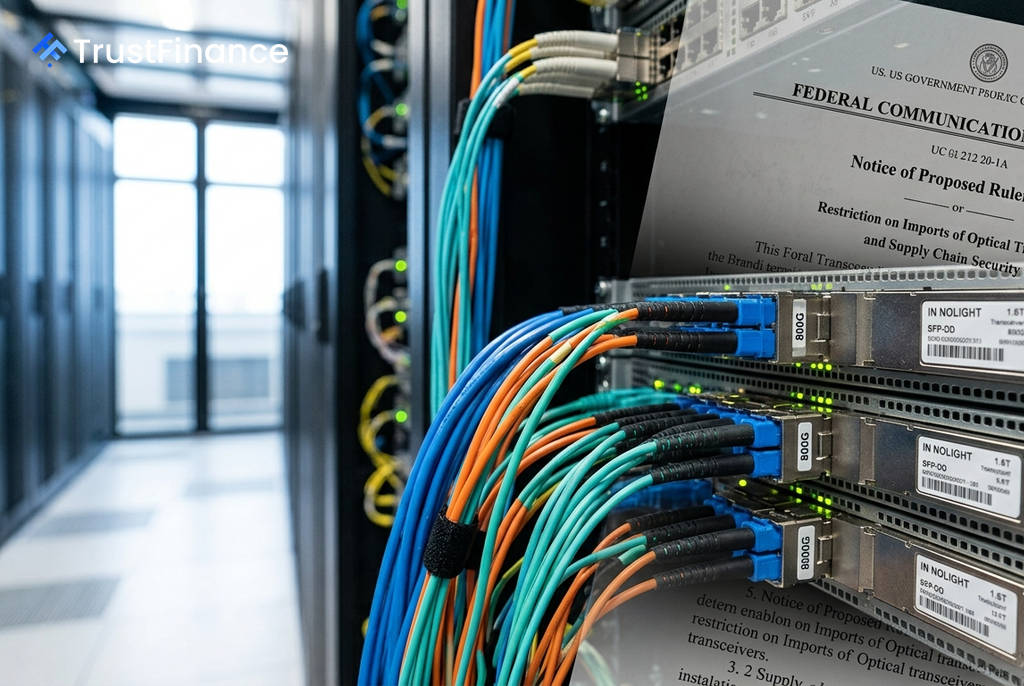
The U.S. Federal Communications Commission (FCC) is developing measures to block imports of new Chinese optical transceivers, a move that could disrupt the supply chain for critical datacenter components. However, significant uncertainty over the potential rules' scope and definitions makes it premature to assess the precise market impact, according to a Bank of America analysis.
Regulatory Fog Persists
Reuters reported that the FCC is actively working on the new rules, with a target for publication within 2026. Still, BofA notes the measures are fluid and could be modified or withdrawn. The core uncertainty hinges on two key questions:
- Company Domicile vs. Manufacturing Location: It is unclear if the restrictions would target products from Chinese-owned companies regardless of where they are made (e.g., a factory in Thailand) or only products manufactured within China.
- Scope of Existing Products: The rules could apply only to future product generations or retroactively to currently shipping 800G and 1.6T transceivers, a distinction with vastly different implications for existing infrastructure.
China's Dominant Grip on Supply
The structural reality of the market complicates any attempt at rapid decoupling. Non-U.S. vendors, the vast majority of which are Chinese manufacturers like Innolight and Eoptolink, account for over 70% of the global optical transceiver supply.
In anticipation of potential restrictions, leading Chinese suppliers have already been shifting production. Since 2024, many have expanded capacity into Southeast Asian countries like Thailand and Malaysia specifically to serve U.S. demand. BofA channel checks suggest that as of 2025, these non-China facilities are capable of satisfying U.S. demand, potentially blunting the effectiveness of a location-based ban.
 Ad
Risk to Next-Generation Datacenters
A broad import ban could extend beyond current supply chains and delay the deployment of future technology crucial for the AI buildout. U.S. cloud service providers are actively collaborating with Chinese vendors on next-generation solutions, including 2.4T and 3.2T transceivers and other advanced interconnects.
Disrupting these co-development partnerships risks slowing the pace of innovation and deployment for the next wave of datacenter architectures at a time of accelerating AI infrastructure investment.
Market Perspective
Analysts note that the national security rationale for restricting optical transceivers—which convert signals but do not process or store data—is narrower than for semiconductors. The primary concern is the high concentration of supply in China.
Given the lack of comparable domestic capacity at scale, near-term substitution by U.S. vendors is not considered feasible. For now, BofA views the situation as an evolving tail risk for investors in the AI and datacenter sectors, rather than an imminent supply shock. The risk would escalate significantly only if the FCC's final rules target companies based on their country of origin and apply retroactively to products already in the market.
Read next
More on Stocks
FTC Orders Walmart, Uber, Delta to Disclose Data on Personalized Pricing
The U.S. Federal Trade Commission is demanding nine major companies, including leading retail, travel, and gig economy firms, to provide information on how they use consumer data for setting individual prices and wages.

Google Launches Gemini 4 Carbon AI Model to Bolster Cybersecurity Capabilities
Alphabet's Google has unveiled Gemini 4 Carbon, its latest AI model specifically designed for advanced cybersecurity tasks like vulnerability detection and secure code generation. The launch escalates competition with rivals OpenAI and Anthropic in the enterprise AI market.

Oracle Shares Surge After Unveiling $225 Billion Revenue Target for 2030
Oracle stock rose sharply after the company presented a long-term financial outlook targeting at least $225 billion in annual revenue by fiscal 2030, driven by its expanding AI infrastructure business.

DOJ Scrutinizes Nvidia's $12.9B Hugging Face Deal Amid Broader Antitrust Probe, Sources Say
The U.S. Department of Justice is reportedly examining Nvidia's planned $12.93 billion acquisition of AI platform Hugging Face as part of a wider, ongoing antitrust investigation into the chipmaker's market conduct.