
Story
Eli Lilly Posts Strong Revenue Growth While Novo Nordisk Beats on Profit in Q2 GLP-1 Battle
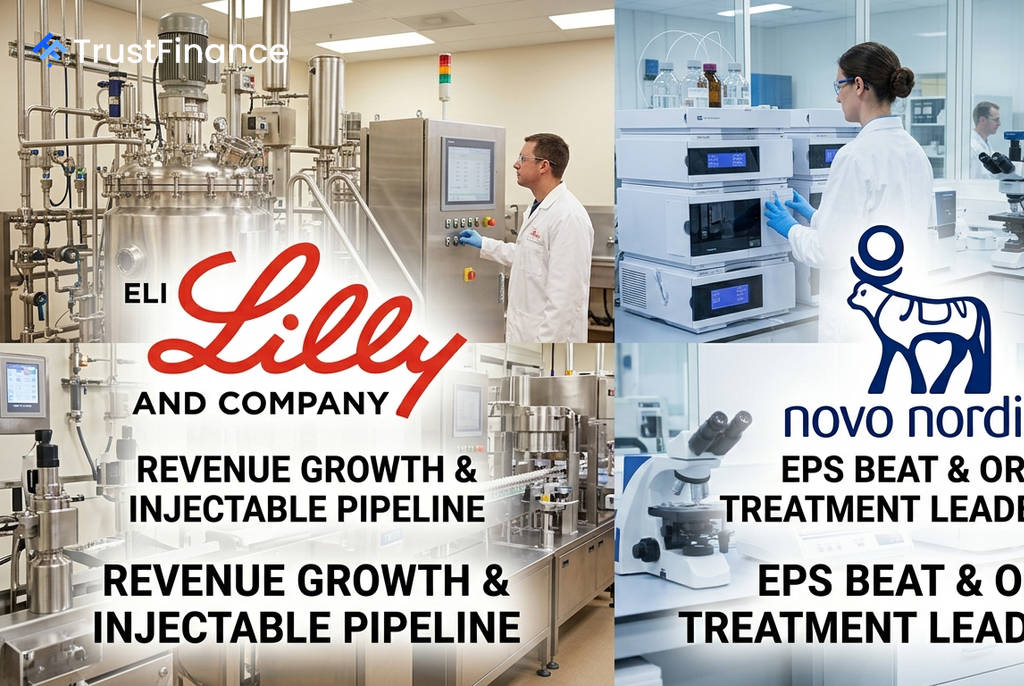
Eli Lilly and Novo Nordisk, the two dominant players in the lucrative market for GLP-1 obesity and diabetes drugs, reported second-quarter 2026 earnings that underscored their different strategic positions. Eli Lilly announced massive revenue growth fueled by its injectable treatments, while Novo Nordisk surprised with a significant profit beat and raised its financial guidance for the year.
Second-Quarter Performance Diverges
Eli Lilly reported quarterly revenue of $22.97 billion, a 48% year-over-year increase that surpassed analyst estimates by 11.7%, according to an August 5 report. However, the company missed earnings per share (EPS) estimates by 5.2%, a result attributed to increased research and development charges. Despite the earnings miss, Lilly raised its full-year revenue guidance to a range of $85 billion to $87 billion.
In contrast, Novo Nordisk posted quarterly revenue of $12.1 billion, beating expectations by 10.6%. The company delivered a substantial 21.9% beat on EPS and also raised its full-year outlook. The results signal a potential comeback for the Danish drugmaker, which faced multiple guidance cuts in 2025.
The GLP-1 Market Battleground
The fierce competition in the obesity drug market was evident in the product-level results. Lilly's growth was overwhelmingly driven by its GLP-1 drugs, with Mounjaro and Zepbound collectively generating $14.9 billion in quarterly revenue. In the U.S., weekly prescriptions for its injectable Zepbound are currently more than double those of Novo's competing drug, Wegovy.
 Ad
Novo Nordisk is finding success with its oral version of Wegovy, which has achieved a record launch with over 5 million U.S. prescriptions. This positions Novo ahead in the oral format, as Lilly's oral drug, Foundayo, has shown lower efficacy in trials. However, Lilly's pipeline appears strong, with its next-generation drug, retatrutide, showing 22.6% weight loss in Phase 3 trials and an expected FDA filing in the first quarter of 2027.
Contrasting Valuations and Investor Outlook
The earnings reports present investors with two distinct profiles. Eli Lilly stands as the high-growth market leader, but with a valuation to match. The company trades at a lofty 40.3x trailing price-to-earnings (P/E) ratio and has a market capitalization approaching $1 trillion.
Novo Nordisk offers a more value-oriented case. Its stock trades at a much lower 11.2x trailing P/E ratio, and its balance sheet is less leveraged. While the company faces challenges, including a 22% decline in U.S. revenue for its injectable Wegovy at constant exchange rates, its strong performance with oral Wegovy and significant undervaluation by some models present a contrarian opportunity for investors.
Read next
More on Stocks
FTC Orders Walmart, Uber, Delta to Disclose Data on Personalized Pricing
The U.S. Federal Trade Commission is demanding nine major companies, including leading retail, travel, and gig economy firms, to provide information on how they use consumer data for setting individual prices and wages.

Google Launches Gemini 4 Carbon AI Model to Bolster Cybersecurity Capabilities
Alphabet's Google has unveiled Gemini 4 Carbon, its latest AI model specifically designed for advanced cybersecurity tasks like vulnerability detection and secure code generation. The launch escalates competition with rivals OpenAI and Anthropic in the enterprise AI market.

Oracle Shares Surge After Unveiling $225 Billion Revenue Target for 2030
Oracle stock rose sharply after the company presented a long-term financial outlook targeting at least $225 billion in annual revenue by fiscal 2030, driven by its expanding AI infrastructure business.

DOJ Scrutinizes Nvidia's $12.9B Hugging Face Deal Amid Broader Antitrust Probe, Sources Say
The U.S. Department of Justice is reportedly examining Nvidia's planned $12.93 billion acquisition of AI platform Hugging Face as part of a wider, ongoing antitrust investigation into the chipmaker's market conduct.