
Story
Asian Refiners Reroute Saudi Oil via Suez Canal Amid Houthi Threats
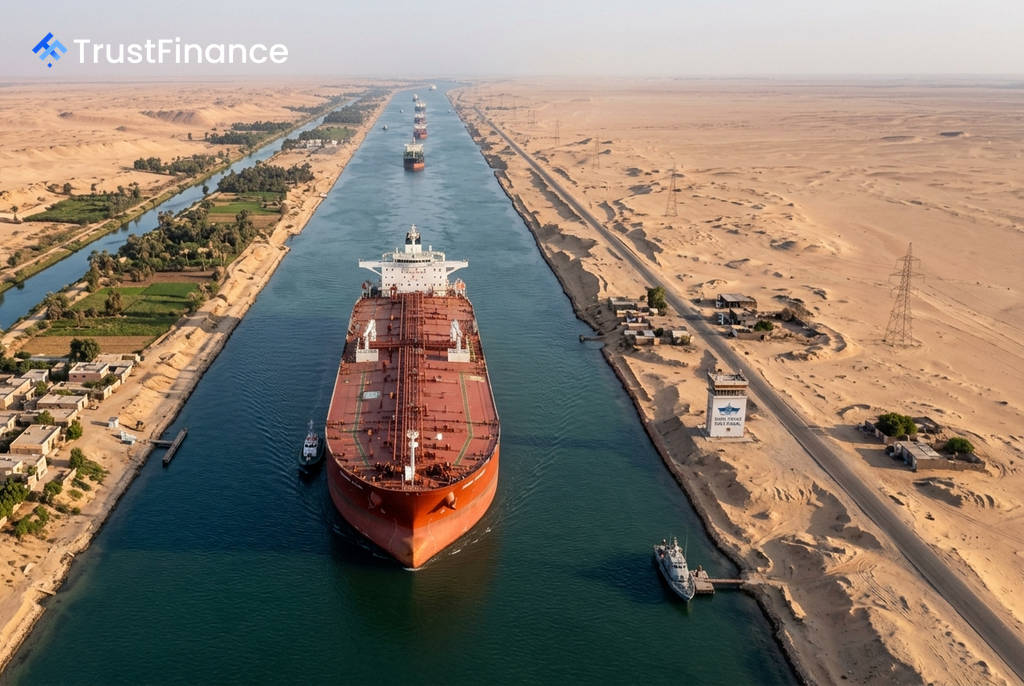
Summary
Asian oil refiners are diverting Saudi crude shipments through the Suez Canal to bypass Houthi threats in the Red Sea, a move that significantly increases voyage times and costs for a key energy supply route.
Asian oil refiners are beginning to divert Saudi Arabian crude shipments through the Suez Canal and around Africa to avoid threats from Yemen's Houthi group in the Red Sea. This significant rerouting is expected to add weeks to delivery times and substantially increase shipping costs, according to a Reuters report.
Shippers Reroute to Avoid Blockade
The move follows a declaration by the Iran-aligned Houthis that they would impose a naval blockade on Saudi Arabia, prompting an immediate reaction in maritime logistics. According to ship-tracking data from LSEG and Kpler, at least two tankers carrying Saudi crude to Asia reversed course in the Red Sea on Tuesday.
One vessel, the Liberia-flagged Rodos, which loaded at the Saudi Red Sea port of Yanbu and was originally bound for India, was observed heading west and signaling for the Suez Canal. This redirection highlights a tangible shift in shipping strategy in response to the escalating regional tensions.
The Logistical and Financial Impact
The alternative route from Yanbu—west through the Suez Canal and then south around Africa's Cape of Good Hope—is a far more expensive and time-consuming journey than the standard eastward path through the Bab el-Mandeb Strait. Industry experts cited by Reuters warn the deviation could:
 Ad
Ad- Extend voyage times by as much as four additional weeks.
- Significantly raise both freight and fuel expenditures for charterers.
- Introduce logistical hurdles, as Very Large Crude Carriers (VLCCs) must partially offload their cargo into Egypt's SUMED pipeline to meet the Suez Canal's draft limits before reloading in the Mediterranean.
A shipping source reported that South Korean refiner Hyundai Oilbank was seeking to charter a VLCC from Yanbu with the explicit option of using the Suez/SUMED route to reach South Korea, signaling that charterers are actively planning for these disruptions.
Market Context
Analysts note that the rerouting indicates the market is taking the Houthi threats seriously, disrupting a critical energy chokepoint. "Changing behavior by tankers tells us that they are taking the threats seriously," said Matt Smith, commodity research director at Kpler, in a comment to Reuters.
The disruption comes at a particularly sensitive time, as Saudi crude and refined product transits through the Bab el-Mandeb reached a record high of over 4 million barrels per day last month, according to Kpler data. This underscores the potential for wider impacts on global energy supply chains should the threats persist.
Read next
More on Commodities
Copper Price Stalls at Key Fibonacci Resistance Near $6.70
Copper futures are facing a significant technical test at the 61.8% Fibonacci retracement level around $6.70, with overbought signals and fading volume creating uncertainty after a recent V-shaped recovery.

Silver Price Stalls at $68 Resistance Amid Bull Trap Warnings
Silver is testing the critical $68.00 resistance level, but technical indicators show weakening momentum and fading volume, raising the risk of a potential 'bull trap' for traders.

Brent Crude Tests Critical $103 Support Amid Conflicting Technical Signals
Brent oil futures are trading at a pivotal technical juncture around $103 per barrel, where a key support indicator is being tested. A breakdown could accelerate losses, while a successful defense may spark a rebound from oversold conditions.

Gold Prices Confined to Narrow Range as Technical Indicators Signal Indecision
Gold is trading within a tight band defined by significant technical support and resistance levels, as conflicting chart signals and declining volume point to a period of consolidation before a potential breakout.