
Story
U.S. 10-Year Treasury Yield Briefly Tops 5% After Hot Inflation Report
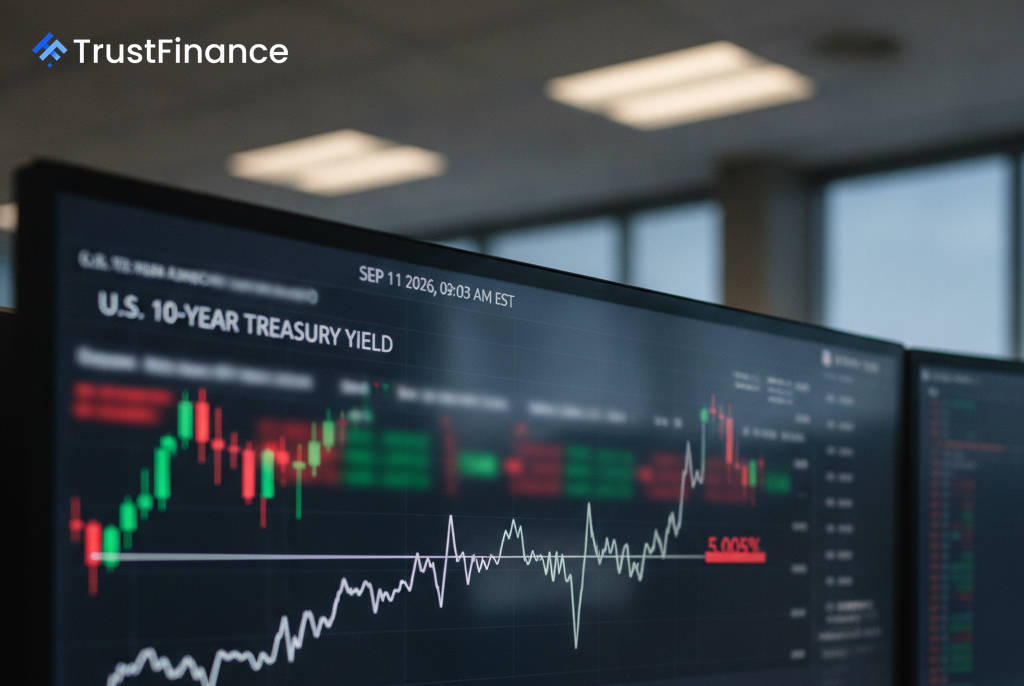
The benchmark 10-year U.S. Treasury yield briefly crossed the 5% threshold on Friday for the first time since 2024. The bond market sell-off was triggered by a government report showing consumer inflation remained stubbornly high in August, reinforcing investor bets on an imminent interest rate hike by the Federal Reserve.
Inflation Data Drives Sell-Off
The yield on the 10-year Treasury note, a key benchmark for global borrowing costs, jumped 6.3 basis points to a high of 5.005% following the data release, according to Investing.com. The move came after the Labor Department reported that the Consumer Price Index (CPI) held firm at 3.4% year-over-year in August. Core CPI, which excludes volatile food and energy prices, rose 0.3% month-over-month, beating consensus forecasts of 0.2%.
This inflationary signal was compounded by a hotter-than-expected Producer Price Index (PPI) print of 5.4% on Thursday, indicating that rising energy costs are impacting the broader economy. Other maturities were less volatile, with the policy-sensitive two-year yield rising to 4.61% and the 30-year bond yield at 5.338%.
Fed Hike Odds Surge
In response to the persistent inflation data, traders rapidly repriced expectations for the Federal Reserve's upcoming policy meeting. The probability of a 25-basis-point rate hike at the Sept. 15–16 meeting surged to 88%, up from 71% earlier in the session, according to the CME FedWatch tool.
 Ad
Adding to the hawkish sentiment, Brent crude oil prices held firm near $109 a barrel, while the European Central Bank raised its key interest rate to 2.50% on Thursday. "That gives the Fed some room to look through the headline increase, leaving the September decision dependent on the broader balance of inflation, labour-market and financial conditions," said Lewis Huang, an analyst at Bitget, in a note cited by Investing.com.
Why the 5% Level Matters
The 5% level on the 10-year yield is a crucial psychological and technical marker for financial markets. As the global risk-free rate, it serves as the foundation for valuing a wide range of assets.
A sustained move above this level has broad implications for the economy and investors:
- It increases borrowing costs for corporations and consumers, affecting everything from corporate debt refinancing to mortgage rates.
- It compresses the equity risk premium, the excess return investors expect for holding stocks over risk-free bonds, making fixed income a more attractive alternative.
- It effectively delivers a form of passive monetary tightening, helping the Fed cool the economy without an immediate policy change.
Read next
More on Forex
Polish Zloty Hits 11-Month Low Against Euro on Energy Price Pressure
The Polish zloty weakened to 4.410 against the euro, its lowest point since November 2023, as rising energy prices and caution ahead of a U.S. Federal Reserve decision weighed on the currency.

Sterling Slips as Dollar Strengthens Ahead of Fed Decision and UK Budget
The British pound lost ground against a resurgent U.S. dollar on Wednesday as market attention shifted from tech sector volatility to upcoming central bank decisions and the UK budget announcement.

Eurozone Bond Yields Climb as French Fiscal Concerns Return Ahead of Fed, ECB Decisions
Yields on French and German government bonds rose as relief from a ratings affirmation for France proved temporary, with investors refocusing on fiscal challenges and awaiting key policy verdicts from the U.S. Federal Reserve and the European Central Bank.

Canadian Dollar Slips as Markets Await Bank of Canada, Fed Decisions
The Canadian dollar edged lower against its U.S. counterpart, snapping a seven-day winning streak as investors adopted a cautious stance ahead of Wednesday's key interest rate announcements from both the Bank of Canada and the U.S. Federal Reserve.