
Story
Uber and Alphabet Rank Highest for Risk-Adjusted AV Exposure, Report Finds
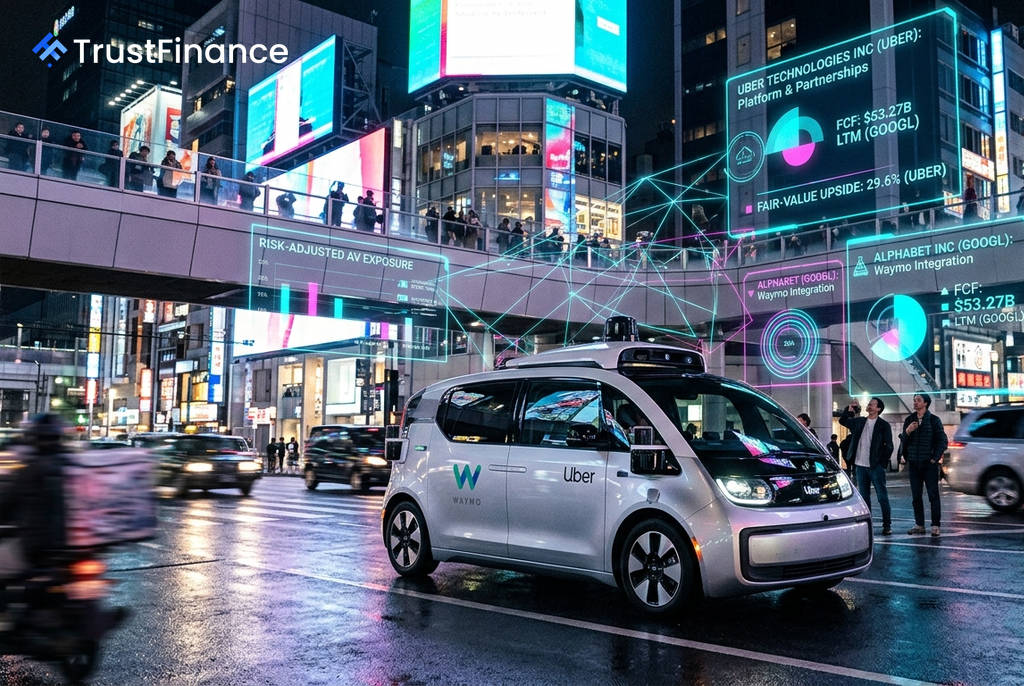
A new analysis of the autonomous vehicle (AV) sector suggests the most compelling investment opportunities may not be pure-play technology developers, but rather established companies with diversified platforms. According to a research note from Citizens, Uber Technologies (UBER) and Alphabet (GOOGL) lead the rankings for best risk-adjusted exposure to the burgeoning AV market.
A Risk-Adjusted Ranking
The report argues that while AV technology is advancing, the best investment is not necessarily the company with the most advanced vehicles. It prioritizes financial stability and market positioning, ranking companies based on their ability to capitalize on autonomy with lower execution risk.
- 1. Uber (UBER): The ride-hailing giant is ranked first, cited as the "best risk-adjusted route." Its strength lies in its platform model, which leverages multiple AV partnerships without depending on a single technology. The report notes its $10.12 billion in last-twelve-months (LTM) free cash flow (FCF) as of June 30, 2026.
- 2. Alphabet (GOOGL): The parent company of Waymo is considered the "strongest technology platform." It combines leading autonomous-ride exposure with robust financials, including $53.27 billion in LTM FCF.
- 3. Mobileye (MBLY): The ADAS supplier is viewed as a "contrarian turnaround" as it expands into robotaxis. It reported $388 million in LTM FCF and no debt.
- 4. Aurora Innovation (AUR): This firm offers the "highest direct AV leverage" as a pure-play developer. However, this comes with significant risk, reflected in its negative $751 million LTM FCF.
- 5. Tesla (TSLA): Described as a "powerful option, expensive stock," Tesla's vehicle scale is a major asset, but its high valuation, including a 370.0x P/E ratio as of June 30, 2026, places it fifth in this risk-adjusted ranking.
Platform Strategy Over Pure-Play Tech
Uber's top position is attributed to its platform-centric strategy, which allows it to integrate robotaxis from various developers into its existing, large-scale demand network. This approach diversifies its exposure and reduces its dependence on the success of any single sensor stack or AV developer.
 Ad
Furthermore, Uber's established commercial operations provide a more stable financial foundation compared to pre-revenue AV companies. The source notes its revenue grew from $17.45 billion in 2021 to $52.02 billion in 2025, demonstrating a sturdy base for integrating future autonomous services.
Industry Headwinds and Outlook
The analysis presents a balanced view of the sector's future. The bull case, supported by the Citizens note, points to a potential commercialization inflection point around 2027. In this scenario, platforms like Uber could capture bookings while Alphabet supplies proven autonomous technology.
However, significant hurdles remain. The bear case highlights persistent challenges, including safety validation, regulatory frameworks, fleet economics, and liability issues, all of which could delay commercial timelines. The report also notes that Tesla's camera-only approach remains a point of industry debate, while pure-plays like Aurora and Mobileye still need to deliver stronger commercial proof.
Read next
More on Stocks
FTC Orders Walmart, Uber, Delta to Disclose Data on Personalized Pricing
The U.S. Federal Trade Commission is demanding nine major companies, including leading retail, travel, and gig economy firms, to provide information on how they use consumer data for setting individual prices and wages.

Google Launches Gemini 4 Carbon AI Model to Bolster Cybersecurity Capabilities
Alphabet's Google has unveiled Gemini 4 Carbon, its latest AI model specifically designed for advanced cybersecurity tasks like vulnerability detection and secure code generation. The launch escalates competition with rivals OpenAI and Anthropic in the enterprise AI market.

Oracle Shares Surge After Unveiling $225 Billion Revenue Target for 2030
Oracle stock rose sharply after the company presented a long-term financial outlook targeting at least $225 billion in annual revenue by fiscal 2030, driven by its expanding AI infrastructure business.

DOJ Scrutinizes Nvidia's $12.9B Hugging Face Deal Amid Broader Antitrust Probe, Sources Say
The U.S. Department of Justice is reportedly examining Nvidia's planned $12.93 billion acquisition of AI platform Hugging Face as part of a wider, ongoing antitrust investigation into the chipmaker's market conduct.