
Story
Oil Surges, Bonds Tumble as Hormuz Tensions and Fed Hike Bets Rise
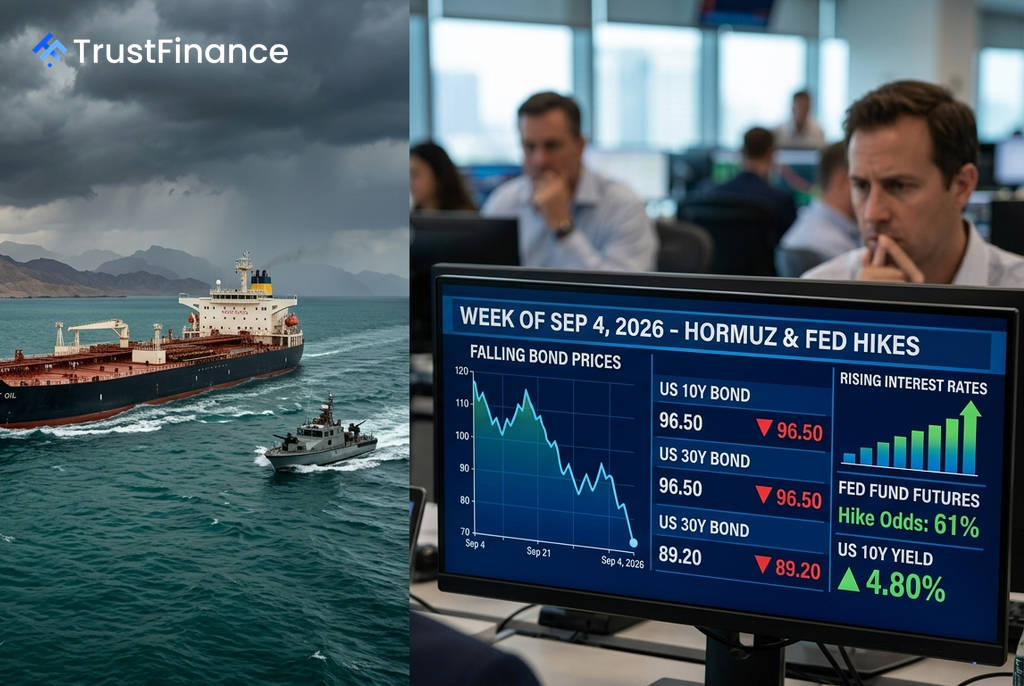
Global markets were roiled this week by a dangerous military escalation in the Strait of Hormuz and increasingly hawkish signals from the U.S. Federal Reserve, sending oil prices soaring and triggering a rout in government bonds worldwide. The convergence of geopolitical risk and monetary policy uncertainty has pushed key benchmarks to levels not seen in years, creating a volatile environment for investors heading into mid-September.
Hormuz Escalation Rattles Energy Markets
The primary driver of market anxiety was a series of military exchanges between the U.S. and Iran in the Strait of Hormuz, a critical chokepoint for global oil shipments. The conflict, which included U.S. airstrikes and Iranian retaliatory attacks on U.S. bases, effectively halted commercial vessel transit through the strait, according to market reports.
As a result, Brent crude futures surged approximately 7% for the week, touching a 1.5-month high of $97.62 per barrel. Analysts at ANZ estimate the conflict could remove 2.3 to 2.4 billion barrels of Persian Gulf supply in 2026, while Citi's base case suggests the strait could reopen in the fourth quarter, potentially creating a significant supply surplus.
Bond Rout Intensifies Amid Hawkish Fed Pivot
The geopolitical turmoil was compounded by a sharp sell-off in global bond markets. Yields on the benchmark U.S. 10-year Treasury note hit ~4.80%, a high not seen since President Trump’s return to office. Similar multi-decade highs were recorded for German, French, British, and Japanese government debt.
 Ad
Driving the sell-off was a significant shift in monetary policy expectations. Following hawkish comments from Fed Chair Kevin Warsh and a stronger-than-expected August jobs report—which showed 162,000 jobs added versus 56,000 expected—fed funds futures are now pricing a 61% probability of a rate hike at the Fed's September 15-16 meeting. Adding to the pressure, Norges Bank proposed that Norway's sovereign wealth fund cut its U.S. Treasury allocation, potentially removing ~$80 billion in demand.
Investors Brace for Key Diplomatic and Economic Events
The market reaction has been a classic flight to safety, with U.S. equity funds seeing $11.12 billion in outflows while money market funds absorbed $46.1 billion, the largest weekly inflow since early August. The S&P 500 slipped -0.2% on Friday, reflecting the cautious sentiment.
All eyes are now on the Federal Open Market Committee's (FOMC) upcoming meeting and crucial diplomatic developments. A mid-September U.S.-China dialogue on AI safety, led by Treasury Secretary Scott Bessent, is seen as a prelude to a high-stakes summit between President Trump and President Xi on September 24, where trade, tariffs, and China's recent restrictions on rare earth exports are expected to be major topics.
Read next
More on Stocks
FTC Orders Walmart, Uber, Delta to Disclose Data on Personalized Pricing
The U.S. Federal Trade Commission is demanding nine major companies, including leading retail, travel, and gig economy firms, to provide information on how they use consumer data for setting individual prices and wages.

Google Launches Gemini 4 Carbon AI Model to Bolster Cybersecurity Capabilities
Alphabet's Google has unveiled Gemini 4 Carbon, its latest AI model specifically designed for advanced cybersecurity tasks like vulnerability detection and secure code generation. The launch escalates competition with rivals OpenAI and Anthropic in the enterprise AI market.

Oracle Shares Surge After Unveiling $225 Billion Revenue Target for 2030
Oracle stock rose sharply after the company presented a long-term financial outlook targeting at least $225 billion in annual revenue by fiscal 2030, driven by its expanding AI infrastructure business.

DOJ Scrutinizes Nvidia's $12.9B Hugging Face Deal Amid Broader Antitrust Probe, Sources Say
The U.S. Department of Justice is reportedly examining Nvidia's planned $12.93 billion acquisition of AI platform Hugging Face as part of a wider, ongoing antitrust investigation into the chipmaker's market conduct.