
Story
Google Cloud, NASA Test AI Robotic Assistant for Deep Space Missions
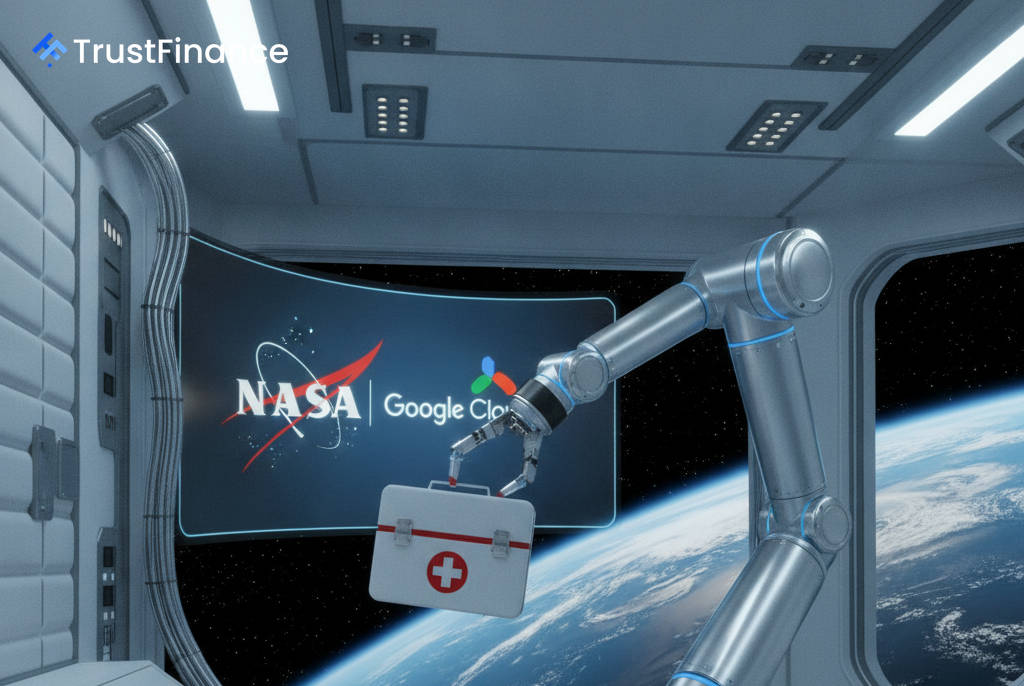
Google Cloud and NASA are developing and testing an AI-powered robotic system to assist astronauts on future deep space missions, including crewed voyages to Mars. The collaboration aims to provide on-site support where communication delays, which can last up to 44 minutes, make real-time guidance from Earth impractical.
System Demonstrates Early Success
In a recent proof-of-concept demonstration at NASA's Johnson Space Center, the robotic system successfully completed a series of pick-and-place maneuvers to locate and move a medical bag. The test, conducted in an early lab environment, achieved an 85% success rate, according to a report from Investing.com.
The system is designed as a versatile payload handler capable of managing cargo, logistics, and routine maintenance. It can also pivot to provide medical support by retrieving and preparing equipment under an astronaut's direction, building on Google Public Sector’s previous work on a Crew Medical Officer Digital Assistant.
Technical Underpinnings
The robotic assistant is powered by vision-language-action models that allow astronauts to direct it using standard English text prompts. The core of the system is the open-source Pi0 model, a 4-billion parameter model developed by Physical Intelligence on Google Cloud's infrastructure.
 Ad
Key technical details from the project include:
- The model was trained in just 2.5 hours using Google Cloud G4 instances.
- It uses Google DeepMind’s MuJoCo simulator for virtual testing and an eye-to-hand camera configuration for physical tasks.
- The system is designed to operate on compact, energy-efficient edge devices suitable for the power and weight constraints of space missions. The team reportedly tested approximately 15 different edge computing devices over the past two years.
Context for Investors
This collaboration between Google's cloud division and NASA's Human Research Program, Johnson Space Center Robotics Team, and the Jet Propulsion Laboratory highlights a specialized application of AI and cloud computing. The project's focus is on creating a tool that operates under astronaut supervision to enhance mission efficiency and safety, rather than full autonomy.
For Google parent Alphabet (GOOGL), this initiative represents an extension of its public sector and AI research into the demanding aerospace field. The ability to train complex models efficiently and deploy them on low-power hardware demonstrates a key capability for potential applications beyond space exploration, including remote industrial operations and healthcare.
Read next
More on Stocks
FTC Orders Walmart, Uber, Delta to Disclose Data on Personalized Pricing
The U.S. Federal Trade Commission is demanding nine major companies, including leading retail, travel, and gig economy firms, to provide information on how they use consumer data for setting individual prices and wages.

Google Launches Gemini 4 Carbon AI Model to Bolster Cybersecurity Capabilities
Alphabet's Google has unveiled Gemini 4 Carbon, its latest AI model specifically designed for advanced cybersecurity tasks like vulnerability detection and secure code generation. The launch escalates competition with rivals OpenAI and Anthropic in the enterprise AI market.

Oracle Shares Surge After Unveiling $225 Billion Revenue Target for 2030
Oracle stock rose sharply after the company presented a long-term financial outlook targeting at least $225 billion in annual revenue by fiscal 2030, driven by its expanding AI infrastructure business.

DOJ Scrutinizes Nvidia's $12.9B Hugging Face Deal Amid Broader Antitrust Probe, Sources Say
The U.S. Department of Justice is reportedly examining Nvidia's planned $12.93 billion acquisition of AI platform Hugging Face as part of a wider, ongoing antitrust investigation into the chipmaker's market conduct.