
Story
Expand Energy, CNX, EQT Screen as Potential Buffett-Style M&A Targets, Analysis Shows
Summary
An Investing.com analysis identified several U.S. oil and gas companies, including Expand Energy, CNX Resources, and EQT Corp., that exhibit valuation metrics historically favored by Warren Buffett, suggesting potential M&A appeal and significant fair value upside.
A new analysis by Investing.com has identified several U.S. oil and gas companies with financial characteristics that mirror the investment criteria historically used by Warren Buffett, potentially positioning them as attractive merger and acquisition targets. The report highlights Expand Energy (EXE), CNX Resources (CNX), and EQT Corp. (EQT) as top candidates, citing their combination of low valuation multiples, high free cash flow generation, and substantial estimated upside.
Key Valuation Metrics
The analysis screened for companies based on a set of six core principles associated with Buffett's investment strategy: low price-to-earnings (P/E) and price-to-book (P/B) ratios, high free cash flow (FCF) yield, a strong balance sheet, high shareholder yield, and a significant margin of safety. According to the report, the top three firms displayed compelling metrics across these categories.
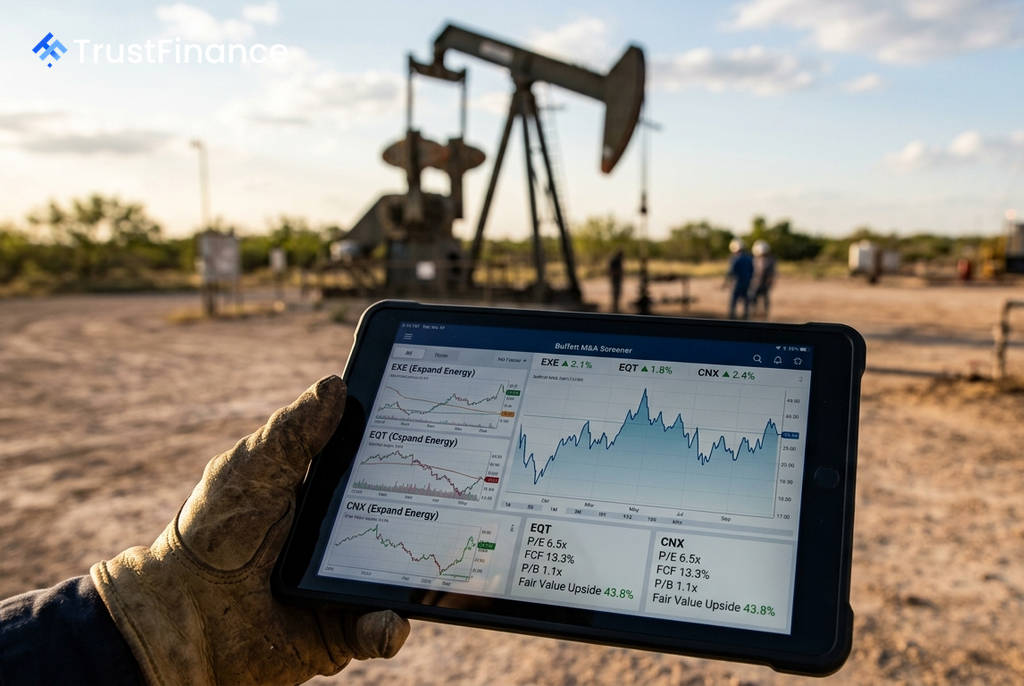
- Expand Energy (EXE): Features a P/E of 6.5x, a 13.3% FCF yield, and a conservative 25.9% debt-to-equity ratio, with a fair value upside estimated at 43.8%.
- CNX Resources (CNX): Trades at a P/E of just 4.6x and a P/B of 1.0x. It offers a shareholder yield of 15.4% and an estimated fair value upside of 42.8%.
- EQT Corp (EQT): Noted for its low debt-to-equity ratio of 20.8% and a 13.1% FCF yield. The analysis places its fair value upside at 28.6%.
The M&A Rationale
Each company presents a distinct profile for a potential acquirer, according to the Investing.com analysis. Expand Energy is described as the "cleanest fit" due to its strong balance sheet and high potential upside. EQT is positioned as a larger, more stable option, valued for its scale and predictability, which are often prized by investors like Buffett.
 Ad
AdCNX Resources stands out for its deep value, trading at exactly its book value. However, its debt-to-equity ratio of 54.8% was noted as a potential risk factor, though the report suggests its earnings could readily service the debt.
Market Context and Risks
The opportunity in these stocks, particularly natural gas producers, stems from recent market underperformance that has pushed their valuations down despite strong cash generation. The analysis points out that year-to-date, Expand Energy's stock is down 19.2% and EQT's is down 7%, creating a potential gap between market price and intrinsic value.
However, the report also cautions that debt levels remain a key risk in the cyclical commodities sector. A prolonged downturn in natural gas prices could pressure the cash flow assumptions underlying these valuations. Consequently, the analysis presents Expand Energy and EQT as lower-risk M&A prospects compared to the more highly leveraged CNX Resources.
Read next
More on Stocks
U.S. Stock Futures Rebound as Markets Digest Hawkish Fed Rate Hike
U.S. stock futures rose in overnight trading, recovering from a sell-off triggered by the Federal Reserve's first interest rate hike in three years. Falling oil prices and positive corporate news helped lift market sentiment.

Holtec Suspends $900 Million IPO Amid Challenging Market Conditions
Nuclear services company Holtec Nuclear Corp. has postponed its U.S. initial public offering, which aimed to raise as much as $900 million, citing unfavorable market conditions and weak performance from recently listed peers in the sector.

Snap Stock Climbs on Enterprise Push for New Specs AR Glasses
Shares of Snap Inc. gained in after-hours trading after the company unveiled its new $2,195 Specs AR glasses and announced key enterprise partnerships with Salesforce, Nvidia, and AWS.

Gold Prices Fall as Hawkish Fed Outlook Boosts US Dollar
Gold prices declined after the Federal Reserve raised interest rates by 25 basis points and signaled further tightening, strengthening the U.S. dollar and increasing the opportunity cost of holding the non-yielding metal.