
Story
Eli Lilly and Novo Nordisk Earnings to Test Diverging Fortunes in GLP-1 Market
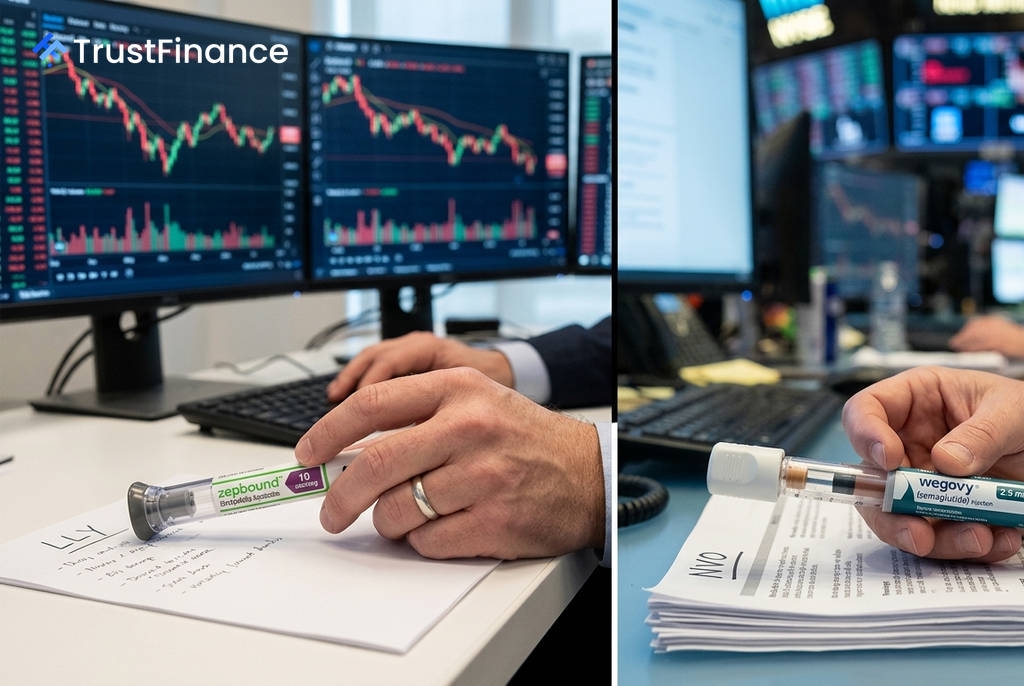
Eli Lilly and Novo Nordisk will report quarterly earnings before the market opens this Wednesday, August 5, in a highly anticipated event for the pharmaceutical sector. The results are expected to highlight the starkly different trajectories of the two leaders in the booming market for GLP-1 weight-loss drugs, with Eli Lilly riding a wave of momentum while Novo Nordisk faces significant headwinds.
A Tale of Two Trajectories
Investor expectations for the two companies are sharply divided. Eli Lilly (LLY), which recently surpassed a $1 trillion market capitalization and has seen its stock rise 50.7% over the past year, faces a high bar. Analysts expect the company to report Q2 revenue of $20.65 billion, a 33% year-over-year increase, with earnings per share (EPS) of $6.06.
In contrast, Novo Nordisk (NVO) has struggled, with its stock declining 8.78% on Friday alone. The consensus estimate for its full-year 2026 revenue is $44.46 billion, which is notably below its actual 2025 revenue of $48.83 billion, signaling that the market is pricing in a potential contraction for the GLP-1 pioneer.
Key Metrics Under Scrutiny
Investors will be scrutinizing several key data points beyond the headline revenue and earnings figures to assess the competitive landscape.
 Ad
- Prescription Volume: The market share battle between Eli Lilly’s Zepbound and Novo Nordisk’s Wegovy is a central focus. According to IQVIA data, Zepbound injections already command more than double the weekly prescriptions of Wegovy. A critical data point for Novo will be the sales performance of its oral version of Wegovy, which was launched in January and is reportedly holding a lead over Lilly's oral alternative.
- Forward Guidance: Eli Lilly is widely expected to raise its full-year forecast. Bernstein analysts project a guidance increase of at least $1.5 billion from the current $82 billion–$85 billion range. For Novo Nordisk, which issued four guidance cuts in 2025, the primary goal is to avoid another downward revision.
- Manufacturing Capacity: Both companies have faced supply bottlenecks due to immense demand. Updates on Eli Lilly’s manufacturing expansions, including over $55 billion in committed U.S. capital expenditures since 2020, will be critical. Likewise, any commentary from Novo Nordisk on scaling up production for its oral drug could be a significant catalyst.
Pipeline and Asymmetric Risks
Looking ahead, Eli Lilly's pipeline appears robust, with its next-generation drug, retatrutide, showing promising Phase 3 trial results. The triple-agonist drug demonstrated an average body weight loss of 22.6%, meaningfully higher than Wegovy’s roughly 15%. Investors will parse management commentary for details on its launch strategy, with an FDA filing planned for Q1 2027.
Novo Nordisk also faces legal challenges, including a securities fraud class-action lawsuit and a separate false advertising suit it filed against Lilly. The market has priced in a significant amount of negative news for Novo, creating an asymmetric risk profile. While Eli Lilly must deliver a flawless report to justify its premium valuation, Novo Nordisk may only need to stabilize its outlook to trigger a relief rally in its stock.
Read next
More on Stocks
FTC Orders Walmart, Uber, Delta to Disclose Data on Personalized Pricing
The U.S. Federal Trade Commission is demanding nine major companies, including leading retail, travel, and gig economy firms, to provide information on how they use consumer data for setting individual prices and wages.

Google Launches Gemini 4 Carbon AI Model to Bolster Cybersecurity Capabilities
Alphabet's Google has unveiled Gemini 4 Carbon, its latest AI model specifically designed for advanced cybersecurity tasks like vulnerability detection and secure code generation. The launch escalates competition with rivals OpenAI and Anthropic in the enterprise AI market.

Oracle Shares Surge After Unveiling $225 Billion Revenue Target for 2030
Oracle stock rose sharply after the company presented a long-term financial outlook targeting at least $225 billion in annual revenue by fiscal 2030, driven by its expanding AI infrastructure business.

DOJ Scrutinizes Nvidia's $12.9B Hugging Face Deal Amid Broader Antitrust Probe, Sources Say
The U.S. Department of Justice is reportedly examining Nvidia's planned $12.93 billion acquisition of AI platform Hugging Face as part of a wider, ongoing antitrust investigation into the chipmaker's market conduct.