
Story
Chevron Shows Stronger Near-Term Metrics Than Exxon as Oil Prices Climb
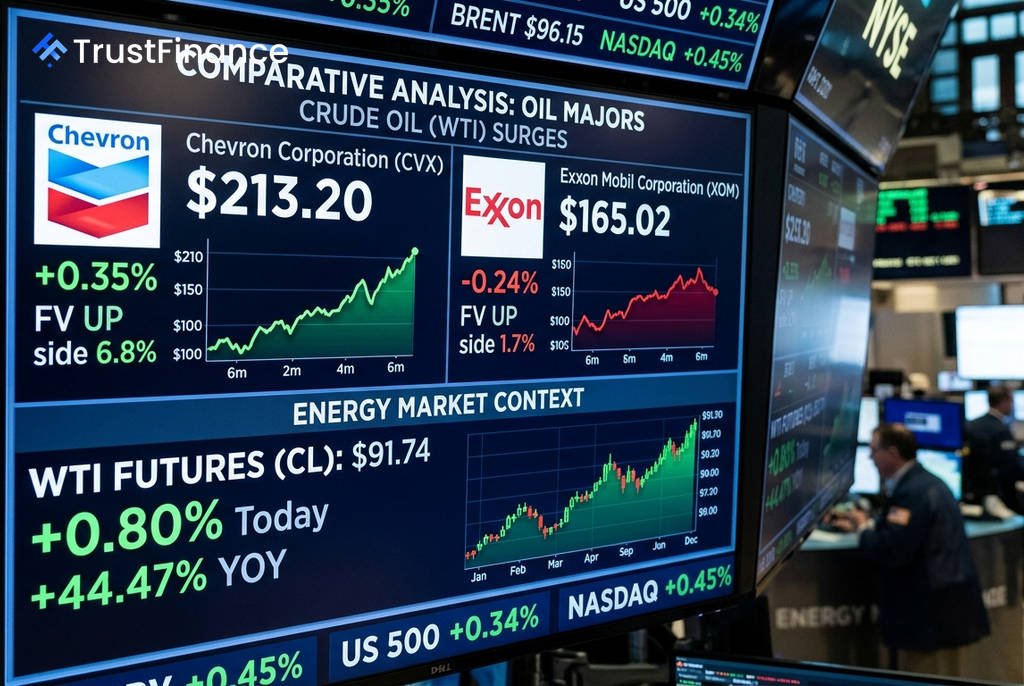
Chevron Corp. (CVX) appears to have a stronger near-term investment profile than its larger rival Exxon Mobil Corp. (XOM) amid a sustained rally in energy markets, according to an analysis of valuation and performance metrics. While both companies are benefiting from surging crude oil prices, Chevron currently presents a more compelling case based on its dividend yield, earnings momentum, and perceived valuation upside.
Chevron's Valuation and Yield Advantage
Chevron's stock shows more room for growth based on current financial models, with data from Investing.com as of September 3 indicating a 6.8% fair value upside. This compares to just 1.7% for Exxon Mobil. The company also offers investors a more attractive income stream with a dividend yield of 3.4%, versus Exxon's 2.5%.
Recent performance further bolsters Chevron's position. The company's second-quarter earnings per share (EPS) of $6.06 beat analyst estimates by over 18%. Following this, analysts have raised the 60-day consensus EPS estimate for Chevron by 10.15%, signaling growing optimism. This positive sentiment is reflected in recent price target increases from firms like BMO ($235) and Piper Sandler ($243).
Exxon's Edge in Scale and Stability
Exxon Mobil remains the larger financial powerhouse, a key consideration for investors prioritizing stability and resilience. The company generates significantly more cash, reporting $67.94 billion in EBITDA and $30.55 billion in levered free cash flow as of June 30, compared to Chevron's $50.66 billion and $27.01 billion, respectively.
 Ad
Exxon also maintains a stronger balance sheet with a lower debt-to-equity ratio of 16.3%, compared to Chevron's 19.5%. However, the company's most recent quarterly earnings missed expectations by 3.83%, and its consensus EPS revision, while positive at 6.77%, trails that of Chevron.
Market Impact and Investor Outlook
The comparison comes as West Texas Intermediate (WTI) crude futures trade above $92 per barrel, up more than 44% year-over-year, providing a powerful tailwind for the entire energy sector. For investors, the choice between the two oil majors may depend on strategy.
Chevron's lower forward price-to-earnings (P/E) ratio of 13.3x and higher yield may appeal to those seeking value and income in the current environment. In contrast, Exxon's superior scale and lower leverage could be favored by those looking for a more defensive position in case of an oil price reversal. It is also notable that Exxon has outperformed over the past year, with its stock up 46.04% versus 34.30% for Chevron, which helps explain its more limited modeled upside at present.
Read next
More on Stocks
FTC Orders Walmart, Uber, Delta to Disclose Data on Personalized Pricing
The U.S. Federal Trade Commission is demanding nine major companies, including leading retail, travel, and gig economy firms, to provide information on how they use consumer data for setting individual prices and wages.

Google Launches Gemini 4 Carbon AI Model to Bolster Cybersecurity Capabilities
Alphabet's Google has unveiled Gemini 4 Carbon, its latest AI model specifically designed for advanced cybersecurity tasks like vulnerability detection and secure code generation. The launch escalates competition with rivals OpenAI and Anthropic in the enterprise AI market.

Oracle Shares Surge After Unveiling $225 Billion Revenue Target for 2030
Oracle stock rose sharply after the company presented a long-term financial outlook targeting at least $225 billion in annual revenue by fiscal 2030, driven by its expanding AI infrastructure business.

DOJ Scrutinizes Nvidia's $12.9B Hugging Face Deal Amid Broader Antitrust Probe, Sources Say
The U.S. Department of Justice is reportedly examining Nvidia's planned $12.93 billion acquisition of AI platform Hugging Face as part of a wider, ongoing antitrust investigation into the chipmaker's market conduct.