
Story
BYD Stock Pressured by Weak Earnings Despite Citi's Valuation Case
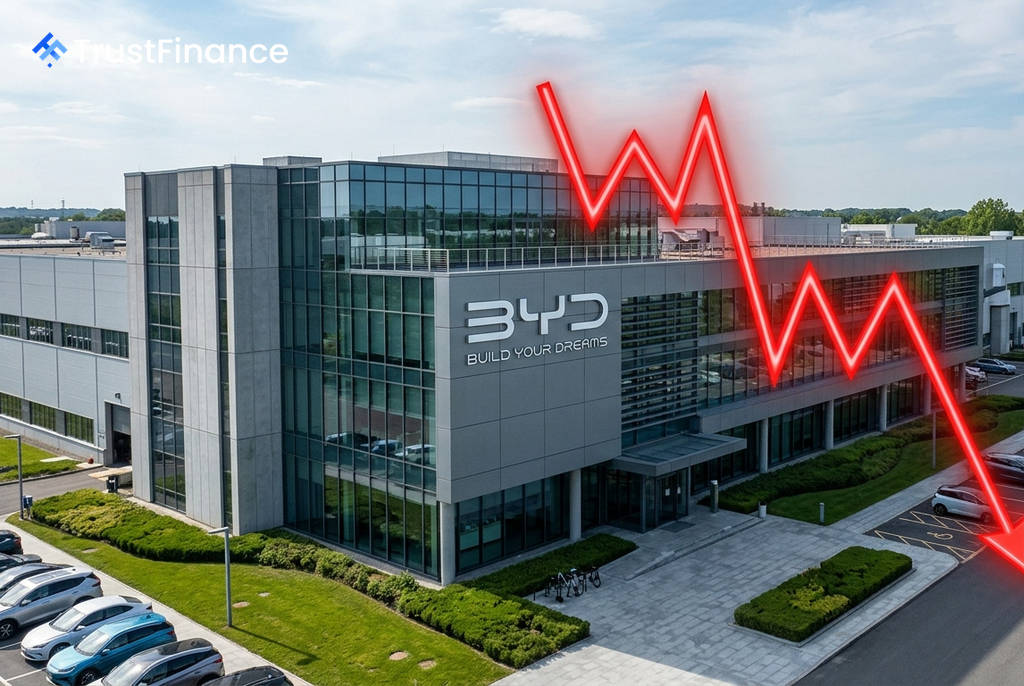
Shares of BYD Co Ltd (1211) are facing significant selling pressure as deteriorating financial results overshadow a more nuanced valuation argument from market analysts. The electric vehicle giant's stock has been in a sustained downtrend, reflecting investor concern over slowing growth and contracting profitability in a competitive market.
Financial Headwinds Intensify
BYD's stock closed at HK$79.05 on September 15, bringing its one-month decline to over 10.4% and its one-year loss to nearly 27%. The negative price action is underpinned by weakening operating fundamentals, according to data compiled by Investing.com.
Key financial indicators paint a challenging picture:
- Slowing Growth: Revenue growth decelerated sharply from 42.0% to just 3.5% between 2023 and 2025.
- Profit Decline: Net income fell from HK$42.80 billion in 2024 to HK$35.98 billion in 2025. This trend continued into the first half of 2026, with net profit falling 20.5% year-over-year on a 7.1% decline in revenue.
- Margin Compression: Gross margin contracted from 19.1% to 17.5% between 2024 and 2025, a likely consequence of the intense price war in China's EV sector.
A Divergence in Price and Fundamentals
Despite the poor performance, analysts at Citi have observed a potential disconnect between the stock's price and certain underlying metrics. In a recent note, the bank pointed out that its proprietary weighted-fundamental index for BYD has shown a slight improvement since May, suggesting the stock's sharp decline may have outpaced the fundamental deterioration.
 Ad
Citi's analysis suggests the possibility of a short-term pricing mismatch or mean reversion, rather than a definitive turn in the company's earnings cycle. The core tension for investors remains:
- The Bull Case: A depressed share price, ongoing overseas expansion, and slightly improving relative fundamentals could attract value-oriented investors.
- The Bear Case: The EV price war in China continues to compress margins, and the company must prove it can convert international sales into profitable growth, not just higher volume.
Technical Outlook Remains Bearish
The technical chart for BYD remains weak, with indicators showing a "Strong Sell" signal across daily, weekly, and monthly timeframes. The daily Relative Strength Index (RSI) is at 29.5, a level considered technically oversold. While oversold conditions can sometimes precede a short-term bounce, they do not by themselves signal the end of a downtrend.
Traders are watching key technical levels, with immediate support near HK$78.85 and a more significant floor at HK$77.50. Any potential rebound would face initial resistance in the HK$81.30–HK$82.40 range. A sustained move above this area, coupled with evidence of margin recovery, would be required to signal a more durable change in trend.
Read next
More on Stocks
FTC Orders Walmart, Uber, Delta to Disclose Data on Personalized Pricing
The U.S. Federal Trade Commission is demanding nine major companies, including leading retail, travel, and gig economy firms, to provide information on how they use consumer data for setting individual prices and wages.

Google Launches Gemini 4 Carbon AI Model to Bolster Cybersecurity Capabilities
Alphabet's Google has unveiled Gemini 4 Carbon, its latest AI model specifically designed for advanced cybersecurity tasks like vulnerability detection and secure code generation. The launch escalates competition with rivals OpenAI and Anthropic in the enterprise AI market.

Oracle Shares Surge After Unveiling $225 Billion Revenue Target for 2030
Oracle stock rose sharply after the company presented a long-term financial outlook targeting at least $225 billion in annual revenue by fiscal 2030, driven by its expanding AI infrastructure business.

DOJ Scrutinizes Nvidia's $12.9B Hugging Face Deal Amid Broader Antitrust Probe, Sources Say
The U.S. Department of Justice is reportedly examining Nvidia's planned $12.93 billion acquisition of AI platform Hugging Face as part of a wider, ongoing antitrust investigation into the chipmaker's market conduct.