
Story
Bank of America Lifts US Semiconductor Growth Forecast to 18% Annually

Summary
Bank of America has raised its compound annual growth rate forecast for the US semiconductor industry to 18% through 2030, citing stronger-than-expected demand for memory chips and data center components.
Bank of America has significantly upgraded its outlook for the U.S. semiconductor industry, now projecting an 18% compound annual growth rate (CAGR) between 2026 and 2030. The new forecast is a notable increase from the bank's previous estimate of 14%, driven by robust expectations for the memory and server component markets.
Forecast Details
In a new report, BofA analysts raised their projection for the semiconductor industry's total addressable market (TAM) to $3.2 trillion by 2030, up from a prior forecast of $2.7 trillion. The bank identified memory chips and data center hardware as the primary growth drivers, with additional support expected from a recovery in the automotive and industrial sectors.
The report highlighted the industry's accelerating growth trajectory, noting that after taking 50 years to reach $1 trillion in sales, the market is now poised to nearly double its current size of $1.7 trillion in just the next four years.
Equipment Spending Surge
The bullish outlook extends to the companies that supply chipmakers. Bank of America also increased its estimates for wafer fabrication equipment (WFE) spending, forecasting it to reach:
 Ad
Ad- $156 billion in 2026, a 33% year-over-year increase.
- $210 billion in 2027, representing a 34% annual gain.
This surge is largely attributed to higher demand for memory-related equipment, particularly for DRAM chips, where spending is expected to hit $61 billion in 2026 and $85 billion in 2027. By 2030, BofA projects the WFE market could expand to $360 billion, implying a 23% CAGR from 2026.
Market Context
Analysts cited "continued strong customer orders and capacity commitments in the data center and artificial intelligence sectors" as the foundation for their revised estimates. This demand is reflected in stable week-over-week pricing for both DRAM and NAND memory chips.
As a proxy for AI demand, the report noted that rental pricing for Nvidia's (NASDAQ:NVDA) B200 GPU remains firm at $5.72 per hour, less than 10% below its March peak. Despite the Philadelphia Semiconductor Index gaining 67% year-to-date, the sector trades at an 18 times next-twelve-months price-to-earnings ratio, a slight discount to the S&P 500's multiple of 19.
Read next
More on Stocks
Nucor Stock Slides After Q3 Earnings Guidance Misses Analyst Forecasts
Nucor Corporation (NUE) shares fell after the company projected third-quarter earnings of $5.55 to $5.65 per share, below the Wall Street consensus of $5.99, citing the absence of significant one-time gains from the prior quarter.

Disney Asks Court to Halt FCC License Review, Alleges Political Pressure From Trump
The Walt Disney Company has filed a legal challenge to stop the Federal Communications Commission from conducting an early review of its ABC station licenses, claiming the regulator is acting on President Trump's directives.

Starbucks Settles Florida Lawsuit Over Diversity Policies for $1 Million
The coffee giant has agreed to settle a lawsuit with Florida's attorney general, pledging to avoid race- or sex-based quotas in its employment practices and pay $1 million to cover the state's litigation costs.
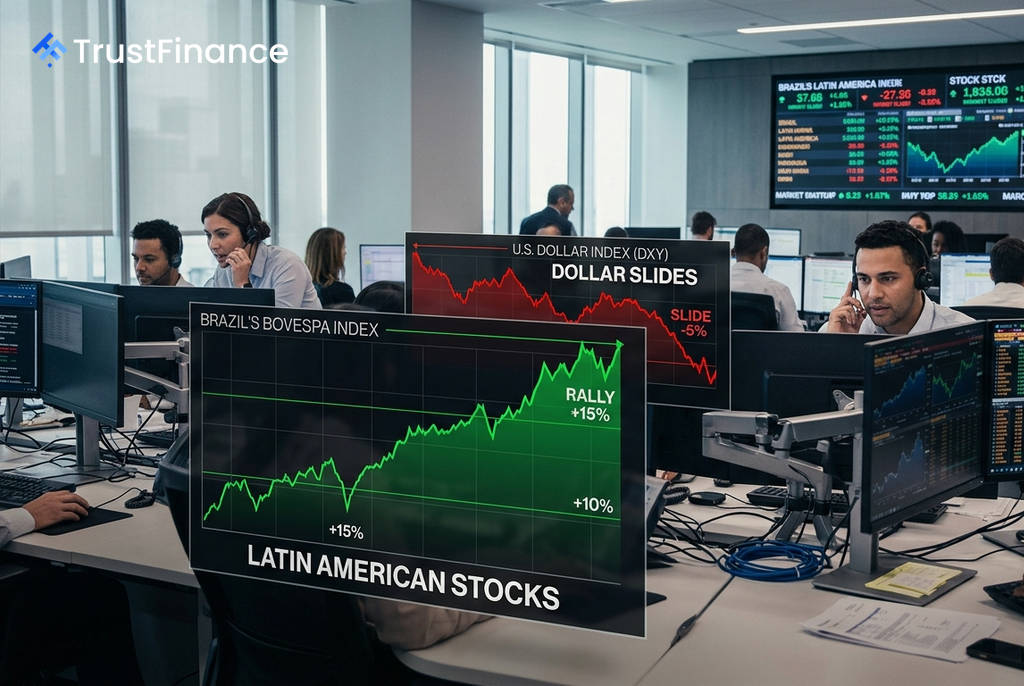
Latin American Stocks Rally as Dollar Slides After Fed Rate Hike
Equities and currencies across Latin America gained as a pullback in the U.S. dollar following the Federal Reserve's latest interest rate increase boosted commodity-linked assets and improved investor sentiment toward emerging markets.