
Story
30-Year Treasury Yield Nears 19-Year High, Intensifying Pressure on Equities
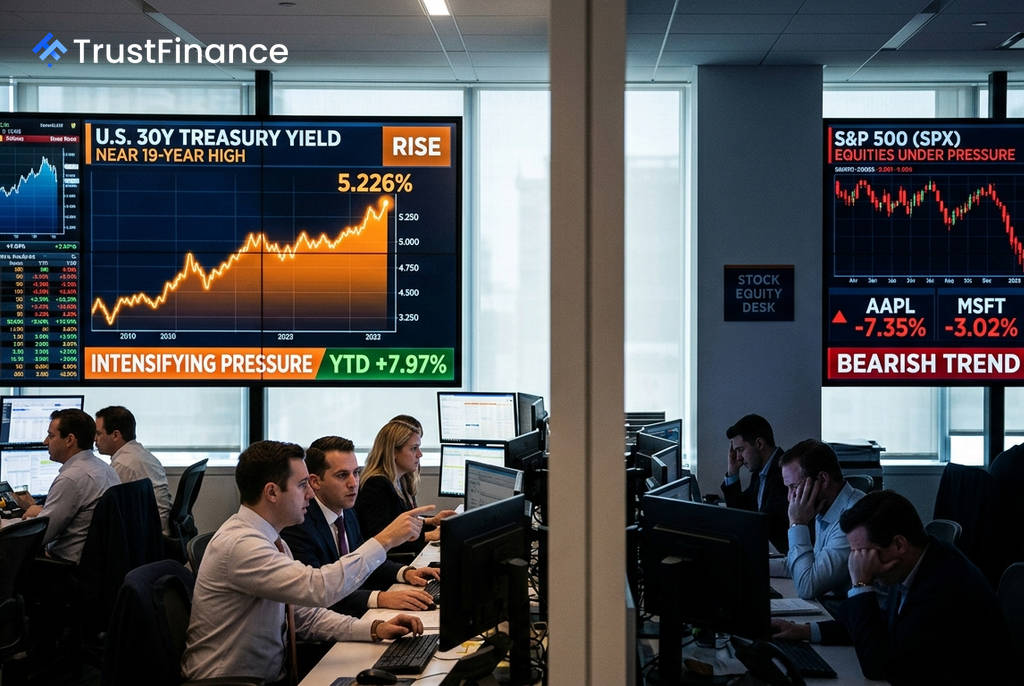
U.S. Treasury yields are surging to multi-decade highs, creating a powerful gravitational pull on equity markets and challenging the investment landscape. The 30-year Treasury yield is trading at 5.226%, near its 19-year high, while the benchmark 10-year note has risen to 4.677%, an increase of nearly 12% year-to-date.
A Steeper Curve Signals New Risks
The entire U.S. Treasury yield curve has steepened significantly, shifting into a normal, upward-sloping formation where longer-term bonds offer higher yields. The spread between the 30-year and 2-year yields has widened to approximately 99 basis points, signaling that markets are pricing in persistent inflation or a structural fiscal risk premium, rather than just near-term Federal Reserve policy moves.
According to analysis from Wolfe Research cited in the source material, this reflects growing concern over the U.S. fiscal situation. The firm noted that federal debt stands at 100% of GDP, budget deficits are running above 6% even during an economic expansion, and net interest expenses are at historic highs.
How Higher Rates Impact Stocks
Higher government bond yields ripple through the financial system, fundamentally altering the valuation architecture for equities. The mechanisms include:
 Ad
- Discount Rate Effect: The value of a company is often calculated by discounting its future cash flows to their present value. A higher risk-free rate increases this discount rate, which disproportionately compresses the valuation of long-duration growth stocks whose earnings are projected far into the future.
- Increased Cost of Capital: Companies face higher borrowing costs, which can squeeze profit margins and make it more expensive to fund expansions, capital expenditures, or share buybacks.
- Direct Competition for Capital: With a guaranteed return of over 5% on a 30-year government bond, the long-held mantra of "There Is No Alternative" (TINA) to stocks has effectively ended. This provides a compelling, lower-risk option for capital allocation.
Fiscal Concerns and Market Levels
The sustained rise in long-term yields may reflect a more permanent fiscal risk premium. Wolfe Research highlighted that if all outstanding Treasury debt were refinanced at current yields, the average federal interest rate would climb from 3.41% to 4.35%. This is a structural headwind that could keep long-term rates elevated, pressuring sectors sensitive to borrowing costs and making high-dividend stocks less attractive relative to bonds.
Investors are closely monitoring key technical and psychological levels. A break above the 52-week high of 5.281% on the 30-year yield could signal further selling pressure. Similarly, a sustained move above 5.0% on the 10-year yield has historically been a threshold where institutional investors begin to rotate more defensively out of equities.
Read next
More on Stocks
FTC Orders Walmart, Uber, Delta to Disclose Data on Personalized Pricing
The U.S. Federal Trade Commission is demanding nine major companies, including leading retail, travel, and gig economy firms, to provide information on how they use consumer data for setting individual prices and wages.

Google Launches Gemini 4 Carbon AI Model to Bolster Cybersecurity Capabilities
Alphabet's Google has unveiled Gemini 4 Carbon, its latest AI model specifically designed for advanced cybersecurity tasks like vulnerability detection and secure code generation. The launch escalates competition with rivals OpenAI and Anthropic in the enterprise AI market.

Oracle Shares Surge After Unveiling $225 Billion Revenue Target for 2030
Oracle stock rose sharply after the company presented a long-term financial outlook targeting at least $225 billion in annual revenue by fiscal 2030, driven by its expanding AI infrastructure business.

DOJ Scrutinizes Nvidia's $12.9B Hugging Face Deal Amid Broader Antitrust Probe, Sources Say
The U.S. Department of Justice is reportedly examining Nvidia's planned $12.93 billion acquisition of AI platform Hugging Face as part of a wider, ongoing antitrust investigation into the chipmaker's market conduct.