
Story
WaFd Shares Tumble on Significant Dilution from $3.9B EverBank Merger
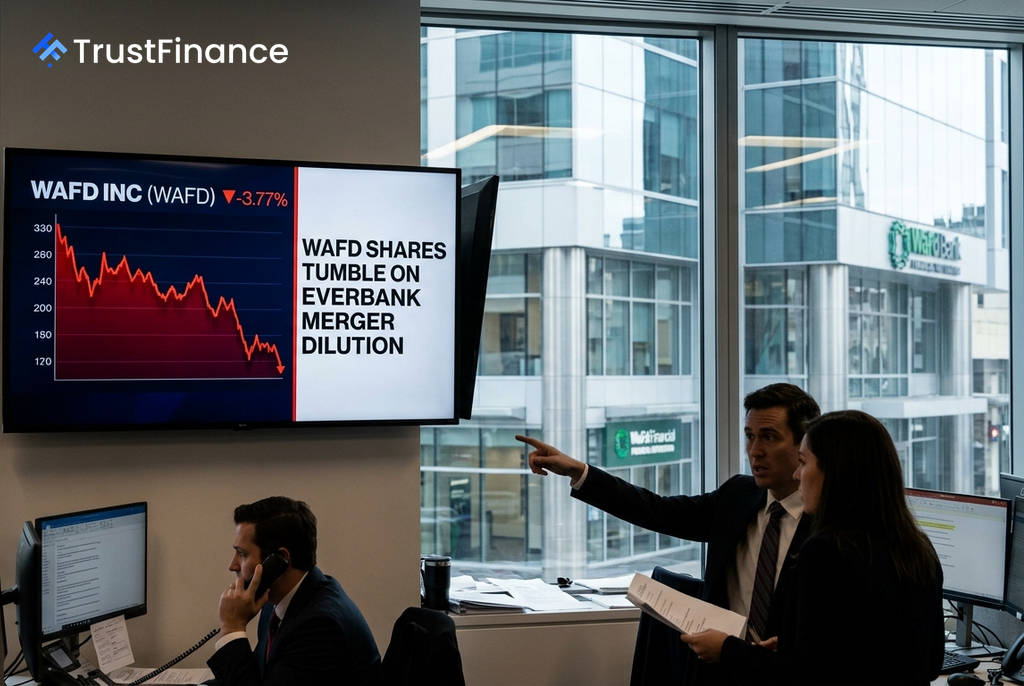
Shares of WaFd Inc. (WAFD), a Pacific Northwest regional bank, fell more than 6% in midday trading after the company detailed a $3.9 billion reverse merger with the Jacksonville, Florida-based digital lender EverBank Financial Corp.
Deal Structure and Shareholder Dilution
The transaction, announced over the Labor Day weekend, is structured as a reverse merger where EverBank will technically merge into WaFd. However, EverBank is designated as the accounting acquirer, reflecting its larger post-merger ownership.
Key terms of the agreement reveal a significant dilution for current WaFd investors:
- EverBank investors will own approximately 59.2% of the combined company.
- Existing WaFd shareholders will see their ownership reduced to a 40.8% minority stake.
- To facilitate the deal, WaFd will issue approximately 103 million new shares of common stock, a move that triggered the sharp negative market reaction.
A New Top-50 Bank
 Ad
The combined institution is projected to become one of the top 50 largest banks in the United States, with approximately $75 billion in assets, $58 billion in total loans, and $59 billion in deposits. Management projects the deal will be about 29% accretive to WaFd's earnings per share by 2027, with a return on tangible common equity of around 15% once synergies are realized. The company expects the dilution to tangible book value will be earned back within two years.
"The opportunity to partner with EverBank is a great fit and allows us to continue to build on the WaFd franchise and deliver enhanced returns for our shareholders," said WaFd CEO Brent Beardall, who will serve as president of the new combined bank.
Market Reaction and Headwinds
While the broader market also trended lower, WaFd's decline significantly outpaced major indices, underscoring that the sell-off was driven by the merger's terms. Investors appear skeptical of the long-term projections, weighing them against the immediate and substantial shareholder dilution.
The deal faces several hurdles before its expected close in early 2027, including regulatory approval from the Federal Reserve and the Office of the Comptroller of the Currency (OCC), as well as a required vote from WaFd's own shareholders. The market's repricing reflects the classic "acquiree discount," where the strategic rationale is overshadowed by the near-term cost to existing owners.
Read next
More on Stocks
FTC Orders Walmart, Uber, Delta to Disclose Data on Personalized Pricing
The U.S. Federal Trade Commission is demanding nine major companies, including leading retail, travel, and gig economy firms, to provide information on how they use consumer data for setting individual prices and wages.

Google Launches Gemini 4 Carbon AI Model to Bolster Cybersecurity Capabilities
Alphabet's Google has unveiled Gemini 4 Carbon, its latest AI model specifically designed for advanced cybersecurity tasks like vulnerability detection and secure code generation. The launch escalates competition with rivals OpenAI and Anthropic in the enterprise AI market.

Oracle Shares Surge After Unveiling $225 Billion Revenue Target for 2030
Oracle stock rose sharply after the company presented a long-term financial outlook targeting at least $225 billion in annual revenue by fiscal 2030, driven by its expanding AI infrastructure business.

DOJ Scrutinizes Nvidia's $12.9B Hugging Face Deal Amid Broader Antitrust Probe, Sources Say
The U.S. Department of Justice is reportedly examining Nvidia's planned $12.93 billion acquisition of AI platform Hugging Face as part of a wider, ongoing antitrust investigation into the chipmaker's market conduct.