
Story
US Treasury Yields Tumble After Shock Contraction in July Jobs
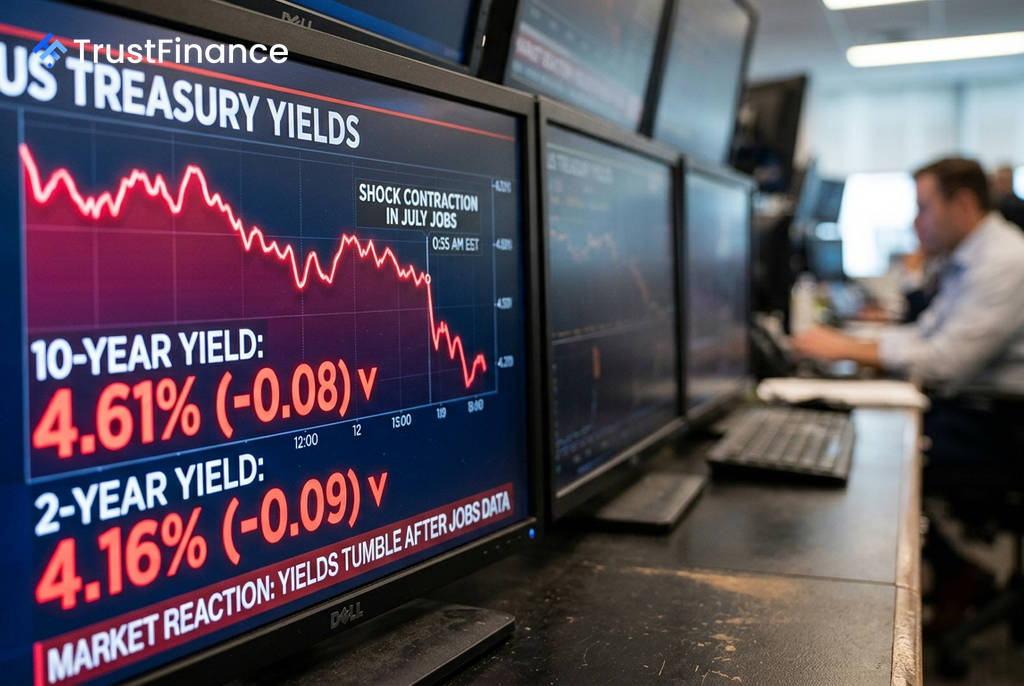
U.S. Treasury yields plunged across the curve on Friday after a government report showed the labor market unexpectedly contracted in July, prompting a swift repricing of Federal Reserve policy expectations among investors.
Shock Jobs Report Drives Rally
The bond market rally was triggered by the U.S. Labor Department's monthly nonfarm payrolls report, which revealed a surprise loss of 23,000 jobs in July. This figure starkly contrasted with consensus forecasts of an 85,000-job gain. Furthermore, employment data for the prior two months was revised down by a combined 103,000.
The report provided strong evidence that the high-interest-rate environment is beginning to significantly cool the labor market's momentum. Despite the headline job loss, the unemployment rate edged down slightly to 4.1%, according to the report.
Yields Plunge on Shifting Fed Bets
In response to the data, investors aggressively bought government debt, pushing prices up and yields down. The moves were most pronounced at the front end of the curve, which is highly sensitive to monetary policy changes.
 Ad
- The 2-year Treasury yield fell 9.2 basis points from its session high to 4.16%, its lowest level since July 17.
- The benchmark 10-year Treasury yield dropped 8 basis points to 4.61%.
- The 30-year Treasury yield declined nearly 6 basis points to 5.175%.
Market Outlook
The weak employment figures have fundamentally altered the outlook for the Federal Reserve's upcoming meetings. Money markets, which had previously priced in a roughly 50-50 chance of a 25-basis-point rate hike at the Sept. 16 meeting, have now slashed those odds to below 15%.
Investors will now turn their attention to next week's July Consumer Price Index (CPI) report. This inflation data will be the next critical test for whether price pressures are cooling fast enough to allow the Fed to extend its pause on interest rate increases.
Read next
More on Forex
Polish Zloty Hits 11-Month Low Against Euro on Energy Price Pressure
The Polish zloty weakened to 4.410 against the euro, its lowest point since November 2023, as rising energy prices and caution ahead of a U.S. Federal Reserve decision weighed on the currency.

Sterling Slips as Dollar Strengthens Ahead of Fed Decision and UK Budget
The British pound lost ground against a resurgent U.S. dollar on Wednesday as market attention shifted from tech sector volatility to upcoming central bank decisions and the UK budget announcement.

Eurozone Bond Yields Climb as French Fiscal Concerns Return Ahead of Fed, ECB Decisions
Yields on French and German government bonds rose as relief from a ratings affirmation for France proved temporary, with investors refocusing on fiscal challenges and awaiting key policy verdicts from the U.S. Federal Reserve and the European Central Bank.

Canadian Dollar Slips as Markets Await Bank of Canada, Fed Decisions
The Canadian dollar edged lower against its U.S. counterpart, snapping a seven-day winning streak as investors adopted a cautious stance ahead of Wednesday's key interest rate announcements from both the Bank of Canada and the U.S. Federal Reserve.