
Story
SCHD's Total Return Outshines High-Yield Rivals SPYI and SDIV, Analysis Shows
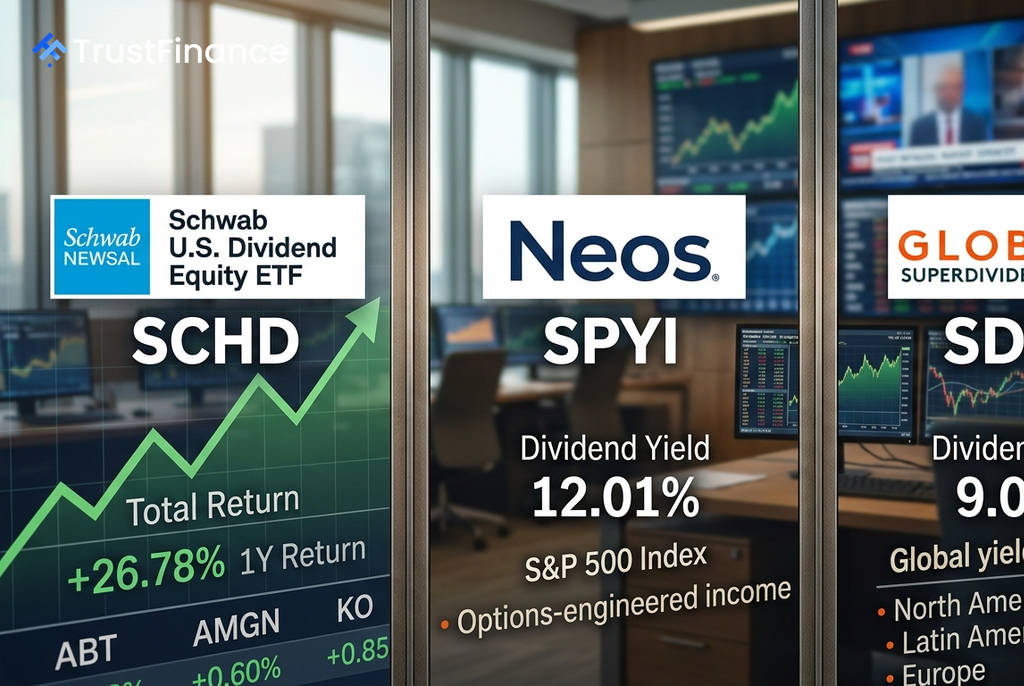
A recent analysis of three popular income-focused exchange-traded funds (ETFs) highlights a stark divergence in performance, with the Schwab U.S. Dividend Equity ETF (SCHD) delivering significantly higher total returns over the past year despite a comparatively modest dividend yield. The comparison with the Neos S&P 500 High Income ETF (SPYI) and the Global X SuperDividend ETF (SDIV) underscores the critical differences between quality dividend growth, options-based income, and global high-yield strategies.
Total Return Triumphs Over Headline Yield
According to an analysis by Investing.com, SCHD posted a one-year total return of +26.78%, a figure that far outpaced its higher-yielding peers. For comparison, SPYI recorded a +6.29% one-year return, while SDIV returned +8.95% over the same period.
This performance gap exists despite a wide disparity in dividend yields, which can often attract income-seeking investors. The data shows yields of:
- SPYI: 12.01%
- SDIV: 9.03%
- SCHD: 3.14%
The figures suggest that for investors focused on total return, the highest yield did not translate into the best overall performance over the last year.
A Look Under the Hood: Three Distinct Strategies
 Ad
The performance differences are rooted in the funds' fundamentally different investment philosophies. SCHD focuses on high-quality, dividend-growing U.S. blue-chip companies. This strategy is reflected in strong risk-adjusted return metrics, including a reported Sharpe ratio of 1.82, and is supported by a very low expense ratio of 0.06%.
In contrast, SPYI generates its high 12.01% yield by holding S&P 500 stocks and implementing an options overlay strategy. This approach is designed to produce high monthly income but typically caps the fund's upside potential during strong bull markets. Its defensive nature is evidenced by a worst three-month drawdown of just -5.94%.
SDIV pursues a global strategy of investing in some of the highest-yielding companies worldwide. However, this approach carries significant risk, highlighted by a severe worst three-month loss of -46.59%. The analysis also noted a three-year earnings growth rate of -6.05% for its holdings, a potential red flag for a "dividend trap," where high yields may prove unsustainable.
Key Takeaways for Investors
The comparison illustrates a classic investment trade-off between maximizing current income and seeking long-term total return. SCHD's outperformance underscores how a focus on dividend quality and growth can contribute to superior total returns, which combine both capital appreciation and income.
SPYI's structure appears tailored for investors who prioritize a high and consistent income stream and are willing to sacrifice potential capital gains. Meanwhile, SDIV's strategy may appeal to those seeking high global yields but comes with a substantially higher risk profile, as shown by its historical volatility.
Read next
More on Stocks
FTC Orders Walmart, Uber, Delta to Disclose Data on Personalized Pricing
The U.S. Federal Trade Commission is demanding nine major companies, including leading retail, travel, and gig economy firms, to provide information on how they use consumer data for setting individual prices and wages.

Google Launches Gemini 4 Carbon AI Model to Bolster Cybersecurity Capabilities
Alphabet's Google has unveiled Gemini 4 Carbon, its latest AI model specifically designed for advanced cybersecurity tasks like vulnerability detection and secure code generation. The launch escalates competition with rivals OpenAI and Anthropic in the enterprise AI market.

Oracle Shares Surge After Unveiling $225 Billion Revenue Target for 2030
Oracle stock rose sharply after the company presented a long-term financial outlook targeting at least $225 billion in annual revenue by fiscal 2030, driven by its expanding AI infrastructure business.

DOJ Scrutinizes Nvidia's $12.9B Hugging Face Deal Amid Broader Antitrust Probe, Sources Say
The U.S. Department of Justice is reportedly examining Nvidia's planned $12.93 billion acquisition of AI platform Hugging Face as part of a wider, ongoing antitrust investigation into the chipmaker's market conduct.