
Story
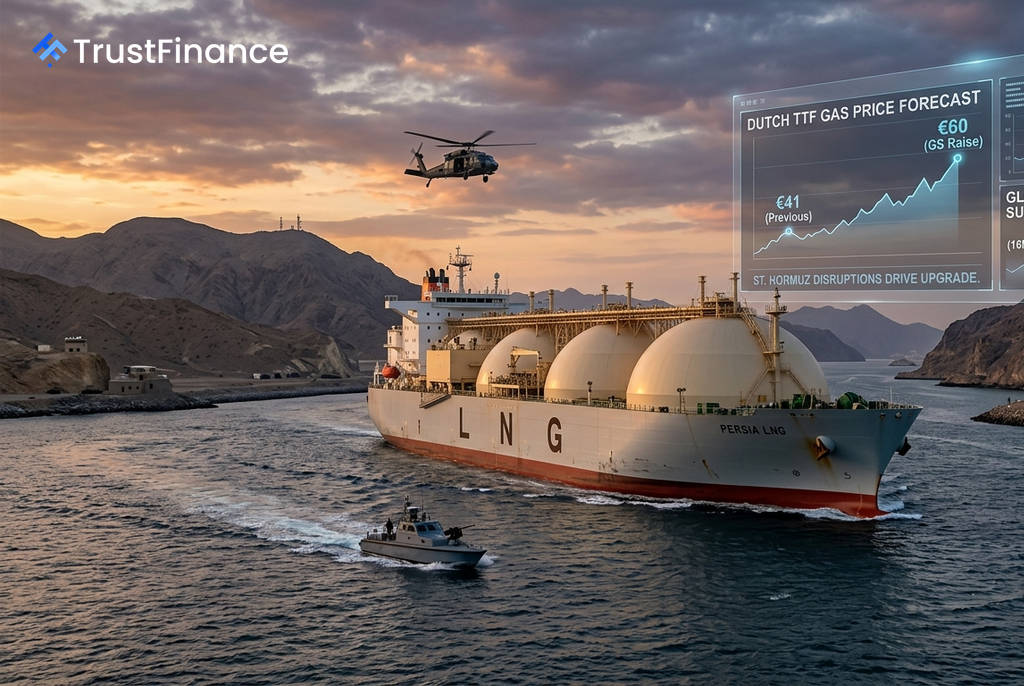
Goldman Sachs Raises European Gas Price Forecast on Strait of Hormuz LNG Disruptions
Summary
The investment bank has significantly increased its near-term price targets for Dutch TTF gas, citing a slower-than-expected recovery in LNG exports from the Persian Gulf due to ongoing shipping tensions.
Goldman Sachs has sharply increased its near-term forecast for European natural gas prices, attributing the revision to persistent disruptions in liquefied natural gas (LNG) exports from the Persian Gulf. The bank now anticipates a tighter supply balance for the continent heading into the crucial winter heating season.
Delayed LNG Recovery
In a note to clients, Goldman Sachs analyst Samantha Dart stated that the bank has pushed back its timeline for the normalization of Persian Gulf LNG exports to October from a previous estimate of July. The delay is linked to ongoing tensions affecting shipping through the Strait of Hormuz, a vital chokepoint for global energy markets.
The strait handles approximately 20% of global LNG exports. According to the bank's analysis, the extended disruption will reduce global LNG supply by 4% for the remainder of the summer, equivalent to 16 million tonnes per annum.
New Forecasts and Storage Impact
This tighter supply outlook is expected to have a direct impact on European gas storage levels. Goldman Sachs now projects that Northwest European storage will be 67% full by the end of October, down from a prior forecast of 74%. Assuming average winter temperatures, storage is forecast to end the season in late March at 28% capacity.
 Ad
AdAs a result of these revised expectations, the bank has raised its price targets for Dutch TTF, the European benchmark:
- Q3 & Q4 2026: Raised to €60 and €53 per megawatt-hour (MWh), respectively, from previous forecasts of €41 and €40.
- Full-year 2027: Increased slightly to €31/MWh from €30/MWh.
Market Risks and Key Price Levels
Goldman Sachs anticipates that for the rest of the summer, TTF prices will trade near the €65/MWh threshold, a level it believes is necessary to discourage demand from Asian buyers and keep LNG cargoes flowing to Europe. The bank noted that risks to its near-term forecast are skewed to the upside.
Under a scenario where Middle East exports only normalize gradually through 2027, TTF prices could surge above €100/MWh to sufficiently curb Asian demand. Conversely, a faster-than-expected resolution in the Strait of Hormuz could see prices fall back toward the €40/MWh coal-to-gas switching level. The bank's longer-term bearish view for 2028-2029 remains contingent on the strait being fully open for shipping.
Read next
More on Commodities
Copper Price Stalls at Key Fibonacci Resistance Near $6.70
Copper futures are facing a significant technical test at the 61.8% Fibonacci retracement level around $6.70, with overbought signals and fading volume creating uncertainty after a recent V-shaped recovery.

Silver Price Stalls at $68 Resistance Amid Bull Trap Warnings
Silver is testing the critical $68.00 resistance level, but technical indicators show weakening momentum and fading volume, raising the risk of a potential 'bull trap' for traders.

Brent Crude Tests Critical $103 Support Amid Conflicting Technical Signals
Brent oil futures are trading at a pivotal technical juncture around $103 per barrel, where a key support indicator is being tested. A breakdown could accelerate losses, while a successful defense may spark a rebound from oversold conditions.

Gold Prices Confined to Narrow Range as Technical Indicators Signal Indecision
Gold is trading within a tight band defined by significant technical support and resistance levels, as conflicting chart signals and declining volume point to a period of consolidation before a potential breakout.