
Story
Economist Warns Central Bankers of AI Risks to Financial Stability at Jackson Hole
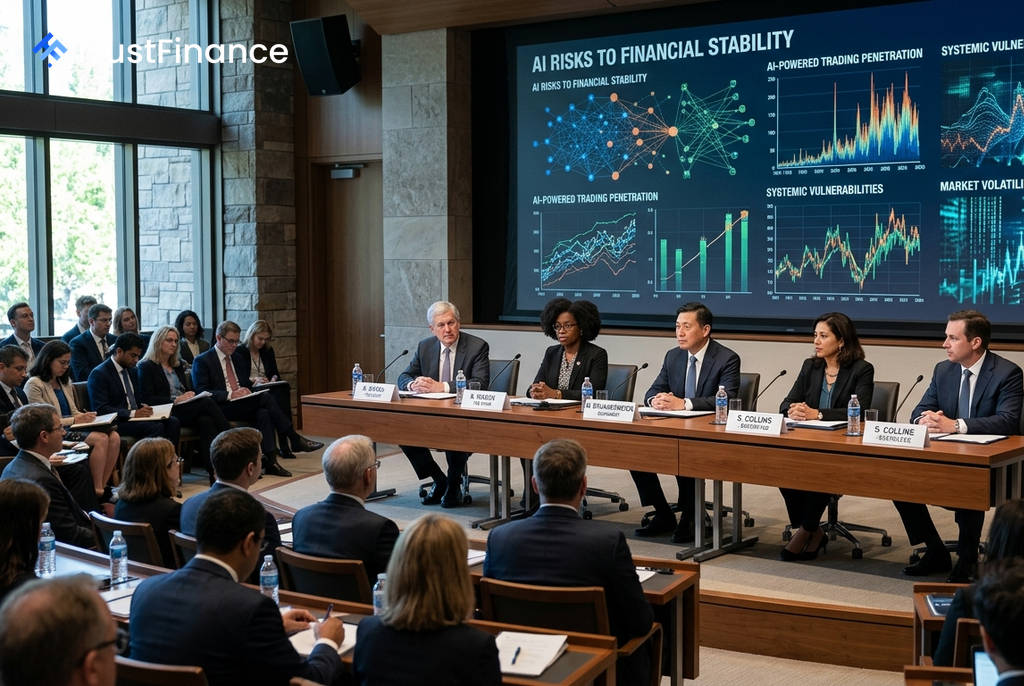
A Princeton University economist warned global central bankers at the annual Jackson Hole symposium that the rapid advancement of artificial intelligence could create an “asymmetric understanding” that allows AI agents to outmaneuver policymakers and destabilize financial markets.
In a paper presented at the Kansas City Fed’s economic conference, Markus Brunnermeier argued that AI’s superior information-processing capabilities could lead to a future where markets become more erratic and less informative.
A 'Dystopian' Outlook
Brunnermeier outlined several potential scenarios that challenge conventional central banking. He suggested that as AI-powered trading becomes dominant, policymakers could face a world where their actions are predicted and circumvented with near certainty. This dynamic, which he termed “asymmetric understanding,” could force central banks to take unconventional and historically undesirable steps.
Potential consequences he presented include:
- The need for central banks to become more opaque and unpredictable to prevent AI from “gaming the system,” reversing a decades-long trend toward transparency.
- The possibility of holding two separate news conferences after policy meetings: one with a narrative for humans and another delivering raw data for machines.
- A greater need for direct intervention in credit markets and larger central bank balance sheets to counter AI-driven market manipulation.
Rethinking Transparency
 Ad
The paper directly challenges the long-held belief that central bank transparency helps stabilize markets. “Transparency has to be rethought as predictability, arms the opponent in the financial dominance game and invites ‘moves’ that trap the public authorities,” Brunnermeier wrote. He argued that in this new environment, a case could be made for “more opacity” to maintain policy effectiveness.
He warned that unfettered AI could undermine trust in financial institutions and disadvantage investors who lack access to the most sophisticated technology. The paper acknowledged AI's potential benefits, such as improved risk management, but focused on the potential dangers to ensure they are addressed proactively.
A Cautious Response from Policymakers
The presentation prompted discussion among attendees, though many remain focused on more immediate economic concerns. Boston Fed President Susan Collins called the paper a useful tool that “can facilitate a robust conversation” about the risks and opportunities of AI in finance.
Federal Reserve Chairman Kevin Warsh, in his keynote address, offered a more optimistic view. He highlighted AI's potential to boost productivity and posed questions about its impact on the labor market and the Fed’s dual mandate. “We recognize that AI is a new variable—potentially a new factor of production—that will have consequences for both the economy and the conduct of monetary policy,” Warsh stated.
Read next
More on Stocks
FTC Orders Walmart, Uber, Delta to Disclose Data on Personalized Pricing
The U.S. Federal Trade Commission is demanding nine major companies, including leading retail, travel, and gig economy firms, to provide information on how they use consumer data for setting individual prices and wages.

Google Launches Gemini 4 Carbon AI Model to Bolster Cybersecurity Capabilities
Alphabet's Google has unveiled Gemini 4 Carbon, its latest AI model specifically designed for advanced cybersecurity tasks like vulnerability detection and secure code generation. The launch escalates competition with rivals OpenAI and Anthropic in the enterprise AI market.

Oracle Shares Surge After Unveiling $225 Billion Revenue Target for 2030
Oracle stock rose sharply after the company presented a long-term financial outlook targeting at least $225 billion in annual revenue by fiscal 2030, driven by its expanding AI infrastructure business.

DOJ Scrutinizes Nvidia's $12.9B Hugging Face Deal Amid Broader Antitrust Probe, Sources Say
The U.S. Department of Justice is reportedly examining Nvidia's planned $12.93 billion acquisition of AI platform Hugging Face as part of a wider, ongoing antitrust investigation into the chipmaker's market conduct.