
Story
ASML to Adapt High-NA EUV Tools for Large AI Chips with Industry Giants
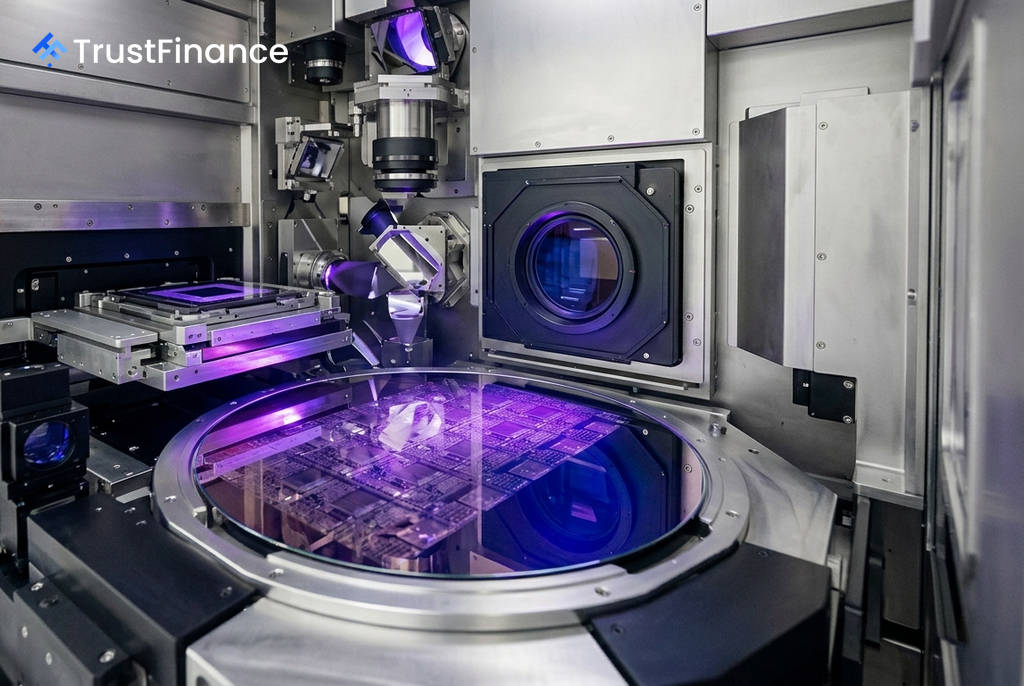
ASML Holding N.V. announced plans to work with its major customers to enable its most advanced lithography tools to produce the large-format chips essential for data centers and artificial intelligence applications, according to a Reuters report.
Overcoming a Size Limitation
The Dutch company is the sole manufacturer of extreme ultraviolet (EUV) lithography machines, which print circuits onto silicon wafers. While its current, widely used EUV systems can produce chips up to approximately 800 square millimeters—a size utilized by designers like Nvidia and Google—its next-generation "High-NA" EUV tools face a limitation.
High-NA technology allows for printing much finer, more detailed features on a chip, but it currently uses a smaller "mask," or pattern template, which restricts the maximum size of a single chip. The new initiative aims to develop a larger mask for the High-NA systems, allowing them to produce chips as large as those made by current-generation tools, thereby unlocking their full potential for high-performance computing.
Industry Roadmap and Timeline
This development is critical for driving broader, high-volume adoption of the costly High-NA machines. While Intel is already using the new tools for smaller laptop chips, major foundries like Taiwan Semiconductor Manufacturing Co. (TSMC) and Samsung Electronics have not yet adopted them for high-volume work.
 Ad
Key chipmakers have outlined their adoption timelines:
- Samsung and SK Hynix plan to introduce High-NA EUV into high-volume DRAM memory production by 2028.
- TSMC intends to use the technology for its advanced-node, high-volume production starting in 2030.
ASML itself projects a pilot line featuring the larger masks by 2031, with the technology ready for high-volume manufacturing by 2033. Marco Pieters, ASML's chief technology officer, told Reuters that successfully implementing this change could boost the productivity of these systems by 40%.
Market Implications
The collaboration underscores the immense technical and financial investment required to continue Moore's Law and advance computing power. For investors, this long-term roadmap solidifies ASML's central role in the semiconductor ecosystem for the next decade. By addressing the die-size limitation, ASML ensures its High-NA platform will be essential for producing the next generation of powerful processors demanded by the AI industry.
Read next
More on Stocks
FTC Orders Walmart, Uber, Delta to Disclose Data on Personalized Pricing
The U.S. Federal Trade Commission is demanding nine major companies, including leading retail, travel, and gig economy firms, to provide information on how they use consumer data for setting individual prices and wages.

Google Launches Gemini 4 Carbon AI Model to Bolster Cybersecurity Capabilities
Alphabet's Google has unveiled Gemini 4 Carbon, its latest AI model specifically designed for advanced cybersecurity tasks like vulnerability detection and secure code generation. The launch escalates competition with rivals OpenAI and Anthropic in the enterprise AI market.

Oracle Shares Surge After Unveiling $225 Billion Revenue Target for 2030
Oracle stock rose sharply after the company presented a long-term financial outlook targeting at least $225 billion in annual revenue by fiscal 2030, driven by its expanding AI infrastructure business.

DOJ Scrutinizes Nvidia's $12.9B Hugging Face Deal Amid Broader Antitrust Probe, Sources Say
The U.S. Department of Justice is reportedly examining Nvidia's planned $12.93 billion acquisition of AI platform Hugging Face as part of a wider, ongoing antitrust investigation into the chipmaker's market conduct.