
Story
SpaceX Rocket Debris on Uncontrolled Collision Course With Moon
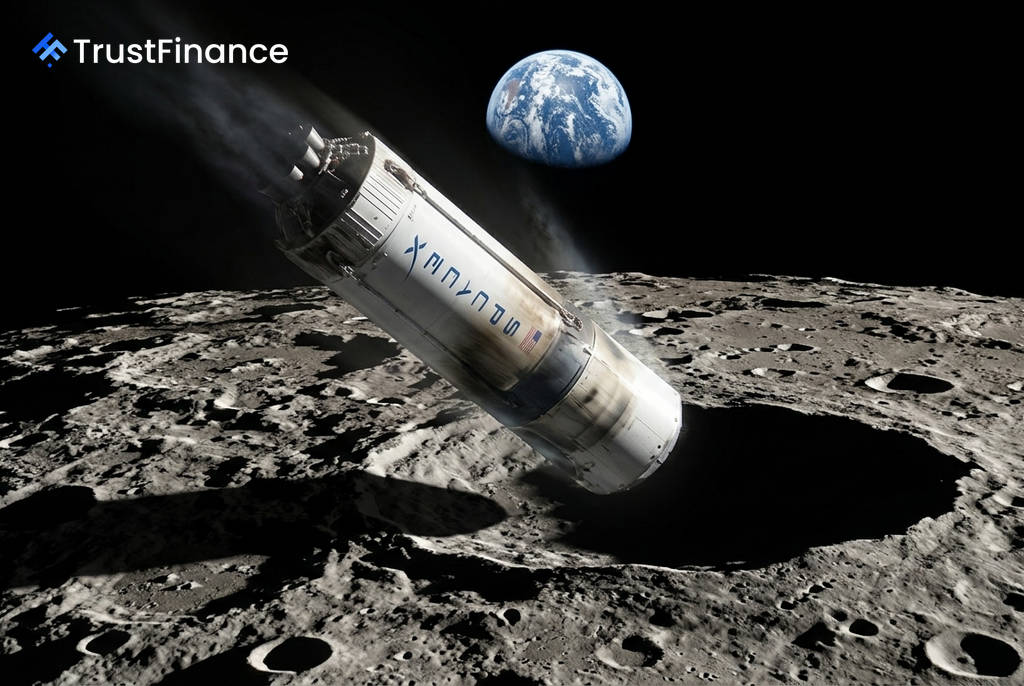
A bus-sized piece of a SpaceX rocket is on an unguided trajectory to collide with the moon early Wednesday, according to a report from Reuters. The four-ton object is expected to strike the lunar surface at high speed, an unintentional impact that underscores the growing challenge of managing space debris.
Details of the Collision
The object is the second stage of a Falcon 9 rocket that launched a Firefly Aerospace lunar lander in January 2025. According to astronomers tracking the debris, the impact is projected to occur around 2:35 a.m. ET on Wednesday.
Key details of the event include:
- Weight: 4 metric tons (4,000 kg)
- Impact Speed: 5,400 miles per hour (8,690 kph)
- Location: Einstein Crater, on the western limb of the moon
The rocket stage was left in a high orbit following its mission. "What has happened is essentially a mixture of solar activity and gravity forces have put it on a path toward the moon," Julianna Scheiman, a SpaceX director, told reporters on Monday. The company confirmed the impact is unintentional.
The Problem of Orbital Debris
 Ad
While rocket stages typically burn up in Earth's atmosphere or fall into the ocean, this component was left adrift in deep space. Its trajectory highlights a growing concern over the disposal of used space hardware.
"It doesn’t present any danger to anyone, though it does highlight a certain carelessness about how leftover space hardware (space junk) is disposed of," said Bill Gray, an astronomer who published a report on the object's path. While the impact may have minor scientific value by exposing subsurface material, it is an uncontrolled event. Such impacts are rare; a Chinese rocket stage hit the moon in March 2022, and NASA intentionally crashed rocket stages in 2009 and during the Apollo program for scientific study.
Implications for Lunar Exploration
The incident comes as government agencies and private companies increase their focus on lunar missions. With NASA's Artemis program aiming to establish a long-term human presence on the moon, the risk posed by uncontrolled debris to future lunar assets is a significant consideration.
SpaceX and NASA are discussing methods to prevent future unintentional lunar impacts, Scheiman said. The event serves as a reminder of the hazards in the increasingly crowded cislunar space, joining a list of recent spacecraft that have crashed on the moon, including missions from Russia, India, and Israel.
Read next
More on Stocks
FTC Orders Walmart, Uber, Delta to Disclose Data on Personalized Pricing
The U.S. Federal Trade Commission is demanding nine major companies, including leading retail, travel, and gig economy firms, to provide information on how they use consumer data for setting individual prices and wages.

Google Launches Gemini 4 Carbon AI Model to Bolster Cybersecurity Capabilities
Alphabet's Google has unveiled Gemini 4 Carbon, its latest AI model specifically designed for advanced cybersecurity tasks like vulnerability detection and secure code generation. The launch escalates competition with rivals OpenAI and Anthropic in the enterprise AI market.

Oracle Shares Surge After Unveiling $225 Billion Revenue Target for 2030
Oracle stock rose sharply after the company presented a long-term financial outlook targeting at least $225 billion in annual revenue by fiscal 2030, driven by its expanding AI infrastructure business.

DOJ Scrutinizes Nvidia's $12.9B Hugging Face Deal Amid Broader Antitrust Probe, Sources Say
The U.S. Department of Justice is reportedly examining Nvidia's planned $12.93 billion acquisition of AI platform Hugging Face as part of a wider, ongoing antitrust investigation into the chipmaker's market conduct.