
Story
Software Stocks Diverge Sharply From Chipmakers on AI Development Concerns
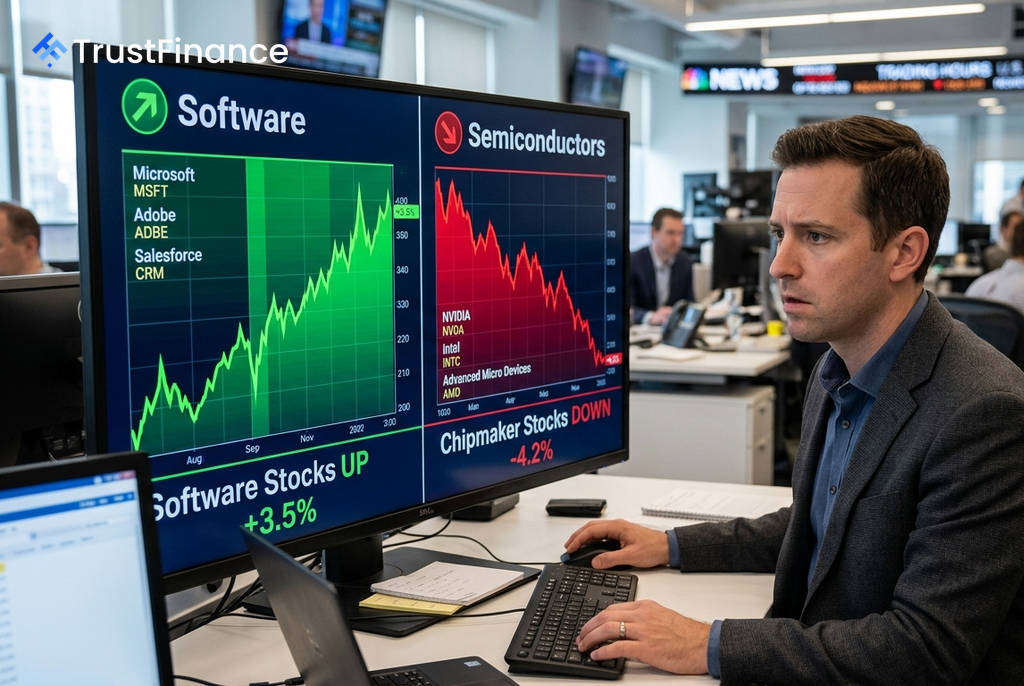
A significant divergence is unfolding in the technology sector, as enterprise software stocks are rallying while semiconductor shares face broad selling pressure. The shift reflects a new investment thesis on Wall Street driven by growing concerns over the rapid pace of artificial intelligence development.
Market Reacts to AI 'Pacing' Calls
The catalyst for Monday's pre-market moves appeared to be an essay from Anthropic CEO Dario Amodei, who proposed slowing improvements in advanced AI capabilities. According to the source material, his call was echoed by other prominent industry figures, fueling debate over AI safety and potentially cooling sentiment toward the hardware powering the AI arms race.
This divergence is creating what some hedge funds see as a classic pair trade: long enterprise software, short AI hardware suppliers. The pre-market session on Monday saw this play out clearly:
- Software Gainers: CrowdStrike (+4.5%), ServiceNow (+3.5%), Atlassian (+3.5%), and Workday (+2.8%).
- Semiconductor Losers: Marvell (-5.5%), Intel (-4.9%), Applied Materials (-4.6%), AMD (-4.1%), and Nvidia (-2%).
The Decoupling Thesis
 Ad
The core investment thesis suggests that spending on AI infrastructure by large cloud providers, or hyperscalers, may be plateauing. This directly impacts chipmakers and equipment suppliers who have benefited from the massive AI buildout over the past two years.
Conversely, enterprise adoption of AI-powered software is expected to continue expanding. Software-as-a-Service (SaaS) vendors are seen as downstream beneficiaries whose recurring revenue is tied to enterprise budgets rather than the more volatile hyperscaler capital expenditure cycle. This effectively decouples the performance of software companies from the hardware sector.
What to Watch Next
This emerging trend faces two key tests. First, upcoming third-quarter earnings from tech giants like Microsoft, Alphabet, Amazon, and Meta Platforms will be scrutinized for guidance on their AI infrastructure spending plans. Any commentary could either validate or reverse the semiconductor sell-off.
Second, macroeconomic factors remain a risk. High-multiple software stocks are sensitive to interest rates, a concept known as duration risk. A more hawkish stance from the Federal Reserve could pressure valuations, potentially complicating the rally in SaaS stocks just as they begin to break away from their correlation with chipmakers.
Read next
More on Stocks
FTC Orders Walmart, Uber, Delta to Disclose Data on Personalized Pricing
The U.S. Federal Trade Commission is demanding nine major companies, including leading retail, travel, and gig economy firms, to provide information on how they use consumer data for setting individual prices and wages.

Google Launches Gemini 4 Carbon AI Model to Bolster Cybersecurity Capabilities
Alphabet's Google has unveiled Gemini 4 Carbon, its latest AI model specifically designed for advanced cybersecurity tasks like vulnerability detection and secure code generation. The launch escalates competition with rivals OpenAI and Anthropic in the enterprise AI market.

Oracle Shares Surge After Unveiling $225 Billion Revenue Target for 2030
Oracle stock rose sharply after the company presented a long-term financial outlook targeting at least $225 billion in annual revenue by fiscal 2030, driven by its expanding AI infrastructure business.

DOJ Scrutinizes Nvidia's $12.9B Hugging Face Deal Amid Broader Antitrust Probe, Sources Say
The U.S. Department of Justice is reportedly examining Nvidia's planned $12.93 billion acquisition of AI platform Hugging Face as part of a wider, ongoing antitrust investigation into the chipmaker's market conduct.